



Digital Camera World Verdict
The Valoi easy35 v2 is an improvement on an already excellent camera-scanning system. It keeps the same core appeal as the original, taking the usual pain and alignment headaches out of camera scanning, but it now feels better made, easier to use, and more polished. The new film holder grips negatives more securely, the light is consistent and bright, the body no longer attracts every piece of fluff on my desk, and the simplified controls make the whole thing feel more like a finished product than a clever workaround. It is still not the cheapest route into film scanning, because you also need a digital camera and a proper 1:1 macro lens to get the most out of it. But if you already own the right camera kit, this is one of the fastest and most enjoyable ways I have found to digitize 35mm film at home.
Reasons to buy
- +
Improved materials and design
- +
Very fast scanning
- +
Excellent light consistency
- +
Better film holder
Reasons to avoid
- -
Needs a camera and macro lens
- -
Dust can still be awkward to clean
- -
Extension tube alignment needs care
Why you can trust Digital Camera World Our expert reviewers spend hours testing and comparing products and services so you can choose the best for you. Find out how we test.
I was not exactly quiet about how much I liked the original Valoi easy35. Before using it, I had largely written off camera scanning as one of those workflows that sounded great in theory, but in practice involved too much setup, too much faffing, and too many opportunities to get something slightly wrong. The first easy35 changed that for me. It took the most annoying parts of camera scanning, such as holding film flat, keeping the camera aligned, blocking stray light, and setting the right distance from the lens, and packed them into a single, compact system.
The easy35 v2 is not a complete rethink of the concept, and I do not think it needed to be. This is still a compact film-scanning unit that screws onto the front of a macro lens and lets you photograph 35mm negatives or other small film formats with a digital camera. The resulting files then need to be inverted and processed separately in software, but the capture stage is about as simple as camera scanning gets.
What Valoi has done for the second generation is focus on refinement. The easy35 v2 has a redesigned light source, smoother materials, simplified controls, a new holder system, magnetic accessories, and better battery life. On paper, these might sound like quality-of-life changes rather than a revolution, but after scanning multiple rolls with it, they make the easy35 v2 feel like a more mature version of a product I already relied on.

Specifications
Standard kit contains |
Valoi Easy35 body with built in light source, Standard 35mm Holder, Distance Tubes, filter thread adapters |
Focal length range |
Full-frame: 55-105mm, APS-C: 40-70mm, M4/3: 35-60mm |
Filter thread compatibility |
39mm - 62mm |
LED Panel |
Built-in 99% CRI |
Battery life |
~4 hours |
Charging |
USB-C |
Price
The Valoi easy35 v2 is available now through Valoi and selected retailers. Pricing sits at $272 / £199 / €229. That makes it more expensive than some of the very basic camera-scanning adapters available online, but still significantly cheaper than building out a more elaborate copy-stand setup, and cheaper than many dedicated high-end film scanners.
The bigger question is not just the price of the easy35 v2 itself, but the cost of everything needed around it. You need a digital camera, ideally with enough resolution to make the exercise worthwhile, and you need a true 1:1 macro lens. If you already own both, the easy35 v2 feels like very good value. If you are starting from scratch, the total cost can mount up quickly, and a dedicated scanner or lab scans might make more sense depending on how much film you shoot.
Design & Handling
The most obvious improvement with the easy35 v2 is how much nicer it feels. The original easy35 worked brilliantly, but its rougher finish had one particularly annoying habit: it picked up fluff and general debris far too easily. The new model switches to a smoother plastic that feels cleaner in the hand, looks more polished, and is much easier to keep presentable.
This might sound superficial, but for a product that is going to spend a lot of time around film – avoiding dust matters. It is still utilitarian rather than luxurious, but it is a clear step forward. The small red accents around the power button and extension tube thread also help give the v2 a bit more identity, and the matching red USB-C cable is a nice touch.

Valoi has also simplified the controls, and I think that is the right move. The previous version had brightness and color temperature controls. On the v2, the controls are reduced to a single on/off button. That makes it much easier to understand, and it absolutely lives up to the “easy” part of its name. There is less to get wrong, less to think about, and less temptation to fiddle when you could just be scanning.
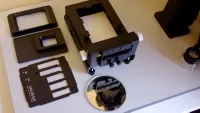
The film holder has also had an update. It grips the film more tightly than before, and I found it slightly tougher to pull a strip through, though still nowhere near difficult. The benefit is that the film feels more securely held and better controlled.

The magnetic duster is a useful addition too. It snaps on securely for storage, and the magnets are strong enough that I never felt it was going to fall off in use. My only design gripe is that the duster seems to use the same finish as the first-generation easy35 than the smoother v2 plastic, which looks a little odd attached to the more polished main unit.
The extension tubes appear to be the same as before, and that is mostly a good thing. They are solid metal, they feel robust, and they allow you to set the right distance between your lens and the film plane. However, they are still magnets for fingerprints and oils.

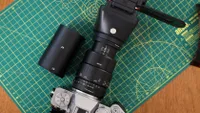
More importantly, I did notice a little flex once everything was mounted. With my Fujifilm X-T5, the camera sits just a few millimeters lower than the easy35 v2, so I had to wedge something underneath the camera to get the sensor and film perfectly aligned. It is an incredibly simple fix, but it is something to be aware of.
Performance
The easy35 v2 is designed to make camera scanning faster and less intimidating, and in that respect, it does exactly what is promised. I scanned six rolls of film over two sessions, and the process was almost comically quick compared with traditional film scanning. Once everything was set up, I could scan a roll of 36 frames in around two minutes. That means the six rolls I scanned represented only around 12 minutes of actual capture time.
The battery is also more than enough for this kind of use. Valoi claims around four hours of battery life, and based on my experience, that is going to last an age. It can also be powered over USB-C while in use, and Valoi includes a long braided cable.


While there are a lot of factors at play, including the camera, lens, and film you're scanning, but for its part, the easy35 v2 does everything right to maximize image quality. I found the light to be consistent across the frame, with no obvious light leaks around the edges and no distracting shifts in color or brightness across a roll, and the illumination is plenty bright enough to expose the film clearly without introducing unwanted blooming.
There are still a couple of practical caveats. The big one is the same as before: you need to already own, or be prepared to buy, the rest of the system. The easy35 v2 is not a complete scanner in the same way a Plustek or Kodak scanner is. It still depends on you owning a digital camera, a macro lens, and software for inversion. If you do not own that kit, the cost equation changes.
Using my very cheap TTArtisan macro lens combined with my Fujifilm X-T5, I was still getting results that were comparable with, if not slightly better than, my Plustek film scanner. Although that is not to say every easy35 v2 setup will automatically beat a dedicated scanner, as it will depend on your equipment, technique, and conversion software.
And conversion software will play a big part. The easy35 doesn't come with any sort of conversion software included. There are some of the free conversion software options available, but I can't personally vouch for their quality and consistency – although there are plenty of positive reviews online. However, I used Negative Lab Pro, which is a paid extension to Lightroom (which itself requires a subscription) and is excellent, so both add to the cost of the overall package.


The new film holder helps here as well. It feels more secure than the previous holder and holds the film flatter and tighter. I would rather have a slightly firmer pull through the holder if it means better consistency, and that is the trade-off Valoi seems to have made.


The second issue is dust. Dust getting onto the light source is still a bit of a nuisance, and because the light is more closed off now, cleaning it is not quite as straightforward as I would like. You can use an air blower or cotton swabs, but I would love a quick way to snap the light section on and off for cleaning. With film scanning, dust is always going to be part of the fight, but anything that makes cleaning quicker would be welcome.


Verdict
The Valoi easy35 v2 is exactly the kind of upgrade I wanted. It does not change what made the original so good, but it fixes a lot of the little things that made it feel like a first gen product. The new smoother body is less prone to picking up fluff, the simplified controls make it easier to use, the film holder feels more precise, and the light gives consistent results across a roll. It is still fast, still compact, and still one of the least frustrating ways I have found to scan 35mm film at home.
It is not for everyone. If you do not already own a suitable digital camera and 1:1 macro lens, this is not a cheap all-in-one solution. But for anyone already invested in camera gear, especially photographers who shoot film regularly and are tired of slow dedicated scanners, the easy35 v2 is easy to recommend.
Features ★★★★½ |
The easy35 v2 keeps the same smart camera-scanning concept, but improves the light, holder system, power options, and accessory mounting. |
Design ★★★★½ |
The smoother finish, simplified controls, and more secure film holder make this feel like a much more polished product than the original. |
Performance ★★★★½ |
Scanning is extremely fast, the light is consistent, and results from my modest macro setup were comparable with, or slightly better than, my dedicated Plustek scanner. |
Value ★★★★½ |
It is excellent value if you already own a digital camera and macro lens, but the total cost rises quickly if you need to buy into the whole setup from scratch. |
Overall |
★★★★½ |

Alternatives