


Digital Camera World Verdict
Superficially, Photoshop Elements 2026 offers lots of guidance for novices, lots of creative assets to play with and lots of project ideas, but its limited technical capabilities soon become apparent. Its support for RAW files is very weak, it doesn’t support 16-bit editing (in 2026!) and its Advanced mode falls a long way short of what modern alternatives can do. And while the generative AI might tempt beginners, you only get 25 AI credits per month.
Reasons to buy
- +
Quick, Guided and Advanced modes
- +
Huge selection of assets, including Adobe Stock
- +
GenAI now included
- +
No subscription
Reasons to avoid
- -
3-year license term
- -
Very weak RAW support
- -
Dated 8-bit editing tools
- -
Frequently weak/crude results
Why you can trust Digital Camera World Our expert reviewers spend hours testing and comparing products and services so you can choose the best for you. Find out how we test.
Adobe Photoshop Elements 2026 is the latest version of Adobe’s novice-friendly photo editor. It comes with Quick, Guided and Advanced modes to help beginners get started easily and learn more about editing at their own pace, together with a low-cost single license fee payment rather than an ongoing subscription.
Note, though, that Adobe has now imposed a 3-year license term – at the end of that period you will have to upgrade to a newer version. However, Photoshop Elements 2026 is available on its own or can be bought with Adobe Premiere Elements where it becomes better value thanks to a cost-saving bundle.
Major new features in Photoshop Elements 2026 include generative AI, both for full image generation and for generating new backgrounds, an AI photo restore feature and an enhanced Remove tool which can now select and remove people in backgrounds.

Photoshop Elements is regularly considered one of the best photo editing software choices, at least for beginners. Otherwise, Photoshop Elements 2026 will be instantly familiar to anyone who has used this software before. The new features are add-ons and the user experience is otherwise much the same. One question will be whether the new features justify upgrading; another will be whether Photoshop Elements 2026 is genuinely keeping up with the modern world or just trying to look like it is.
Adobe Photoshop Elements 2026: Specifications
Windows |
macOS |
|
|---|---|---|
Operating system |
Windows 11 (version 23H2) or later, 64-bit versions only; Windows 10, Windows 7, Windows 8.1 not supported |
macOS 14 (14.4 or later), macOS 15 (15.5 or later) |
Processor |
Intel 8th Generation or newer processor or AMD equivalent with AVX2 and SSE4.2 support; Windows on ARM processor not supported |
Intel 8th Generation or newer processor; Apple silicon M1 or newer processor recommended |
RAM |
8GB, 16GB recommended |
8GB unified memory; 16GB recommended |
Graphics |
1.5GB GPU memory, Microsoft DirectX 12 compatible display driver |
Not quoted |
Storage |
9GB for installation, more for downloaded assets |
8GB for installation, more for downloaded assets |
Monitor resolution |
1280 x 800 display resolution, 1920 x 1080 or higher recommended |
1280 x 800 display resolution, 1920 x 1080 or higher recommended |
Adobe Photoshop Elements 2026: Price
Photoshop Elements 2026 costs $99.99 / £86.99 / AU$160, or $79.99 £70.99 / AU$127.99 if you’re upgrading from a previous version. Alternatively, you can buy the Photoshop Elements and Premiere Elements 2026 bundle for $149.99 / £130.49 / AU$241.99 (upgrade price $119.99 / £107.78 / AU$193.99) or $119.99 / £94.69 / AUS193.99 if you qualify for a Students & Teachers discount.
It’s certainly a lot cheaper than getting Adobe’s subscription-based Photography Plan, even when you take into account Elements’ 3-year subscription limitation. However, it’s also much older and more basic software that doesn’t really compare with Adobe’s modern subscription software for features, cloud storage and workflow fluency.
What about non-Adobe products? On1 Photo RAW is a much more capable and powerful tool for photographers and is available subscription-free too, though it lacks the projects and assets of Elements 2026. Canva Affinity is rather more technical, but as powerful as Photoshop and currently free. Photoshop Elements 2026 is decent value, but only if you definitely want its project-based approach and ready-made assets, and don’t care too much about its technical limitations.
Adobe Photoshop Elements 2026: Design & Handling

Both Premiere Elements 2026 and Premiere Elements 2026 share the same Organizer app for managing, tagging and searching your files. You will need to switch to Detail view to see whether images are landscape or portrait format, and while you can double-click a JPEG to see a full-size preview, if you try that with a RAW file you’ll just get a blank screen. It seems the Organizer does not generate previews from RAW files.
When you open a RAW file from the Organizer, Photoshop Elements 2026 launches a (very) cut-down version of Adobe Camera Raw. You can adjust tones and colors but not much more, and it’s far more basic than the regular Adobe Camera Raw. In fact, this ACR implementation is simply to make your RAW files editable in the main editor.
There’s another thing to watch out for here, though. This version of ACR can output 16-bit files but the Elements Editor can’t do much with them. For guided edits, layers in the Advanced mode and other editing operations, you’ll need to switch the files down to 8-bit – which feels like a really old-fashioned limitation.
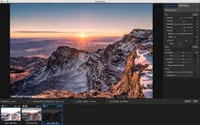
Now that’s out of the way, let’s talk about the editing modes. Quick mode is great for beginners because it comes with a range of Quick Actions for common tasks like dehazing a landscape, colorizing a black-and-white photo or applying a general smart fix. You can also carry out manual adjustments, apply a range of special effects and add textures and frames.


Guided mode is designed to walk you through a range of editing tasks manually. There are lots of these guided edits, all arranged into categories. They cover basic topics like cropping, resizing and object removal, through to more complex tasks like landscape improvement with dehazing and sky replacement. Some of the results from these guided edits can be quite crude, so you may need to touch them up with tools provided in the guided edit panel, or switch to the Advanced mode and do it there.
The blue sky replacement in the Perfect Landscape process is a good example. The sky can merge awkwardly with the foreground – it’s nowhere near as good as Photoshop’s equivalent – in the guided edit, but if you swap to the Advanced mode you’ll see the guided edit has created masked adjustment layers for the sky and the foreground that you may be able to improve on with some manual tweaks.
The advanced mode is like a mini-Photoshop in its layout, but with a really cut-down set of tools. You can only create a handful of different adjustment layer types, and there’s no curves adjustment or B&W conversion adjustment, for example. Incidentally, if the adjustment layer button is unresponsive, it’s because you’ve opened a RAW file as a 16-bit image and you’ll need to convert it to 8-bit.
You can apply a nice range of artistic effects, though, together with Photoshop-style filters and graphics, which include frame styles. These are confusing, though. You might drag one onto your photo thinking it will automatically frame it, but instead it creates a new layer group that’s not even the same size as your current photo and prompts you to choose a photo from your hard drive. There are many instances where Photoshop Elements 2026 feels like it’s been rather thrown together without a lot of thought or explanation, and this is one of them.

Adobe Photoshop Elements 2026: Performance


The new generative AI features in Elements 2026 work well, using Adobe’s regular Firefly engine, presumably. Other AI features are a little less impressive. The AI photo restore cleans up some dust and scratches but appears to do little else, in stark contrast to ON1’s Restore AI, for example. You can colorize old photos too, but that’s a separate process.
The enhanced remove tool can indeed identify people in the background of your shots, but not necessarily all of them, so you may need to mask out any extras manually. It replaces them with surrounding detail which doesn’t always line up well.
The Depth Blur feature can work very well. It doesn’t have the same speed, fluidity and control of the Lightroom Lens Blur tool, but it’s not bad. The motion effects aren’t so good, though. They’re designed to animate parts of your still photos, but the selection tools are crude and the results variable.
The main performance limitation for photographers is the weak RAW support and 8-bit editing environment. If you shoot RAW, this is not the program for you. If you only shoot JPEGs, Photoshop Elements 2026 is a stronger proposition.
Adobe Photoshop Elements 2026: Verdict

Adobe Photoshop Elements feels like an old photo-editing platform being kept alive by some headline-grabbing new features every time the annual upgrade comes around. It’s perhaps fine for ‘memory keepers’, school projects or anyone who just wants to mess about with photos, but it’s not a good tool for photographers.
Its basic RAW conversions and lack of support for 16-bit editing severely limit the results you can achieve, and are not helped by pretty basic tools even in Advanced mode. Really, this is not a program designed for photographers where the image is the end result, but for people who want to do things with their photos and aren’t really that bothered about finessing their quality.
Features ★★★☆☆ |
Photoshop Elements 2026 talks a good talk, but its headline features are bolted on to an old and technically limited platform. The weak RAW support and 8-bit editing tools are a serious drawback |
Design ★★★☆☆ |
Adobe has tried hard to make the interface accessible to everyone, and while the Quick, Guided and Advanced modes cater well for different user levels, it does feel like there’s a little too much to absorb |
Performance ★★★☆☆ |
Many of the tools and effects produce disappointing results – though that’s perhaps a matter of opinion. The AI restore feature doesn’t really achieve an awful lot, the motion effects are patchy and so on |
Value ★★★☆☆ |
Photoshop Elements 2026 looks cheap compared to Adobe’s Photography plans, but so it should be, given its technical limitations and dated workflow. The 3-year license deal is an unwelcome twist, too |
Alternatives