Digital Camera World Verdict
Thanks to its simple design and intuitive app integration, the ATLI Eon is one of the most user-friendly ways of getting into time-lapse photography. Small and pocketable, with a tripod mount and manual focus macro lens, it offers an impressive level of flexibility for the price – but its small sensor puts a ceiling on image quality, and the lack of weatherproofing reduces its time-lapse use cases.
Reasons to buy
- +
App makes it easy to use
- +
Pocketable dimensions
- +
Manual lens with macro capability
Reasons to avoid
- -
Not waterproof
- -
Manual focus won’t be for everyone
- -
Limited dynamic range from small sensor
Why you can trust Digital Camera World Our expert reviewers spend hours testing and comparing products and services so you can choose the best for you. Find out how we test.
The ATLi Eon is all about making time-lapse photography easy. A small, simple, app-controlled camera, its operation is about as close to point-and-shoot as a time-lapse camera gets, so if you’re a novice looking for a time-lapse camera, it’s the kind of option that will likely capture your attention.
Some time-lapse cameras are hardy things, designed to be screwed into walls and left for months on end for seriously long-term projects like documenting building construction. That isn’t really the ATLi Eon’s bag – it’s a small, non-weatherproof device that’s about the size of an action camera, better suited for indoor timelapses like houseplant monitoring or brief outdoor sojourns.
Still, with a manual-focus lens, tripod mount and full manual settings control via the app, the ATLi Eon offers a surprising depth of control for such a lightweight and affordable time-lapse camera. Could it be the ideal entry point for time-lapse enthusiasts? Let’s find out.

ATLI Eon: Specifications
Sensor |
1/3in OmniVision CMOS |
Video resolution |
Full HD 1920x1080 at 25fps |
Photo resolution |
2688x1520 px (about 4MP) |
Time lapse modes |
Video and photo |
Time lapse intervals |
0.5sec – 24 hours |
Lens |
Manual focus (7cm – infinity) |
Field of view |
72° |
HDR |
Yes |
Photo format |
JPEG |
Video format |
MP4 |
Storage |
MicroSD (card included; max. card supported 128GB) |
Battery |
Rechargeable Li-Ion, 2050 mAh |
Charging |
USB-C |
Dimensions |
54 x 70 x 50mm |
Weight |
125g |

ATLI Eon: Price & availability
The ATLi Eon is one of the cheaper dedicated time-lapse cameras on the market. Its price fluctuates regularly; at time of writing, it can be bought for around $179 / £127, either directly from ATLi or via third-party retailers like Amazon. I bought mine a few weeks ago for £97, so don’t be surprised if you see the price move significantly in either direction. Other entry-level time-lapse cameras tend to be more expensive – the Brinno BCC300 costs $249 / £269 standalone without any accessories.
ATLI Eon: Build & handling
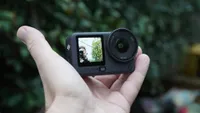
Upon unboxing the ATLi Eon, I was quite charmed. In form, shape and size it essentially resembles a GoPro with a big round lens stuck on the front, smaller and lighter than many other time-lapse cameras. There are minimal physical controls – just the power button on top – and no screen, meaning that you’re going to need to use the app to operate the camera.

With that said, there is one piece of manual control that I found rather delightful – the manual focus lens. The f/2.8 optic on the front turns with a smooth, well-regulated action, allowing you to bring your chosen subject sharply into focus, with a range spanning from 7cm to infinity. Not everyone will like this piece of physical admin, but for me, it made the ATLi Eon feel much more like a real camera than other webcam-style time-lapse cameras do. Plus, that 7cm minimum range opens up some interesting potential for macro shooting.
This focus range makes the ATLi Eon suitable for a broad range of time-lapse applications, from tracking the growth of a houseplant to capturing the changing view outside of your bedroom window. The ATLi Eon also has a tripod screw thread on its base to make it easier to set up in a secure, consistent position – ideal for long-term projects.

However, as we’ve discussed already, there is one aspect of the camera’s design that majorly restricts the time-lapse functions it can be used for: it isn’t waterproof. The ATLi Eon is not designed to be used in rain, unlike many other time-lapse cameras which can be left for months in the worst of the elements and still capture usable footage. Previous versions were apparently sold with a weatherproof silicon casing, but mine was not.
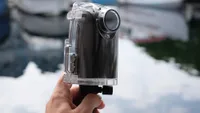
If you’re looking for a time-lapse camera to leave outdoors for long periods, I’d go with the Brinno BCC300 (as long as you get the waterproof housing).

ATLI Eon: Performance
As a rule I’m not a huge fan of cameras that are dependent on an app to function, but I suppose it makes a reasonable amount of sense for a timelapse camera, and the ATLi app is a good one. The shooting interface is simple and well-designed, making it easy to set up, shoot or schedule a time-lapse, or switch to photo and straight video capture modes. The photo mode isn’t bad – it’s difficult to imagine getting much use out of it, not least because you have to awkwardly juggle the camera and your phone, but it captures acceptable-looking images.

You can output your timelapse as a Full HD video, a photo sequence to stitch together yourself (which will give you the higher 2.7K quality of the camera’s photo mode), or both. Delve into the settings on the app and you’ll find a wealth of options for customising the look of your content, including exposure and white balance controls. There are profiles for different conditions such as ‘Sun’ and ‘Cloudy’, or you can take complete manual control over your shutter speed, aperture and white balance – useful once you’ve got the hang of the basics.
Still, no matter how many settings you tweak, you are ultimately still at the mercy of quite a small sensor, and the resultant narrow dynamic range can be a problem. During my time testing the ATLi Eon, the UK was experiencing extremely hot and sunny weather, and those scorchingly bright skies blew out very easily. The conditions also presented challenges for the lens – I found that harsh directional sunlight could easily cause an unsightly lens flare, and there’s no means of attaching a hood.

In less harsh light, though, it acquits itself well, producing bright and vivid imagery with a decent amount of detail.
I’d call the image quality sufficient. It’s no great shakes, and your smartphone is almost certainly capable of producing better-looking video without even trying, but you’re not going to leave your smartphone in front of a houseplant for two weeks – and there’s a lot to be said for the straightforward time-lapse functionality of the ATLi Eon. Once you’ve set it up, you can simply close the app, leave it to its own devices, and then come back to pick up your completed time-lapse.
ATLI Eon: Sample video
The following video was captured over a short period of 20 to 30 minutes, with the camera shooting at 0.5-sec intervals. It was converted to an MP4 video in-camera.
ATLI Eon: Verdict
The ATLi Eon isn’t going to produce the kinds of stunning, Einaudi-soundtracked, Icelandic starscape time-lapses you’ve seen on YouTube and Vimeo – those are made using proper mirrorless cameras with expensive lenses. However, what it will do is produce a decent-looking timelapse in most conditions, even when operated by someone who has little familiarity with cameras.
This ease of use, combined with the temptingly low price tag, makes the ATLi Eon a solid choice for anyone looking to dip their toes in the world of time-lapse. And once you’ve got a handle on the basics, its range of settings controls provide a solid platform for improving the quality of your footage – before, perhaps, you upgrade to something more sophisticated.

Features: ★★★★☆ |
Much more fully featured than you’d expect from its small dimensions, with full settings control via the app. |
Design: ★★★☆☆ |
Cute design in the action camera mold with a nifty MF lens, but the lack of weatherproofing hurts versatility. |
Performance: ★★★½☆ |
Imagery looks pretty good in the right conditions, but the small dynamic range of the sensor can cause problems. |
Value ★★★★☆ |
Cheaper than other time-lapse cameras, it’s an excellent starting point. |
Alternatives