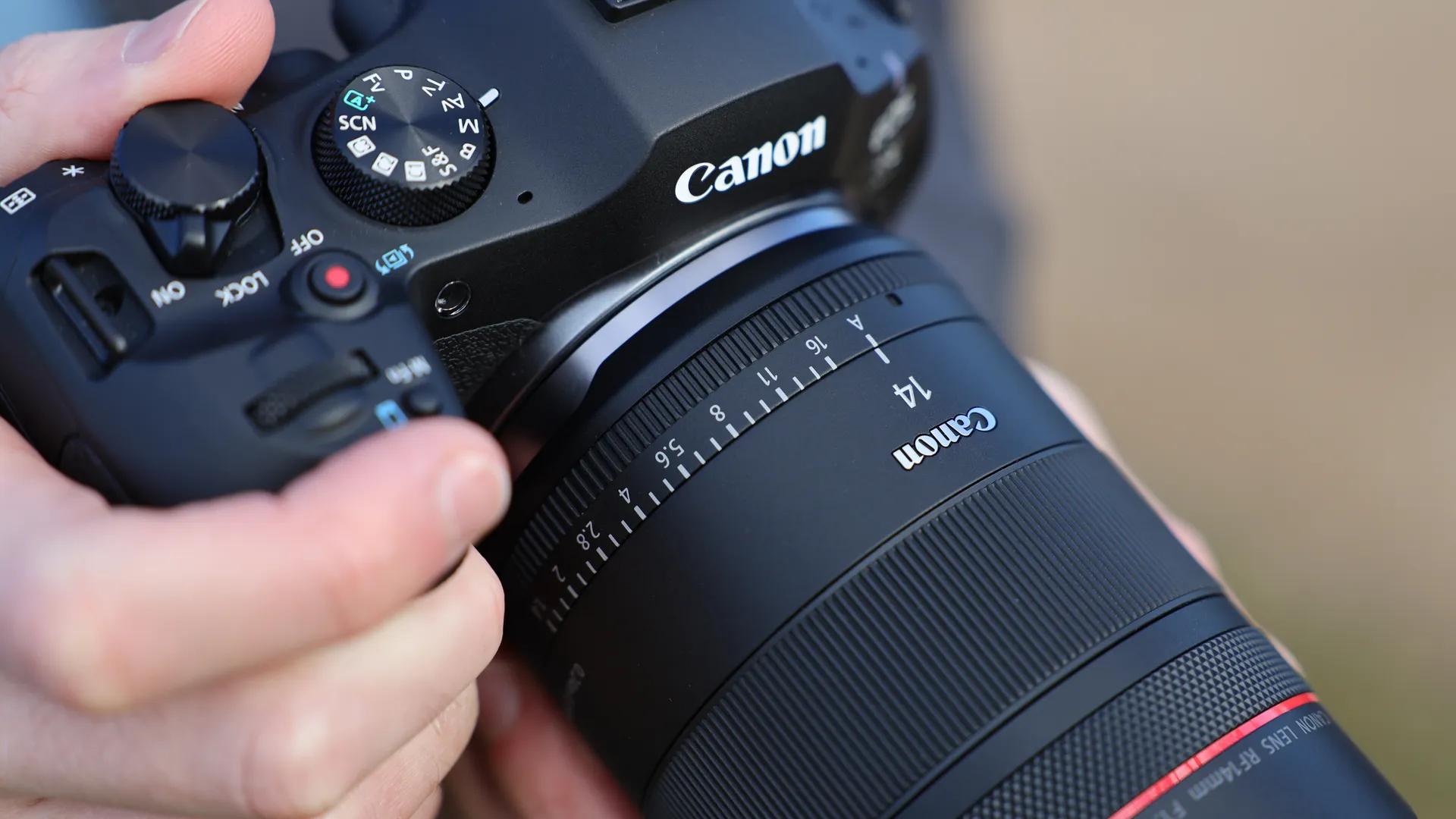
Canon’s mirrorless cameras tend to feature good-sized, ergonomically shaped grips – but could future cameras come with a fingerprint scanner built inside that grip? A recently published patent application suggests that Canon is considering building a fingerprint scanner right into the grip of future cameras.
The patent – which was published in the US on September 17 under patent number 0279905 – describes three different potential designs that would build fingerprint sensors directly into a mirrorless camera’s grip.
The first design places a fingerprint sensor on the front grip as well as a thumbprint reader on the finger rest at the back of the camera. The second design uses two fingerprint sensors at the front of the grip to increase accuracy for different hand sizes. The third design similarly uses two sensors on the front grip, but places the second sensor at a different orientation than the first.
The goal of the patent seems to be to take earlier ideas on integrating fingerprint sensors into cameras but in a way that works with how photographers already shoot and grip the camera.

While the patent details a few different designs to integrate a fingerprint reader that doesn’t require moving the hand from the typical shooting position, the filing doesn’t detail what that fingerprint reader could be used for.
But, the new patent isn’t the first time that Canon has explored the idea of using biometric authentication on a camera – and earlier patents offer hints on what such a feature could be used for. Back in 2018, the imaging giant filed a patent for a fingerprint sensor on both the front of the camera and on the lens that could be used for security or, by touching different fingers to the pad, to access different shortcuts.
In 2020, Canon filed a patent in Japan for a screenless selfie camera that used fingerprints to save profiles and determine who to follow.
Fingerprint sensors are common in smartphones to protect data and discourage theft – though more modern devices have hidden under-display sensors or have moved from fingerprints to facial scans instead.
Building a fingerprint sensor into a camera grip could have similar security implications, preventing a camera in the wrong hands from shooting or altering network settings. Through a series of updates, Canon recently added firmware that requires users to set a PIN to unlock the camera. This option was added in order to comply with regulations in Europe requiring all internet-connected devices to have specific security features.

I could see the fingerprint sensor being a helpful alternative to setting a PIN – I find the delay in needing to type in a PIN annoying, so I’ve always turned this PIN feature off. I could see such a tool being used to require a fingerprint to alter the camera’s Wi-Fi and network settings, or perhaps to lock features like the image playback.
But another potential use of a fingerprint sensor is in scenarios where multiple people may be using the same camera, like on production teams. A fingerprint scanner could potentially be used to save a user profile and customize the settings based on who is holding the camera.
While Canon’s 2018 fingerprint scanner patent suggested that tapping different fingers could unlock a different shortcut, much like a custom function button, I don’t think that’s the purpose of the latest patent, as the new patent seems focused on positioning the sensor where the fingers already rest, not touching different fingers to the pad.
The question is whether or not enough people would use such a feature to warrant the cost of adding a fingerprint sensor – both the actual cost and the compromises in terms of adding weight or requiring additional weather seals.
Canon files thousands of patents every year – in 2025, the imaging giant filed 2,623 just in the US. That means that there are plenty of patents that Canon files that never actually wind up arriving inside of an actual product. But looking at published patents offers a rare look into what the camera maker is researching behind-the-scenes.
You may also like
Browse the best Canon cameras, or read about the new Canon EOS R8 Mark II.

