
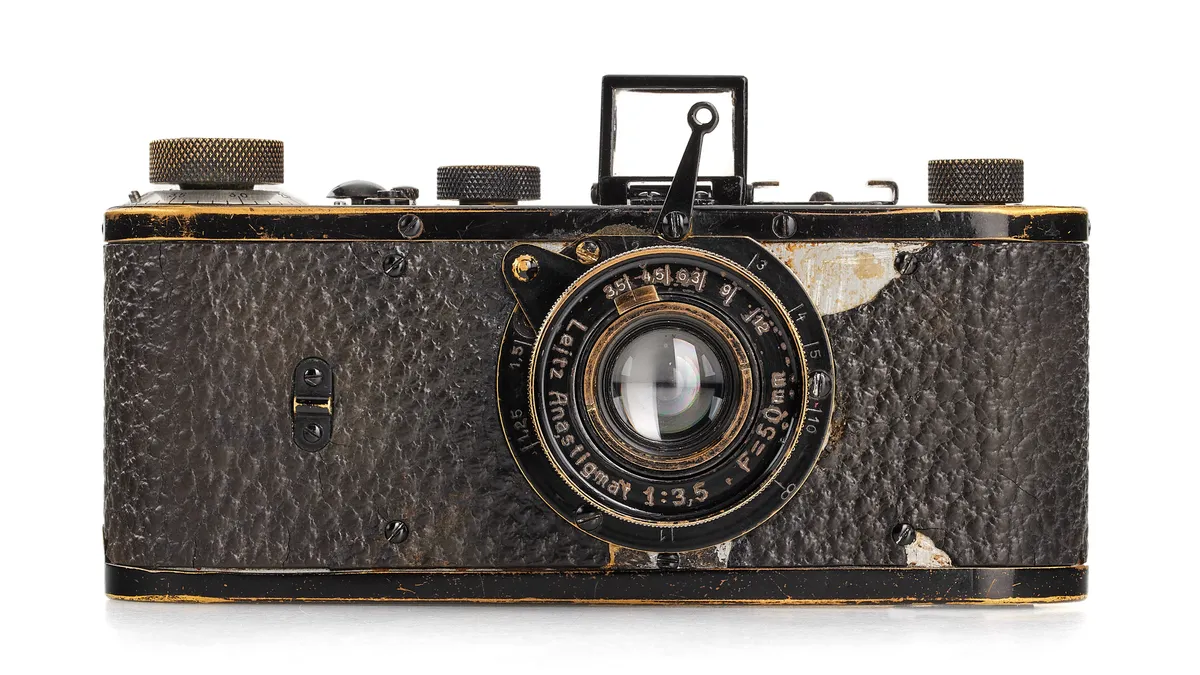
In June, an anonymous bidder paid $8.5 million for a 100-year-old camera that's essentially a light-tight box with a shutter. Five months later, another dropped £7.6 million on a current-production mechanical film camera you can buy new for just over six thousand dollars. Welcome to the world of collectable Leicas, where the gulf between function and value has become so vast it makes your head spin.
The cameras in question – a 1923 Leica 0-Series prototype and a Leica M-A gifted to Pope Francis – headlined what Leitz Photographica Auction is calling an "outstanding year" for the official auction house of Leica Camera AG. Together they accounted for over $16 million of sales during Leica's centenary celebration of the Leica I; the camera that revolutionized photography in 1925 by proving you didn't need a suitcase-sized contraption to take decent pictures.
A sense of theater
The 0-Series No. 112 is one of roughly 25 prototypes built before Leica committed to serial production in 1925. Only about a dozen survive. Its $8.5 million price makes it the second most expensive camera of all time, behind another 0-Series that fetched $17 million in 2022.
The Pope's camera is even more fascinating because it exposes the pure theater of high-end camera collecting. Here, we're talking about a mechanically controlled rangefinder with no exposure meter, no electronics, no battery; just brass, leather and glass. Leica gifted it to His Holiness in 2024, complete with white leather covering and the milestone serial number 5000000.

Following Pope Francis's death in April 2025, the camera came to auction as a charity lot. Estimated value: €60,000-70,000. Final hammer price: €6.5 million. That's more than a thousand times retail, for a camera that almost certainly never exposed a single frame of film.
Photographic mythology
It's easy to be confused. After all, you can still buy working Leica IIIs from the 1930s for under $2,000. Some will still take perfectly decent photographs.
But that misses the point of why people collect Leicas. These cameras occupy a unique position in photographic mythology because they enabled a particular kind of seeing. The small, quiet, portable 35mm rangefinder liberated photographers from tripods and dark cloths. It made street photography and photojournalism possible. Cartier-Bresson used one. So did Capa and countless others who defined how the 20th century saw itself.
So when someone pays $8.5 million for an 0-Series prototype, they're not buying a functional camera. They're buying proximity to that creation myth. They're acquiring one of the 25-ish objects that made everything else possible. It's the photographic equivalent of owning Shakespeare's First Folio – you're not buying it to read in the bath.
Obtaining immortality
The Pope's camera operates on different logic, but arrives at the same destination. That M-A is valuable because it connects the buyer to multiple narratives simultaneously: the pontiff's humanitarian legacy, the charitable purpose of the sale, and the historical moment of his death.
Which brings us to what Leitz Photographica Auction really sells: a kind of immortality. When you die, your business gets sold, your property gets divided, your achievements get forgotten. But a camera that sold for millions? That's going in a museum where your name gets attached to it forever. You become a footnote in photographic history.
Leica has cottoned onto this brilliantly. They gift cameras to popes and royals, reserve milestone serial numbers for famous figures, and invite collectors to exclusive viewings in Wetzlar. They've built an entire mythology around German craftsmanship and photographic heritage, then monetised that mythology through their auction house.
And perhaps that's fitting. Photography has, after all, always been about capturing time; holding onto moments that would otherwise disappear. What are these auction prices if not the ultimate expression of that impulse?
Someone paying €7.2 million isn't really buying a camera. They're buying their way into photographic history, ensuring their name gets mentioned in the same breath as Barnack and Leica and the birth of modern photography.
Check out the best Leica cameras you can buy new today

