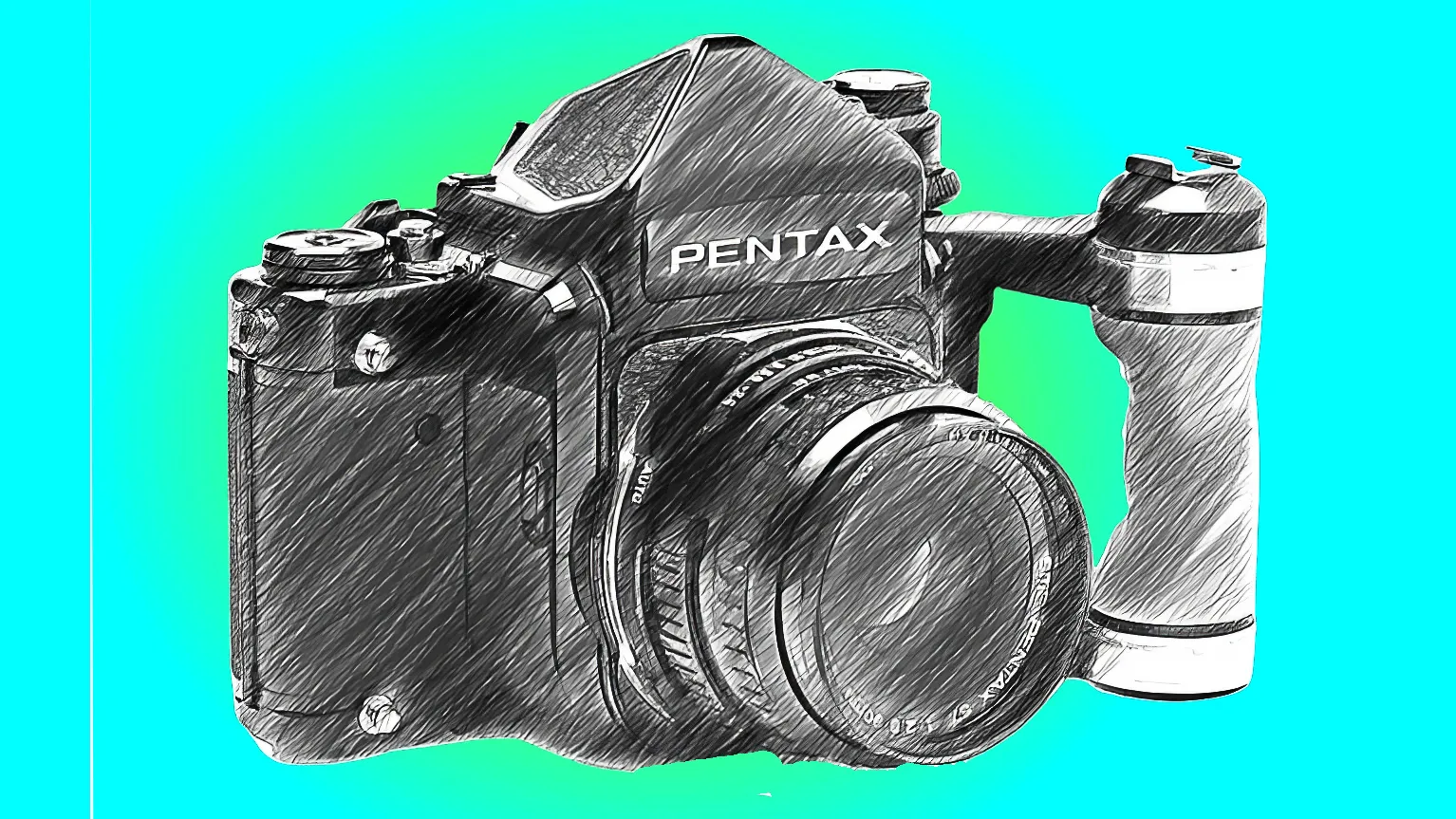
The Pentax 6x7 (later simplified to the Pentax 67) was one of the great medium format cameras, combining the handling of a 35mm SLR with the image quality of 120 roll film.
For many photographers, it offered the ideal balance between portability, simplicity, reliability and exceptional image quality. Even today, almost 60 years after the system's introduction, it remains one of the most sought-after film cameras.
Development of the camera began in the mid-1960s as Asahi Optical (now Pentax, a brand owned by RIcoh) wanted to build a medium format SLR that would feel familiar to photographers accustomed to 35mm SLRs.
Rather than copying the square 6x6 format used by Hasselblad, Bronica and others, Pentax chose the 6x7cm format, producing negatives approximately 56x70mm – about 4.5 times the area of a 35mm frame and, more importantly, a 4:5 image ratio, a perfect match for the standard 8x10-inch print.
It was first shown as a prototype at the Photokina trade show in Cologne, Germany, in 1966, but was called the Pentax 220 – as Pentax wanted to emphasize that it could use the new 220 film introduced by Kodak the year before.
Unlike most medium format cameras, the Pentax 6x7 was intentionally designed to resemble an oversized 35mm SLR. It featured a right-hand shutter release, a film-wind lever, a focal-plane shutter and interchangeable lenses.
Someone familiar with a Pentax Spotmatic, Nikon F or Canon F-1 (or virtually any modern 35mm SLR) could begin using the Pentax almost immediately. It is a big, heavy camera, but one that balances well in the hand.
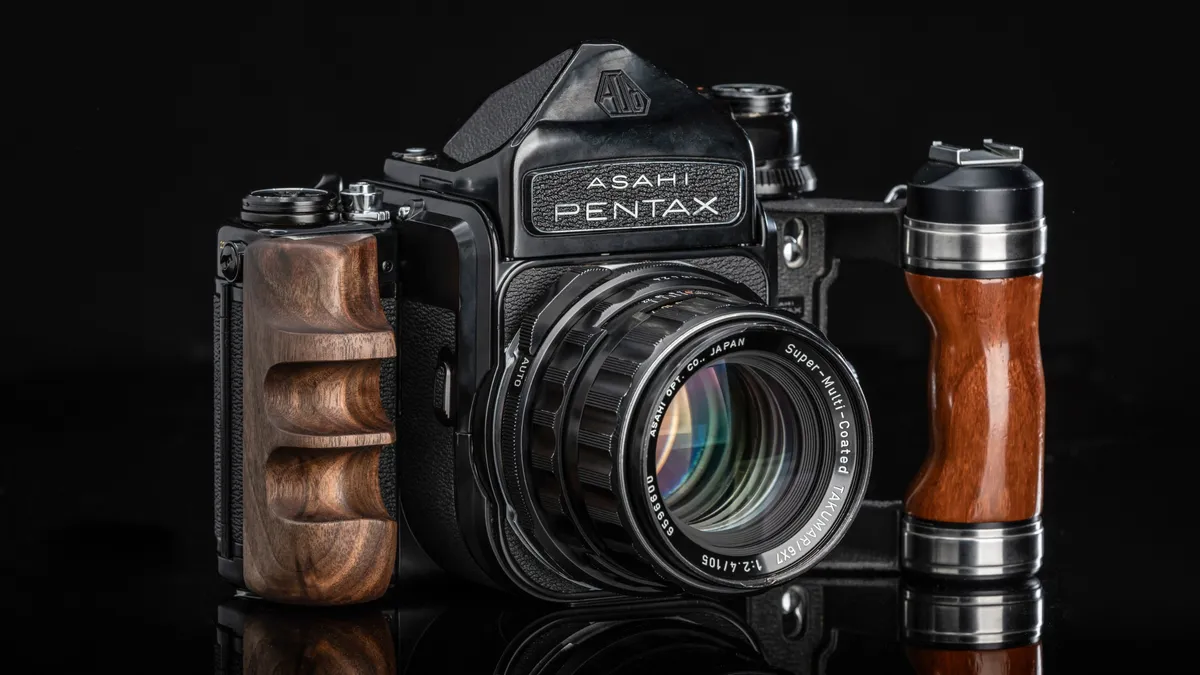
It made 10 exposures on a roll of 120 film or 20 exposures on 220 film (21 on the later 67II). The Pentax used a cloth focal-plane shutter, with speeds to 1/1000 sec and flash sync at 1/30 sec. This meant simpler (lower cost) lenses with larger maximum apertures.
The first production Asahi Pentax 6x7 appeared in 1969, while the final version, the Pentax 67II, remained in production until 2009, giving the system an exceptional 40-year life.
The four versions were a fairly straightforward evolution. The 6x7MLU followed in 1976 and was identical except for the addition of a mirror lock-up, to eliminate the mirror-slap (desirable as it greatly reduced mirror-induced vibration during long exposures and close-up work).
In 1989 the electronics were updated, it was given a cosmetic overhaul and its name was shortened to the Pentax 67. The last version, introduced in 1998, provided better ergonomics, added an LCD display and improved the metering in the form of an autoexposure prism. The 67II was made until 2009 – well into the digital era!
One of the Pentax 67's greatest strengths was its remarkable lens lineup. More than 40 lenses were eventually produced, covering focal lengths from the 35mm fisheye to a 1,000mm mirror lens.
But it was its standard 105mm f/2.4 lens that made the Pentax 67 famous – and its history is almost as fascinating as the camera itself.
From the beginning, the company wanted a standard lens that would equal or exceed the quality of Zeiss Planar lenses on Hasselblad cameras, be fast enough for available-light photography, provide excellent edge-to-edge sharpness on the large 6x7 cm negative yet remain reasonably compact and affordable.
Those requirements were difficult to reconcile.

Simultaneously with the development of the Pentax 6x7, Asahi began investigating multi-layer coatings and negotiated the rights to the technology from a California company, Optical Coating Laboratory, Inc.
Asahi's achievement was inventing an industrial process that could apply those coatings consistently and economically to photographic lenses.
Applying up to seven ultra-thin layers uniformly to every air-to-glass surface of a complex photographic lens was extremely difficult in the late 1960s. But it enabled Asahi to upgrade all its lenses with its now-famous Super-Multi-Coat (SMC) standard in 1971.
On any camera, the focal length of a "normal" lens should be roughly the diagonal of the negative in order to give a perspective equivalent to the human eye (not counting peripheral vision).
For a 35mm camera, the diagonal is 43.3 mm. Thus, manufacturers have used anything from a 40 to 58mm lens as standard; with the longer focal lengths used on early SLRs where the length was needed to enable the rear element to clear the mirror without resorting to more complex retrofocus designs.
The diagonal of the Pentax 67 negative measures roughly 89.5mm, so a 90mm lens should do it. But Asahi selected 105mm because it provided a slightly narrower field of view than a 90mm (about equal to a 52mm lens on a 35mm camera) for a more flattering perspective for portraits.
This was enough working distance for general photography and room for a relatively large f/2.4 aperture without making the lens gigantic.
The optical formula comprised six elements in five groups. Rather than chasing extreme sharpness at every aperture, the designers struck a careful balance between high center resolution, excellent correction of spherical aberration, smooth transition from sharp to out-of-focus areas (bokeh), and low distortion.
This balance is a major reason for the lens' enduring reputation. But curiously, the lens did not achieve instant legendary status in the 1970s.
It was respected as an excellent standard lens, but its near-mythical reputation grew in the digital era when high-resolution film scans revealed just how much detail the lens could resolve. As a result, prices for clean examples have risen dramatically since the 2010s.
In the digital era, the Pentax 67 has enjoyed a resurgence among portrait, landscape and fine-art photographers, with its large negatives scanning exceptionally well and producing images with a distinctive depth and tonal richness that many photographers prize.
Read more of David Young's ongoing series on classic cameras, as well as his book A Brief History of Photography.
You might also like…
Take a look at the best Hasselblad cameras of today – which are still among the best medium format cameras on the market.

