





After 23 years, the Pentax K series of DSLRs has met its end. The camera maker that has stubbornly clung to the DSLR in the mirrorless era says that another “completely new concept digital SLR camera” is coming, but production for all K-series DSLRs has officially ended.
However, Pentax isn’t just unusual in that the brand remains committed to DSLRs – the K-mount was home to some of the most unusual camera features. Pentax wasn’t afraid to break the unwritten rules of cameras, breaking traditions from the color of cameras to unheard-of features.
In honor of the end of the Pentax K series of DSLRs, these are some of the strangest, wackiest and wonderfully rare features over the last 23 years.
A lens mount that hasn’t changed

In the transition from film to digital, many camera makers changed the lens mount. While the Nikon F and Canon’s later film-era EF mount also survived the transition, the Pentax K-mount has persisted for more than 50 years. (That, notably, doesn't beat the Leica M mount launched in 1959, which is still used today).
Any Pentax DSLR can mount nearly any K-Mount film camera lens without the need for an adapter. Even the in-body stabilization works with old film lenses.
While Pentax has discontinued the K series of DSLRs, the company says that the next DSLR will keep that same mount – so its longevity is expected to continue.
Sensor stabilization inside a DSLR

One of the key advantages of switching from a DSLR to mirrorless is in-body image stabilization – except Pentax has had stabilization inside its DSLRs since the K100D and K10D in 2006.
Stabilization inside a DSLR is rare because the camera’s mirror-centered design made building a stabilization system inside the body difficult, leading to many camera makers opting for stabilized lenses instead. Pentax was a notable exception (along with some Sony DSLRs).
A sensor that could move with the stars

Pentax’s stabilized sensor powered another rather unusual feature: the ability to ”follow” the stars. The rotation of the Earth will blur long exposures of the night sky into star trails without complex astro-tracing equipment, which moves the camera in time with the planet's rotation.
But Pentax used GPS (global positioning system) technology in tune with the image stabilization, in order to move the sensor in line with the stars – creating a built-in astrotracer. Some models required an external GPS accessory for this to work, while cameras like the K-3 Mark III didn’t require any external help.
Intentionally shaking the camera sensor

Pentax’s stabilization system may have been built to avoid camera shake, but it could also do the opposite and intentionally add blur. Pentax’s anti-aliasing filter simulator was designed to correct moiré, a distortion of fine patterns created by a digital camera’s grid of colors that enables the camera to see in color.
Unlike the more traditional optical moiré correction, because Pentax’s version was sensor-based, it could be turned on and off when needed.
A camera with a modular grip

Smaller grips make a camera more portable, but larger grips are more comfortable for shooting heavy telephoto lenses. Back in 2017, Pentax created a camera that could adapt the grip to the shooting scenario.
The Pentax KP used a modular grip system. Grips came in three sizes – small, medium and large – and could be swapped out depending on the situation. The swappability also enabled photographers to customize their cameras to better fit their hand size.
A camera with 100 different possible color combinations

Pentax really questioned the notion that most cameras are black with the Pentax K-x. Launched in 2009, the camera was sold in four different colors – but in Japan, photographers could choose from twenty different body colors and five different grip colors, creating a hundred possible color combinations.

Pentax’s colorful camera history also can’t go without a mention of the Pentax K-r Korejanai, a special edition that only offered 100 units in a colorful mix of red, blue, yellow, and gray, with a robot on the hot shoe slot.
A camera with color-coded grip lights

Speaking of colors, one of Pentax’s most unusual features was found on the K-S1: a bank of color-coded LED lights on the grip.
These lights changed color depending on the camera settings. Green was for still photos, red for video. When using face detection in Live View mode, the lights even light up with the number of faces detected in the frame.
A camera that couldn’t shoot color images
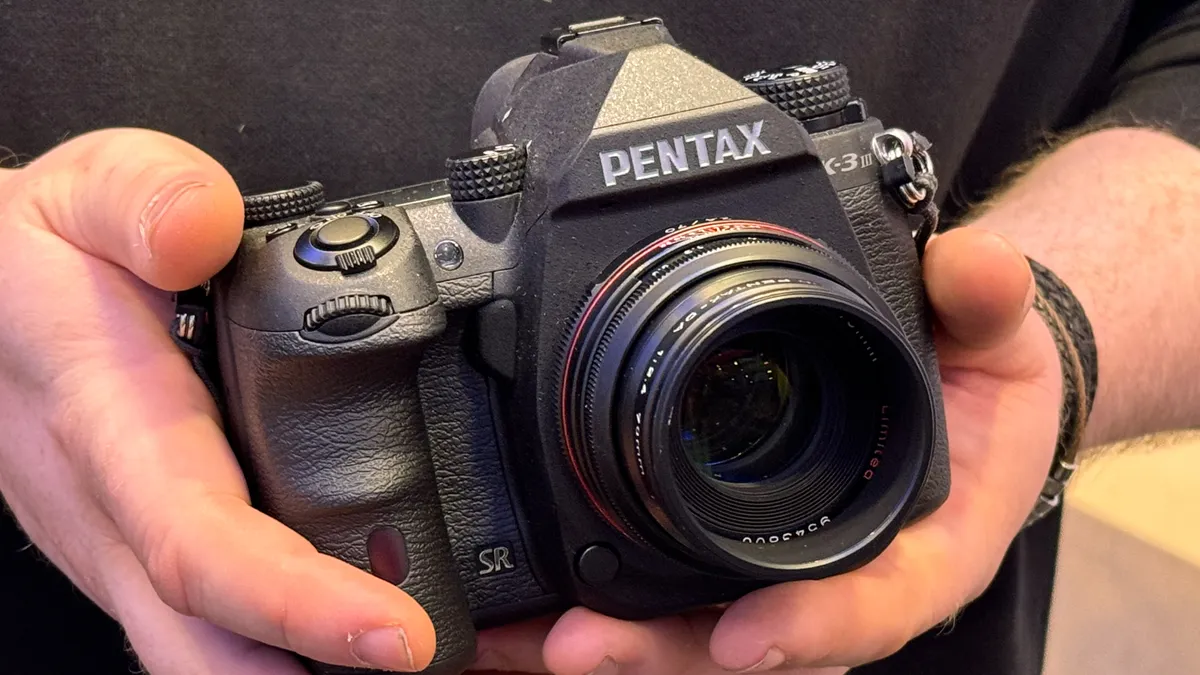
Cameras dedicated to black-and-white photography remove the color filter, creating a system that only shoots in monochrome while also decreasing noise.
While Kodak had an earlier, rare option, the Pentax K-3 III Monochrome is considered to be the only widely available dedicated black-and-white DSLR, launched in 2023.
Weather-sealing shouldn’t be exclusive to high-end cameras

One of the features that Pentax’s DSLRs are known for is weather-sealing, but the company also brought the feature down even to entry-level cameras.
Enthusiast-grade bodies like the K-30, K-50, K-3S, and KF were weather-sealed at a time when most camera makers reserved the feature for high-end bodies.
You may also like…
Browse the best DSLRs or the best Pentax cameras.

