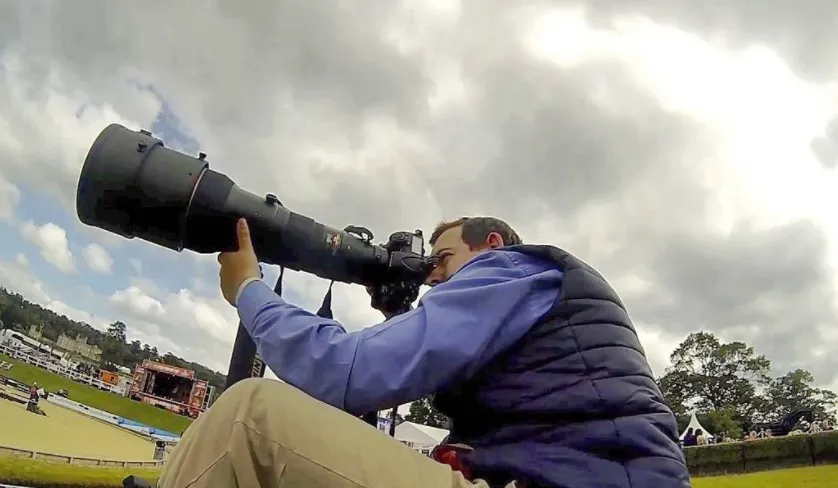
When people think about professional sports photography, they usually imagine cameras firing at ridiculous speeds, enormous telephoto lenses lining the edge of the field and photographers transmitting images to waiting news desks before the action has even finished.
For a long time I bought into that philosophy as well, because speed was everything – or at least, that was what sports photographers were constantly told.
The more frames your camera could capture, the greater your chances of recording the decisive moment. Miss the shot and somebody sitting three feet away from you would almost certainly have it – which meant fast frame rates, deep buffers and responsive autofocus were considered the defining qualities of any serious professional sports camera.

At the time I was using the Nikon D3, a camera that deserved every bit of praise it received. Its 12MP sensor might sound rather modest by modern standards, but it delivered excellent images, dependable autofocus and the sort of speed that pro sports photographers required.
It was a proper working camera, built to survive difficult conditions, constant travelling and thousands upon thousands of shutter actuations.
Then Nikon announced the Nikon D800, and suddenly my understanding of what a professional sports camera could be changed completely.
I was fortunate enough to see an early preview through Nikon Professional Services and, the moment I learned what the camera could do, I knew it was going to become my game-changer both on and off the sports field.
This was a 36.3MP full-frame DSLR arriving at a time when most sports photographers were still concentrating almost entirely on frame rates, buffer depths and how quickly they could fire another burst.
The Nikon D800 was not designed as an obvious replacement for the D3, and its 4fps continuous shooting speed at full resolution looked positively pedestrian beside Nikon’s flagship sports cameras.
However, I could see something in the D800 that went far beyond the numbers on a specification sheet.
I ordered two bodies almost immediately and was fortunate enough to be among the first group of photographers to receive them, before taking both cameras to one of the most demanding assignments of my professional career.

One of their first major outings was the Badminton Horse Trials, one of the biggest equestrian events in the world, where I was photographing athletes competing at the highest level of the sport for the FEI (Fédération Equestre Internationale).
Taking a pair of Nikon D800 bodies into that environment might have seemed like a strange decision, because high-resolution cameras were still widely considered tools for studio, landscape and commercial photographers rather than fast-moving sporting events.
My work, however, was already beginning to sit between those different worlds. I was not only photographing riders for editorial coverage; many of my clients were brands that wanted images showing their products being used by leading equestrian and human athletes in the field.
These clients needed photographs for advertising campaigns, promotional displays, websites, brochures and sometimes enormous exhibition stands. That was where the Nikon D800 gave me an advantage, because its 36.3MP files captured a level of detail that was remarkable at the time.
Logos on clothing, saddlecloths, riding boots, protective equipment and horse rugs were clearer and more usable than they had been in my 12MP files. Clients could crop a photograph while still retaining sufficient resolution for professional advertising work, and I could offer them considerably more flexibility with every image I delivered.
That cropping freedom was particularly valuable in equestrian sport, where a horse and rider can change position incredibly quickly.
There are times when the perfect expression, stride or product placement occurs slightly outside your intended composition, and the D800 gave me room to straighten, reframe and crop without immediately degrading the quality of the final photograph.
It did not mean that composition suddenly stopped mattering. In fact, the additional demand for images made me think more carefully than ever about where I positioned myself, which backgrounds I used and how many different angles I could capture during a single competition.

At some events, I had a roster of around 20 clients requiring photographs – and they were not always interested in just one rider. On occasion, I needed to cover more than half of the competitors in the field, all while keeping track of which athlete was using which client’s product.
That meant planning my positions carefully and understanding exactly how the competition was likely to unfold.
I could not simply stand in one place, point a long lens towards the action and hope everything worked itself out; I had to know the course, understand the sport and anticipate where each photograph was most likely to happen.
The Nikon D800’s comparatively modest frame rate also forced me to trust my timing.
I could not rely on holding down the shutter button and returning home with dozens of almost identical frames from every moment, so I had to understand the rhythm of a horse approaching a fence, anticipate the point of take-off and press the shutter when the image was actually there.
Its autofocus was more than capable of keeping pace and, when everything came together, the resulting files were extraordinary. The photographs had the resolution that my commercial clients wanted while retaining the responsiveness, durability and familiar handling I needed from a professional DSLR.
As brands and advertising agencies began asking for increasingly detailed files, my decision to adopt the Nikon D800 put me ahead of the curve.
I could provide editorial photographs when required, but I could also deliver files capable of being cropped, enlarged and adapted across multiple advertising formats without compromising the fine detail that clients expected.
That combination helped me build long-term relationships and eventually maintain a substantial roster of brands at major events. The camera did not do the job for me, because no camera ever will, but it gave me a tool that perfectly matched the direction in which my professional work was moving.

Those two Nikon D800 bodies went on to capture hundreds of thousands of photographs during my ownership. They endured demanding equestrian events, unpredictable weather, long days beside competition arenas and the constant pressure of delivering images to multiple clients, earning their place in my camera bags many times over.
They remained an important part of my working setup until I retired from professional sports photography – and they proved that outright frame rate was not the only specification that mattered at the highest level.
A camera capable of producing detailed, flexible and commercially valuable files could be every bit as useful as one designed simply to fire as many frames as possible.
The funny thing is that high-resolution cameras at major sporting events no longer look unusual. Modern photographers routinely use cameras with 40, 50 or even 60MP sensors, often combined with burst rates that would have seemed unbelievable when the D800 first appeared.

Resolution and speed are no longer treated as opposing choices, but the Nikon D800 helped demonstrate that high-megapixel cameras belonged in professional sport.
It showed that the value of a sports image was not determined solely by how quickly the camera could capture it, but also by how much detail, flexibility and commercial potential that photograph could offer afterwards.
Today, the Nikon D800 has naturally found its way onto the second-hand market, with used examples often available for very reasonable prices through retailers such as MPB and marketplaces like eBay.
It may no longer represent cutting-edge technology, but its 36.3MP files remain extremely capable, particularly for photographers who do not require the fastest burst rates or the latest mirrorless autofocus systems.
For me, though, the Nikon D800 will always represent something far more important than its current used price or its place in camera history.
It was the camera that encouraged me to look beyond the accepted rules of sports photography, recognize what my clients actually needed and build my professional approach around resolution as well as speed.
The Nikon D3 might have been the conventional sports camera, but the D800 became the camera that changed my professional career. It gave me an advantage when other photographers were still concentrating entirely on speed, and it proved that sometimes the best tool for the job is not necessarily the most obvious one.
You might also like...
Take a look at the best cameras for sports photography on the market today, along with the best professional cameras for working pros.

