




I’ll die on this hill: the Nikon F5 is the best 35mm SLR camera you can buy.
Camera opinions are rarely worth dying over, but I have one that I will defend for as long as there is breath in my body and film in my refrigerator: the Nikon F5 is the best 35mm film camera out there. It is not the prettiest, the lightest, or the most discreet film camera ever made, but I firmly believe it is the best.
Furthermore, it can be bought surprisingly cheaply secondhand – I have seen bodies on sale recently for around £300 / $400 (although obviously actual prices will vary hugely depending on condition).
I know that statement will immediately upset the Leica faithful, Nikon F3 owners, Canon EOS-1V devotees, and anyone who believes a “proper” film camera should be fully mechanical, covered in brass, and operated entirely through dials. That is fine. You are welcome to meet me on this hill, but I am not moving.

The Nikon F5 represents the moment when 35mm photography reached its professional peak. It arrived in 1996 as Nikon’s flagship autofocus SLR, built primarily for photographers who had to return with the picture rather than those who simply enjoyed the process of trying to take it. Nikon designed the camera around speed, reliability, and professional use, giving it five-area autofocus, Dynamic AF, 3D Color Matrix Metering, and a 1,005-pixel RGB metering sensor.
With the dedicated MN-30 battery, the F5 could advance film at up to eight frames per second. That might sound financially irresponsible now that every press of the shutter carries a noticeable cost, but you do not have to burn through an entire roll in a matter of seconds to appreciate what that specification represents. It tells you that the F5 was engineered without compromise.
This was not a camera designed to look attractive on a shelf or appear tastefully beside a flat white on Instagram. It was built for sidelines, press pens, racetracks, war zones, fashion studios, and any other environment where missing the photograph was not an acceptable outcome. That is why I believe it remains the best 35mm camera to buy today: the F5 does not ask you to romanticize inconvenience. It simply gets out of the way and lets you take photographs.
Film photography has become strangely obsessed with limitations. We praise cameras for slowing us down, forcing us to concentrate, and making every frame more deliberate. There is truth in that, of course, but sometimes I think we confuse inconvenience with creativity.
A camera does not make you more artistic simply because it lacks autofocus. A light meter that requires a separate handheld device does not automatically produce better photographs, and manually winding the film does not make the final image more meaningful. Those things can make the experience enjoyable, but they do not necessarily make the camera better.
Sample images


The Nikon F5 gives you the character, latitude, grain, color, and unpredictability of film without requiring you to abandon the practical advantages of a modern professional camera. Its controls feel familiar, its autofocus works, its metering is remarkably dependable, and the body is shaped like something designed to be held for hours rather than admired through a glass cabinet. It is, in many ways, the perfect bridge between analog and digital photography.
That matters because the F5 allows someone accustomed to a DSLR to begin shooting film without first having to relearn the entire process of operating a camera. Load a roll, set your exposure mode, select your focus point, and start shooting. The image is still being recorded onto 35mm film, but getting it there does not have to be unnecessarily difficult.
Some film photographers will consider that a weakness, but I consider it one of the F5’s greatest strengths. I have owned and used mine for more than 15 years, and during that time I have never felt creatively restricted by it.
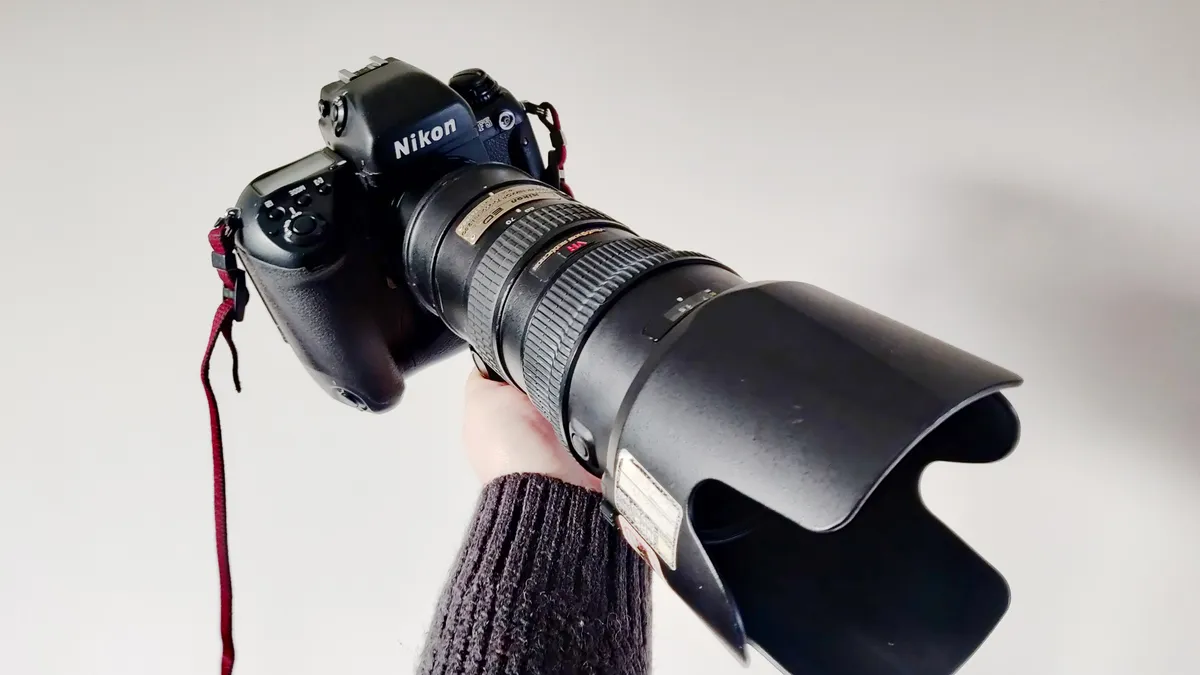
I have used the F5 with relatively modest lenses, fast primes, professional zooms, a Nikon 200mm f/2, and even a huge 600mm f/4. The fact that a camera released in the mid-Nineties can still communicate with such a wide selection of Nikon F-mount lenses remains one of its greatest practical advantages.
That enormous lens selection means the F5 can become almost anything you need it to be. Fit a 50mm prime and shoot everyday documentary work, add an 85mm lens and use it for portraits, attach a 70-200mm and photograph sports, or put a 600mm lens on the front and turn it into an analog wildlife machine. There are more romantic cameras, but few are more versatile.

Naturally, the F5 has its critics. It is big, it is heavy, and it requires eight AA batteries in its standard configuration. Nobody is going to mistake it for a pocket camera, and carrying one around your neck all day will certainly make its presence known. However, I would argue that its size is part of the appeal.
The grip is substantial, the controls fall naturally under your fingers, and the integrated vertical shutter release makes portrait-orientation shooting feel just as natural as holding the camera horizontally. With a larger professional lens attached, the body provides the balance needed to make the entire setup feel manageable. It feels purposeful because it is purposeful.
The use of AA batteries is often presented as another sign of the camera’s age, yet it may be one of the most practical power solutions ever fitted to a professional camera. You can find AA batteries almost anywhere, with no discontinued proprietary battery to hunt down, no specialist charger that becomes useless when it fails, and no need to worry about whether a decades-old rechargeable pack can still hold a meaningful charge.

Put eight batteries into the F5 and get on with taking photographs. It really can be as simple as that, and there is something reassuring about using a camera that does not depend on an increasingly rare power source to remain functional.
Yes, the F5 relies heavily on electronics, and eventually every electronic camera carries the possibility that something will fail. However, mine has endured years of use and abuse, while other cameras I have owned have long since given up. The F5 was never intended to be disposable technology; it was a professional investment designed to survive the demands of photographers who worked every day.
There is also the question of the Nikon F6. On paper, Nikon’s final professional film SLR is arguably the more technically advanced camera. It is newer, more refined, and equipped with a more sophisticated autofocus system, but I would still choose the F5.
The F6 feels like an exceptional film camera created at the beginning of the digital age. The F5 feels like the camera that conquered the film age, and there is something gloriously uncompromising about it.
Nikon did not build the F5 as a nostalgic tribute or a luxury object. It built the camera to become the new professional standard, and almost three decades later, that intent remains obvious every time you pick one up.
Other cameras may offer a purer analog experience. A Nikon F3 provides beautiful simplicity, a Leica M offers discretion, precision, and one of the greatest viewfinder experiences in photography, while a compact camera can fit into a coat pocket and accompany you everywhere. However, if you asked me to choose one 35mm camera to photograph everything for the rest of my life, I would take the Nikon F5.
I could use it for portraits in the morning, street photography in the afternoon, and professional sports in the evening. I could attach decades of Nikon glass, rely on its autofocus when the subject started moving, trust its metering when the light became difficult, and know that the body was built to handle more punishment than I would ever reasonably give it.
That, to me, is what makes a camera the best. The best camera is not always the one that creates the most romantic shooting experience; it is the one that gives you the greatest chance of making the photograph you saw in your head.
The Nikon F5 might not make you look like a fashionable film photographer. It might not match your vintage camera strap, and nobody will describe it as small or elegant, but it will take the photograph. I will die on the hill that, when it comes to 35mm film cameras, nothing does that job better.
Shop the Nikon F5
Find a Nikon F5 on eBay

