





The Sony RX10 V refreshes a nearly decade-old design with modern autofocus smarts, but the new super zoom also comes with another key change: it’s the priciest bridge camera that I’ve seen yet.
I tried the Sony RX10 V and loved the mix of wide-angle, telephoto and macro all in one camera instead of a bag full of gear. But considering the price change that comes with the new luxury super zoom, I had to ask: is there a mirrorless combination that has a similar reach for a lower price point?
Enter the Sony A6700 with an all-in-one superzoom, like the Tamron 18-300mm f/3.5-6.3 Di III-A VC VXD, which brings a 27-450mm equivalent focal length, or the Sigma 16-300mm f/3.5-6.7 DC OS | C with a 24-450mm equivalent range.
No, those all-in-one zooms don’t reach as far as the RX10 V’s 24-600mm equivalent lens, but the A6700’s larger sensor (APS-C versus 1-inch on the RX10 V) and higher resolution can help make up for that difference.
The Sony A6700 has a 23% boost in megapixels, 26MP versus 20.1MP. If you cropped in the A6700 by 23%, you’d end up with a view that looked more like 550mm – a much closer perspective to the RX10’s telephoto 600mm reach.

The Sigma 16-300mm f/3.5-6.7 DC OS | C still hits 24mm on the wide end and comes in at a similar weight of 615g / 1.4lb and price point to the Tamron.

The Sony RX10 V comes with a $2,299 / £2,200 / AU$3,499 price. That’s about $600 higher than the 2019 Sony RX10 IV in the US. While that seems steep, the number actually matches quite close to inflation.
According to inflation calculators, the $1,700 that the RX10 IV cost in 2019 would be about $2,160 today. (And in the US, the discontinued RX10 IV was going for even higher in mint condition.)
But while the price change isn’t too far removed from inflation, over the last several years there seems to be a growing trend for mirrorless optics that fall in the all-in-one / superzoom category.
The Tamron 18-300mm, introduced in 2021 for E-Mount, covers wide to telephoto and also shoots half macro, all without swapping lenses. Sigma's option is even newer, launched in 2025.
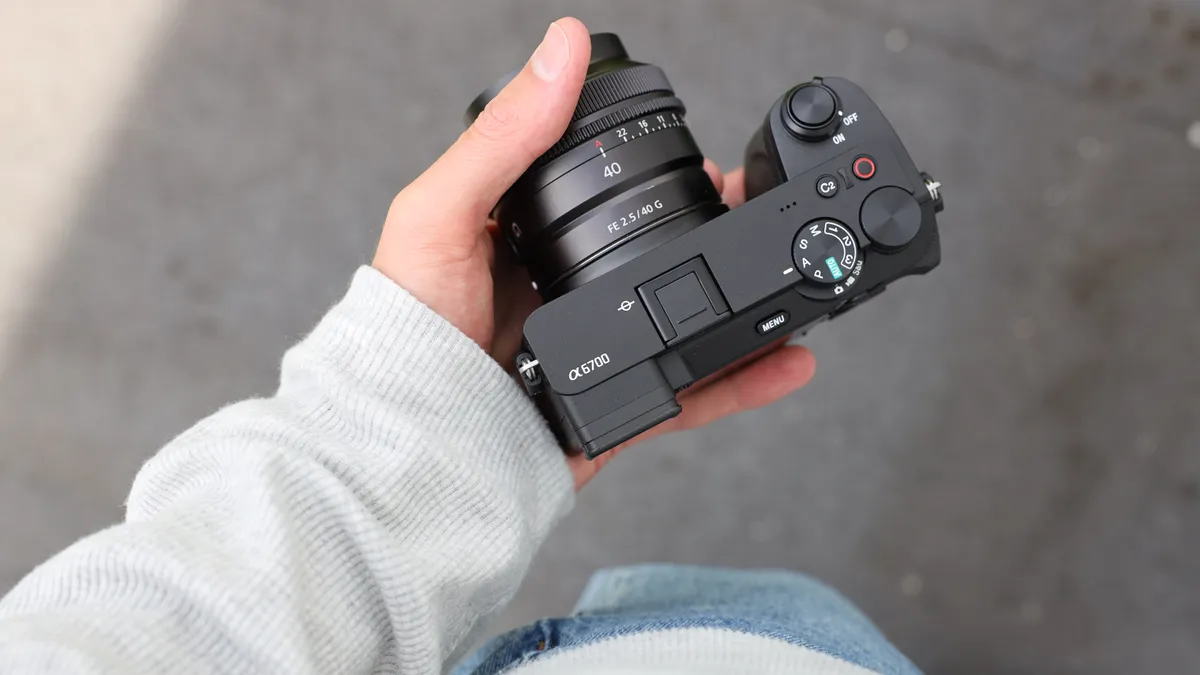
A superzoom won’t be smaller than the RX10 V, as the lens doesn’t collapse when powering the camera off, like with the bridge camera. But the two options do have a similar weight.
The RX10 comes in at 2.4 lbs / 1110g. Combining the weight of the A6700 (17.4 oz / 493.2 g) with the weight of the Tamron 18-300mm (21.86 oz / 620g) comes to 2.45 lbs / 1,113g. The sigma 16-300mm is about 5g less, putting it actually under the weight of the RX10 V with the A6700.
Of course, there are mirrorless lenses that can get that 600mm reach on the A6700 – like the Tamron 50-400mm f/4.5-6.3 Di III VC, which creates a 75-600mm 35mm equivalent on an APS-C body. But that lens doesn’t fall under the cost of the RX10 V unless paired with a more affordable body like the Sony A6400, which doesn’t have as robust an animal detection autofocus system.

The capabilities of the Sony A6700 aren’t a direct match with the RX10. On the one hand, the A6700 has the larger sensor and higher resolution, but the RX10 V wins in burst speed with 30fps over the mirrorless camera’s 11fps.
Am I glad that Sony revived its super zoom from the dead? Yes. Did I love shooting with the RX10 V? Also, yes. The RX10 V is a great camera for packing only one fixed lens camera and still hitting every genre from wide angle to telephoto to macro.
But, like with the compact camera trend, it’s worth pointing out that the RX10 V doesn’t necessarily save money over a mirrorless system.
You may also like
Dive deeper into the best bridge cameras or the best cameras for wildlife photography.

