Digital Camera World Verdict
After testing a range of products built around Baader AstroSolar Safety Film OD 5.0 – including loose A4 sheets for DIY filters, homemade telephoto lens filters, and Baader’s own AstroSolar Binocular Filters – one thing became consistently clear: the film’s reputation is entirely deserved. Baader delivers sharp and clean white-light solar images that preserve fine sunspot detail even at long focal lengths. That neutral white rendering also gives photographers huge flexibility during post-processing. However, AstroSolar film is less rugged than thicker Thousand Oaks polymer film or glass solar filters, and it requires very careful handling to avoid scratches or tears. It also costs a lot more for larger apertures. For photographers chasing the best possible eclipse and sunspot images, though, it remains the standard against which most other solar filter materials are judged.
Pros
- +
Exceptional sharpness and contrast
- +
Superb fine-detail rendering
- +
Neutral white sun ideal for post-processing
- +
Lightweight and excellent for travel
- +
Ideal for high-resolution eclipse photography
- +
Widely trusted by serious eclipse photographers
Cons
- -
More expensive than Thousand Oaks film
- -
Thin film is prone to tearing if mishandled
- -
Requires careful mounting and storage
- -
Brighter visual image may not suit everyone
- -
Not always easy to source in North America
Why you can trust Digital Camera World Our expert reviewers spend hours testing and comparing products and services so you can choose the best for you. Find out how we test.
Among eclipse chasers and photographers, Baader AstroSolar Safety Film has achieved near-legendary status. Manufactured by Baader Planetarium in Germany, it has become one of the most widely trusted materials for safe white-light solar photography and observation.
During the 1999 total solar eclipse across Europe, Baader Planetarium reportedly supplied enough solar safety film for more than 20 million eclipse viewers – a remarkable indication of the company’s scale and reputation within the astronomy community.
But it’s not for everyone. Unlike rigid glass solar filters or photographic ND filters, AstroSolar is an ultra-thin 0.0004-inch [0.01mm] metalized film specifically engineered for observing and imaging the sun safely with telescopes, binoculars, and camera lenses.
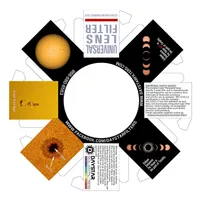
It’s available in a number of forms, including loose A4 sheets for DIY filter construction, and integrated into products like Baader’s ASBF AstroSolar Binocular Filters, ASBF Solar Filters for Binoculars and Camera-Lenses, and its ASTF AstroSolar Telescope Filter. All come in various sizes and block 99.999% of visible sunlight.

For this review, I tested several products using the same AstroSolar film, including a homemade binocular filter made from an A4 sheet, an ASBF AstroSolar Solar Filter used on a small telescope, and an AstroSolar Solar Filter used on a camera’s zoom lens.
While the housings and mounting methods varied, the underlying optical performance remained the same throughout.
Something to note about AstroSolar Safety Film is that, technically, it does not meet the strict ISO 12312-2 international standard required for eclipse viewers. The problem is that it allows slightly too much UV light through.
However, it has been safely used by amateur and professional astronomers for several decades with telescopes, binoculars, and camera lenses, whose glass elements filter out the excess ultraviolet light. The safest way to use it on a camera is by using a digital viewfinder.

Baader AstroSolar: Specifications
Filter type |
Solar safety film |
Material |
Baader AstroSolar Safety Film |
Optical density |
OD 5.0 |
Transmission |
99.999% light rejection |
Certification |
Does not meet ISO 12312-2 transmission requirements for eclipse viewers |
Solar color |
Neutral white |

Baader AstroSolar: Price
AstroSolar film occupies an interesting position in the solar filter market because, while the loose A4 sheets themselves can appear relatively affordable, complete large-aperture filter builds quickly become more expensive than equivalent Thousand Oaks polymer-based filters.
However, an A4 sheet of AstroSolar Safety Film can produce multiple DIY filters for telephoto lenses or binoculars, making it relatively economical in the long term, while Baader’s own filters made with AstroSolar Safety Film are lightweight and reasonably travel-friendly – though delicate.
Availability can also be frustrating. While Baader products are extremely common throughout Europe, they are not always widely stocked in North America, particularly close to major eclipses when demand spikes dramatically.

Baader AstroSolar: Design & Handling
The first thing most photographers notice about Baader AstroSolar Safety Film is just how thin it is. Compared to Thousand Oaks polymer film, which is darker on one side with a reflective metallic surface on the other, AstroSolar Safety Film is identical on both sides and feels far more fragile.
It’s prone to tearing or scratching if mishandled, particularly around the edges or if packed carelessly during travel. Extreme care is required when making and using homemade filters; resist the temptation to stretch it, instead keeping it slack (wrinkles or ripples in the film make zero difference to optical quality).
That said, it’s crucial to store Baader filters very carefully so the film doesn’t get damaged. Do that, and a filter – whether homemade or pre-constructed – can last for many years.
During testing, I used Velcro straps mounted on a Baader filter and a camera's lens hood to keep everything in place, and masking tape to secure a homemade filter. Both methods made it relatively quick to remove the filter.
![Baader AstroSolar Safety Film is just 0.0004 inches [0.01mm] thin.](https://cdn.mos.cms.futurecdn.net/BSV5PWcyThdmHHdFqkdd5S-1200-80.jpg.webp)
Baader AstroSolar: Performance
Compared to Thousand Oaks polymer film and many glass solar filters and ND filters, AstroSolar Safety Film consistently delivered noticeably sharper images with cleaner edge definition and stronger micro-contrast during testing.
At focal lengths around 70-200mm, the differences are relatively modest, with the sun much smaller in the frame. But once moving into the 400mm range, the optical advantages of AstroSolar Safety Film become clear.
Most noticeable are sunspots, which look sharper, as well as a more defined solar limb. That’s helpful because, depending on the lens used, significant cropping is typical during post-processing after an eclipse. The more detail there is in the raw file, the better.
One characteristic of AstroSolar Safety Film is its neutral white rendering of the sun’s disk. Unlike Thousand Oaks film, which produces a warm orange sun straight out of the camera, Baader renders the sun white or slightly bluish-white.
That provides more than enough flexibility during post-processing; you can always warm a white sun, but you can’t recover detail.


One reason AstroSolar Safety Film is slightly sharper is that it is slightly brighter. It’s essentially why the film is not used in eclipse glasses (and why it's best to use a digital, not optical, viewfinder).
For photography, however, the brighter image allows faster shutter speeds, which yield more detail. In my tests at ISO100 and f/8, exposures of 1/500 sec, 1/800 sec, and 1/1000 sec produced excellent images, with the latter yielding the most detail. Anything longer was overexposed.
All the different AstroSolar Safety Film products I tested – from DIY A4 sheet filters to Baader’s own ASBF binocular filters – performed identically.

Baader AstroSolar: Verdict
Baader AstroSolar Safety Film is the benchmark choice for serious eclipse photographers and high-resolution white-light solar imaging.
Its ability to allow fast shutter speeds to preserve fine detail, excellent contrast, and neutral solar images makes it slightly superior to competing filter materials, particularly at longer focal lengths.
It’s not perfect. The film demands much more careful handling than Thousand Oaks polymer filters; it’s more expensive for larger apertures, and beginners may initially find DIY filter construction intimidating.
But for photographers chasing top-quality eclipse imagery, those compromises are relatively minor.
Features ★★★★★ |
Extremely versatile and available in multiple formats, from DIY sheets to binocular filters and telescope systems. |
Design ★★★★☆ |
Ultra-lightweight and adaptable, though the thin film requires careful handling and secure mounting to avoid damage. |
Performance ★★★★★ |
Among the sharpest white-light solar imaging materials available, with excellent contrast and crisp detail at long focal lengths. |
Value ★★★★☆ |
More expensive than Thousand Oaks polymer film, particularly for large apertures, but the optical performance helps justify the premium for serious photographers. |
Alternatives