Digital Camera World Verdict
Daystar’s Universal Lens Filter is one of the simplest and most affordable ways to safely photograph a solar eclipse, particularly for travelers who don’t want to invest in expensive threaded filters for multiple lenses. Built around trusted Thousand Oaks SolarLite film, it delivers a warm orange sun with pleasing contrast and dependable protection, while its universal slip-on design works with everything from camera lenses and binoculars to spotting scopes and small telescopes. However, assembly is slightly fiddly, the cardboard construction won’t withstand years of abuse, and securing it properly sometimes requires masking tape. Optically, it also requires slightly longer exposures and produces softer detail than pricier Baader AstroSolar film. However, for occasional eclipse photographers after a lightweight travel rig, the Daystar filter punches well above its modest price.
Pros
- +
Affordable and lightweight
- +
Uses trusted Thousand Oaks SolarLite film
- +
Universal design fits multiple lenses and scopes
- +
Warm orange solar disk
- +
Faster to remove during totality than threaded filters
- +
More robust than Baader film
Cons
- -
Cardboard construction reduces lifespan
- -
Assembly can be fiddly
- -
Softer detail than Baader AstroSolar film
- -
Slower shutter speeds
- -
Needs careful securing in windy conditions
Why you can trust Digital Camera World Our expert reviewers spend hours testing and comparing products and services so you can choose the best for you. Find out how we test.
Total solar eclipses may happen somewhere on Earth almost every year, but for most photographers, they’re rare events to capture. That makes solar filters a surprisingly difficult buying decision. Should you spend heavily on a premium threaded glass filter or opt for something lighter, cheaper, and more adaptable? After all, solar filters are only necessary for the partial phases – but then there are also partial solar eclipses and annular solar eclipses, both of which demand a solar filter.
Daystar’s Universal Lens Filter is firmly aimed at those seeking versatility. Rather than a traditional screw-in filter, this clever fold-flat design uses trusted American-made Thousand Oaks SolarLite film mounted inside a collapsible cardboard cup that slips over the front of lenses, binoculars, and small telescopes. Available in three sizes, it’s designed as a universal solution for eclipse photographers who may use multiple lenses (or who frequently upgrade gear) and want something inexpensive, portable, and easy to remove quickly during totality.

It’s important to understand exactly what material is being used here. Alongside Baader Planetarium and American Paper Optics, Thousand Oaks is widely regarded as one of the “big three” eclipse filter manufacturers relied upon by experienced eclipse chasers. SolarLite film is also used in eclipse glasses and in solar filters for equipment.
I tested the filters on a DSLR camera with a 100-400mm telephoto zoom lens to see whether its low-tech approach could genuinely compete with more sophisticated, pricier solar filters.
Daystar Universal Lens Filter: Specifications
Filter type |
Slip-on universal solar filter |
Material |
Thousand Oaks SolarLite polymer film |
Transmission |
ND5 / 99.999% light rejection |
Certification |
Meets ISO 12312-2 transmission requirements |
Sizes available |
ULF-50, ULF-70, ULF-90 |
Solar color |
Warm orange |
Weight |
0.39 ounces / 11g (ULF-70) |
Daystar Universal Lens Filter: Price
One of the Daystar Universal Lens Filter’s biggest strengths is value. Prices start at just $17 / £21 for the smallest ULF-50 model, rising to $30 / £37 for the larger ULF-90 version designed for telescopes and large telephoto lenses. Compared to threaded glass solar filters, which can easily exceed $100/£75 even before you start buying multiple thread sizes for different lenses, the Daystar system is inexpensive. Its universal design also means a single filter can often work across multiple optics. During testing, I was able to swap the filter between telephoto zoom lenses, binoculars, and a spotting scope.
However, the tradeoff is longevity. Unlike aluminum-framed glass filters, the Daystar’s folded cardstock construction inevitably feels temporary. After repeated use, transport and setup, it will likely accumulate tears in the cardboard and some reinforcing tape (though the SolarLite film itself is hard-wearing). Considering the modest asking price, that’s reasonable.
Buy Daystar solar filters at Astroshop.eu

Daystar Universal Lens Filter: Design & Handling
The Daystar Universal Lens Filter is very simple. It ships flat, housed in a square plastic envelope, and folds into a cup-shaped holder, with cardboard tabs that serve both as structural supports and gripping fins to hold the filter against the outside of a lens barrel.
In practice, the setup is slightly fiddly the first time, though the process quickly becomes familiar. Once assembled, the fit is surprisingly secure, particularly on larger telephoto lenses, where the tabs grip the barrel tightly. However, because this is fundamentally a slip-on system rather than a locking threaded filter, I found myself instinctively reaching for masking tape during windy conditions.
But what photographer doesn’t carry masking tape? For eclipse chasing, it’s important because the consequences of a solar filter falling from a lens mid-shoot are potentially catastrophic. Securing the filter in three places gave far more confidence during testing, especially when the sun was lower in the sky (if you’re shooting straight up, gravity keeps it in place).

One major advantage over threaded filters became obvious during testing: removal speed. During a total solar eclipse, the filter must be removed entirely moments before totality so the corona can be photographed. The Daystar’s slip-on design is dramatically faster to remove than threaded filters, which can be awkward to remove quickly.
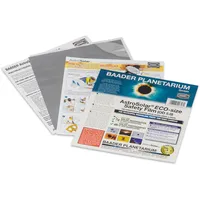
What makes this product very different from other solar filters is its use of Thousand Oaks SolarLite film, which produces a warm orange sun rather than the neutral white sun associated with Baader AstroSolar film and ND filters. It largely comes down to aesthetic preference, but the warmer tone is immediately more natural straight out of the camera.
Another advantage of Thousand Oaks SolarLite over Baader AstroSolar is that the polymer film itself is more robust. The cardboard may degrade after a few eclipses, but the polymer film is very unlikely to tear or crease, which makes it easier to travel with.

Daystar Universal Lens Filter: Performance
For eclipse photography and casual solar imaging, the Daystar filter performs very well. Mounted on a 100-400mm telephoto zoom, exposures were straightforward to manage, manual focus worked well, and the solar disk showed strong contrast with clearly defined sunspots. In some ways, the warm orange sun produced by the Thousand Oaks film is irrelevant given what can be done in post-processing, but it does save time.
One practical difference compared to Baader AstroSolar film is exposure speed. The Thousand Oaks SolarLite film produces a dimmer image, which requires slower shutter speeds under identical conditions. For example, with ISO100 and f/8, anywhere between 1/13 sec and 1/40 sec produces a terrific image, whereas it’s more like 1/500 or 1/1000 sec using Baader AstroSolar film.


If you demand fine sunspot detail and razor-sharp solar edges, choose products using Baader AstroSolar film, but only if you’re using extreme focal lengths. For anyone shooting with telephoto zooms between 70-400mm, the Daystar filter delivers more than enough sharpness for high-quality eclipse sequences, composites, and social media-ready imagery.
The filter’s practical advantages arguably outweigh its very slight optical shortcomings. Its lightweight design packs flat into a camera bag, one filter can fit several lenses, and the ability to remove it instantly during totality is so valuable.

Daystar Universal Lens Filter: Verdict
The Daystar Universal Lens Filter is not elegant, premium, or especially durable, but it succeeds brilliantly at what it’s designed to do: provide a low-cost, lightweight, and versatile way to safely photograph the sun. Its foldable cardboard design may initially feel crude compared to other products, but in real-world eclipse photography, it’s surprisingly practical. The universal fit, rapid removal during totality, and compact portability make it particularly attractive for traveling eclipse chasers using multiple lenses or telescopes. Don’t bank on its cardboard remaining intact for more than three or four trips, though the tough polymer filter itself will likely last much longer.
Sure, it offers slightly softer detail and marginally slower exposure speeds than Baader AstroSolar film, particularly at long focal lengths. But it also provides a pleasing orange rendering of the sun, saving time on post-processing. For occasional eclipse photographers, the Daystar Universal Lens Filter is easy to recommend. Just keep some masking tape in your camera bag.
Features ★★★★☆ |
The universal fit, use of trusted solar film and rapid slip-on design make this an extremely practical eclipse tool, though the basic construction limits shelf life. |
Design ★★★☆☆ |
Clever and lightweight, but ultimately still a folded cardboard holder that requires careful handling and occasional reinforcement. |
Performance ★★★★☆ |
Excellent results for casual and enthusiast eclipse photography, with pleasing warm solar rendering and dependable contrast, though Baader film remains sharper and faster for high-resolution work. |
Value ★★★★★ |
Very affordable, adaptable across multiple lenses and ideal for occasional eclipse travelers who don’t want to invest heavily in threaded solar filters. |
Alternatives