
The epic Panasonic Lumix GH7 launched in 2024 as the flagship camera Panasonic’s Lumix G range, tailored to the needs of professional videographers and content creators. As such, it uses a smaller Micro Four Thirds sensor compared to the full frame sensors in the Lumix S range, but Lumix G cameras have been around for much longer and have built up a huge fan base (me included).
The Lumix GH7 is one of the best Panasonic cameras and perhaps the ultimate Panasonic hybrid model, combining professional video capabilities with the highest 25MP Micro Four Thirds resolution yet, and exceptional image stabilization. The big news with this camera was the introduction of on-sensor phase-detect autofocus to bring it up to speed – finally – with its hybrid mirrorless rivals.
So if the GH7 is one of the best hybrid cameras on the market, which are the best lenses to use with it?
I’ve taken a few things into account with my list. The GH7 is likely to be used by pro filmmakers, so I’ve included some top-flight Panasonic-Leica lenses. But the GH7 is not particularly expensive by hybrid camera standards, so I’ve also included some relatively affordable, everyday lenses for enthusiasts. I’ve also tried to cover just about every base for focal lengths and photography genres - let's get right down to it!
Best lenses for the Panasonic Lumix GH7
Why you can trust Digital Camera World Our expert reviewers spend hours testing and comparing products and services so you can choose the best for you. Find out how we test.
Let's crack on with the best lenses for this highly desirable hybrid camera, making the most of your stills and video shooting opportunities. I'm going to start with what I think is the best kit lens option...
Best kit zoom for the Panasonic Lumix GH7

Panasonic makes two 12-60mm zoom lenses for its Lumix G cameras, but this is the premium version co-branded with Leica. Some might say that the variable f/2.8-4 maximum aperture is disappointing in a pro lens, but Leica does this a lot with its zooms so I’ve come to expect it.
For my money, this is the ideal standard zoom to get as part of a GH7 kit deal, but it’s also worth considering as a standalone purchase. I’d like to see a little better edge sharpness, but overall it's a great lens with premium build quality and a very useful 24-120mm effective zoom range. It’s also pretty light and easy to handle, so it balances very nicely on the GH7 as a do-it-all everyday lens.
See our full Panasonic 12-60mm f2.8-4.0 Leica DG Vario-Element Power O.I.S review
Best travel superzoom for the Panasonic Lumix GH7

I like the Leica DG Vario-Elmarit 12-60mm f/2.8-4 ASPH. as a premium kit lens, but if you’re looking for one lens to rule them all, the Lumix G Vario 14-140mm f/3.5-5.6 II ASPH. POWER O.I.S. takes the crown, with a 10x zoom range and remarkably compact and light design.
With any super-zoom lens you do have to accept a variable maximum aperture and some loss of sharpness at longer zoom settings, but the 14-140mm is very good for its type and not ruinously expensive, either – especially if you can get it as part of a kit. It also comes with Panasonic’s Power O.I.S. stabilization, although this matters less on the GH7, which has excellent stabilization of its own.
See our full Panasonic Lumix G Vario 14-140mm f/3.5-5.6 II ASPH. Power OIS review
Best fast standard zoom for the Panasonic Lumix GH7
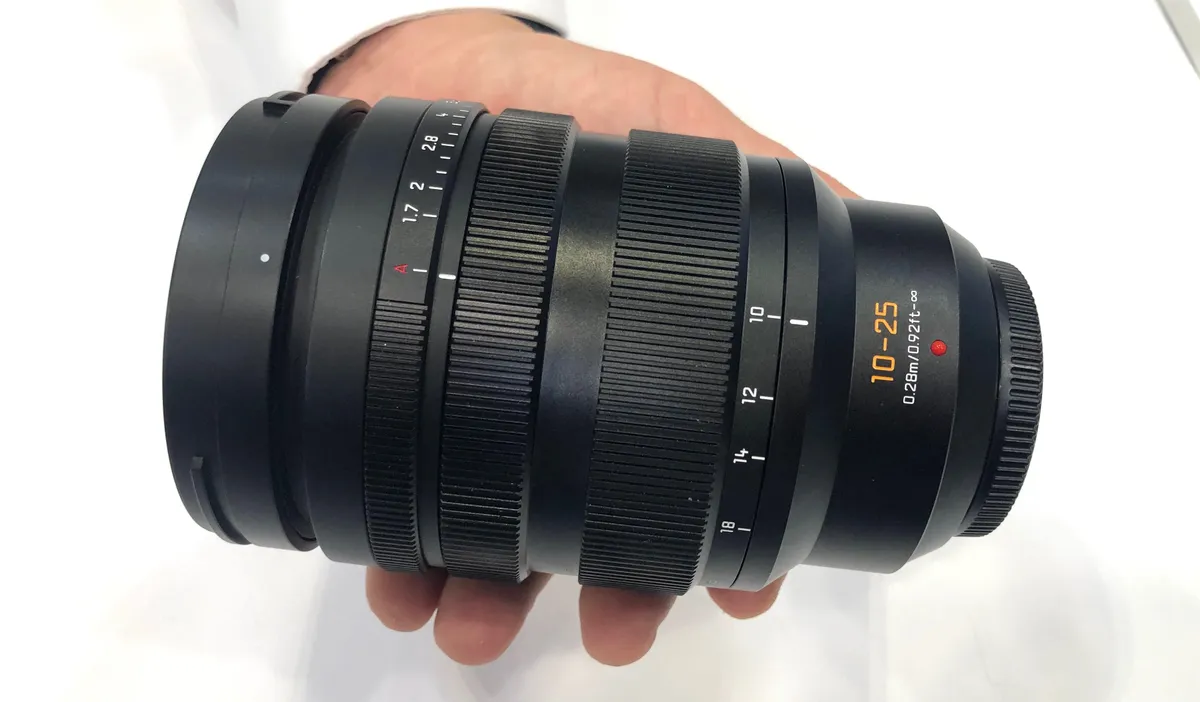
If you use the GH7 as a filmmaking tool fully rigged up with a cage, monitor, mic and all the rest, then you’re probably not going to worry about how big the lens is – which is just as well, because this one is a bit of a monster. The payback, though, is a spectacular constant f/1.7 maximum aperture and a wide-standard focal range ideal for all sorts of filming, especially interiors.
While it costs a lot more than the average Lumix G lens, the 10-25mm is not wildly expensive and a veritable bargain for a 'professional' video lens. Note that it also has a stepless aperture ring, although Panasonic didn’t go the whole hog and equip it with focus/iris gears and T-stops, so some might feel it’s not quite the full monty for a cinema lens.
See our Panasonic Leica DG Vario-Summilux 10-25mm f/1.7 ASPH hands-on review
Best value wide-angle zoom for the Panasonic Lumix GH7

Constant-aperture wide-angle zooms tend to be both big and expensive, which can cramp your style. The Lumix G Vario 7-14mm f/4 keeps both of these facotrs well in check. It’s less expensive than the Panasonic Leica 8-18mm f/2.8-4 and a good deal smaller and lighter too, so it’s an excellent ultra-wide alternative if you don’t need this focal range very often or you need to travel light.
The edge definition isn’t that great at 7mm, but otherwise the optical performance is pretty impressive and very pleasing. The front element is pretty bulbous, so the petal shaped hood is fixed in place to give physical protection. As such, it’s not a very practical lens to use filters – so it may not be ideal for classic landscape photography.
See our full Panasonic Lumix G Vario 7-14mm f/4 ASPH review
Best portrait prime for the Panasonic Lumix GH7

When I think of portrait lenses, the classic 85mm focal length springs to mind, along with a fast aperture for soft background blur and premium bokeh. Thanks to the smaller Micro Four Thirds format, the Nocticron 42.5mm equates exactly to 85mm in full frame terms, and while the f/1.2 maximum aperture won’t deliver quite the same shallow depth of field of a full frame lens, it can still create very strong subject separation with good background blur.
It’s one of Panasonic’s Leica co-badged lenses, so while it is more expensive you do get premium design and build quality – and pretty spectacular optical performance. There’s even an aperture ring – a rarity on MFT cameras – though this won’t work with Olympus/OM System cameras.
See our full Panasonic Leica DG Nocticron 42.5mm f1.2 ASPH Power OIS review
Best trinity telephoto zoom for the Panasonic Lumix GH7

Professional photographers using full frame cameras will have the holy trinity of f/2.8 constant aperture zooms, including a 70-200mm f/2.8. Indeed, I've met pro photographers who use one of these as their only zoom rather than prime lens. This is Panasonic’s equivalent, boasting the same effective focal range and maximum aperture, but at a fraction of the size and price. The MFT format does have its critics, but the smaller size and lower cost of professional-quality lenses is often overlooked.
This lens isn’t just small, it has a neat and unfussy design which makes it easy to stow in a small corner of your camera bag. You don’t get a customizable control ring or focus hold button, for example, so it is a bit plain and the bokeh quality isn’t absolutely the best – but the size and the price are very compelling.
See our full Panasonic Lumix G X Vario 35-100mm f/2.8 II Power OIS review
Best telephoto power zoom for the Panasonic Lumix GH7

Top quality telephotos don’t come cheap, even in the Micro Four Thirds world, so the PZ 45-175mm f/4-5.6 ASPH. is interesting for all sorts of reasons. First, it offers huge telephoto reach for such a small lens and, second, it doesn’t cost much. The third feature that might tempt GH7 owners in particular is its power zoom lever. It’s a filming technique that can sometimes be overused and isn’t always easy to get right, but if live zooms are part of your filming style, then a PZ lens is practically a must.
The optical performance is good rather than entirely great (as reflected in the price) but this is another handy little lens to keep in your bag in case you need it.
See our full Panasonic PZ 45-175mm f/4-5.6 Power OIS review
Best super-telephoto zoom for the Panasonic Lumix GH7

Do you do any wildlife filmmaking or photography? Want to give it a try? The Vario-Elmar 100-400mm f/4-6.3 gives you an effective focal range of 200-800mm, which is huge. The downside is that you are stuck with a relatively limiting f/6.3 maximum aperture at full zoom and, like most consumer telephotos, this one starts to lose a little sharpness at longer focal lengths.
However, you should take into account the size, cost and zoom range of this lens and the fact that professional supertelephotos cost, very literally, ten times more to buy. You get a focus limiter for faster AF on subjects more than 5m away, and optical stabilization too. Optical stabilization can pay dividends in long telephoto lenses, desptie the GH7 having IBIS of its own.
See our full Panasonic Leica DG Vario-Elmar 100-400mm f/4-6.3 Asph Power OIS review
Lab data and comparisons
The graphs below show the comparative performance of the lenses in this guide, based on our in-house lab tests. Surprisingly, of the lenses we’ve been able to lab-test, the Panasonic Lumix 7-14mm f/4 ASPH leads the way in terms of sharpness, which is no mean feat for such an ultra-wide-angle lens. The Panasonic Lumix 14-140mm f/3.5-5.6 II OIS comes bottom in the group, which is fairly typical for a 10x ‘superzoom’ lens.
Scores for sharpness and color fringing are averaged from data taken across the entire image frame, from the center to the edges and corners, throughout the aperture range. For zoom lenses, the scores are also averaged from data measured at all marked focal lengths, and the same applies to distortion.
Bear in mind that these average values don't fully reflect specific areas of performance. For example, a zoom lens might have noticeable barrel and pincushion distortion at its shortest and longest focal lengths respectively, which tends to average out when looking at the data overall. For more detailed graphs of each lens's performance, which give the full picture, check out the graphs in our full standalone lens reviews.
Also see our guide to the best Micro Four Thirds lenses

