
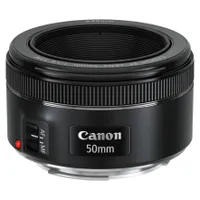
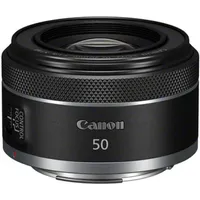
It's a question that has been asked ever since Canon moved to mirrorless: should you use DSLR glass on your mirrorless camera, particularly when the DSLR versions are so much cheaper? A good case in point is the Canon RF 50mm f/1.8 vs Canon EF 50mm f/1.8.
During Amazon's latest sale, for example, the Canon EF 50mm f/1.8 has been slashed to just £89 in the UK. Meanwhile the mirrorless equivalent, the Canon RF 50mm f/1.8, is discounted to £165.
That's massive difference. And spoiler alert: at £89 the EF lens is so ridiculously well-priced that anybody who doesn't own a nifty fifty should definitely buy it. But what are the pros and cons of doing so?
Obviously the first thing to consider is whether or not you have a lens adapter. A cheap third-party one (which I wouldn't recommend) is as little as £35, while the official Canon adapter (which I own and use) is £119. Either way, if you have to buy one to save money on an EF lens, it's probably false economy.
That aside, what are the real talking points when it comes to the Canon RF 50mm f/1.8 vs EF 50mm f/1.8?
Canon RF 50mm f/1.8 vs EF 50mm f/1.8: What are the differences?

If you have the opportunity to try and compare the lenses for yourself, that's the best way to see what the differences really are.
Shy of that, I can tell you my personal experience as someone who owned and used the Canon EF 50mm f/1.8 STM (review here) for years on DSLRs, before upgrading to the R System and adapting it on mirrorless cameras.
Using it with Canon's Mount Adapter EF-EOS R, you get absolutely native performance when it comes to things like autofocus speed. I know that in years past, adapting lenses has been a bit of a minefield in terms of functionality – but with the official Canon adapter, the EF 50mm performs absolutely flawlessly on any EOS R camera.
Ultimately I upgraded to the Canon RF 50mm f/1.8 STM (review here), mainly to achieve a smaller footprint. The mount adapter works brilliantly, but it adds an extra inch or so to the front of your camera. So that was my main reason for moving to the RF version of the lens.
In and of themselves, the lenses are about the same size – so neither one really takes up any more or less space in your camera bag. The RF lens is sleeker and prettier, while the EF feels a bit more plasticky, but otherwise there's no size saving either way.
In terms of pure image quality, I don't think anyone could tell the difference. I look back at shots in my portfolio and, without looking at the EXIF, even I can't tell them apart. The RF lens is sharper across the frame while pixel peeping, but it's not a profound difference.

Optically, both the EF and RF versions render similar results – the f/1.8 designs are built for economy, not performance (for that, you'll need to look to the f/1.4 and f/1.2 models). But unless you're zooming into all your shots at 200%, you won't notice much difference.
When it comes to focusing speed, here there is a difference. Both lenses feature stepper motors (the "STM" in the name), but the EF version is slower and noisier.
Factor in that the EF mount only has eight electronic contact points, compared to the twelve on the RF mount, and the mirrorless version communicates faster and keeps up better when it comes to movement and subject tracking.
However, I don't think anyone is really using these lenses for fast action or sports – so the speed difference will be minor or even unnoticable to most people.
In truth, the only real difference in practice is that the RF lens has a customizable control ring on the nose. This can be toggled via a switch to act as a manual focus ring or to adjust exposure values such as ISO. It's not something I really use on any of my RF lenses, but it might be a consideration for some.
By contrast, the switch on the EF lens toggles between auto and manual focus; to do this on the RF version, you need to go into menus and make the change in-camera. So if you're someone who likes to snap into manual for fine focusing, this might also be a deal maker / breaker.
Canon RF 50mm f/1.8 vs EF 50mm f/1.8: Which should you buy?

As noted, I upgraded from the EF version to the RF version specifically to reduce the size (by removing the adapter from the equation). Yes the lens is slightly sharper and a fair bit snappier to focus, but in real-world use neither of those have been a factor.
Truth be told, if I was buying a nifty fifty today and looking at £89 for the EF lens and £165 for the RF, I would buy the DSLR version in a heartbeat. The price saving outweighs the performance benefits.
On top of that, the RF lens only works on my mirrorless cameras but the EF one works on my DSLRs as well. So in that sense, the EF is a much more versatile option.
If you want a really noticeable performance boost on your mirrorless camera, you're looking at the Canon RF 50mm f/1.4L VCM (or even the Canon RF 50mm f/1.2L USM). Pound for pound, though, I suggest saving some cash and getting yourself the EF lens.
Get a Prime Day discount
You might also like…
Take a look at the best Canon RF lenses of all focal lengths, along with the best 50mm "nifty fifty" lenses from all brands.

