
If you don't have the best memory card for your camera, then you're not going to get the most out of your photoshoots. With so many options for speed, capacity, brand, compatibility, and price available, you might initially feel overwhelmed. However, we've broken down the best memory cards available to show you which ones are best for you.
When you think of a memory card, you'll likely find that the popular SD card format comes to mind. However, if you're using a newer camera, or one of the best professional cameras, then you'll likely need to look for a CFexpress card. However, Compact Flash, microSD and CFast cards are still all in use by some cameras as well.
One of the most obvious ways to differentiate between memory cards is how much storage they have. A 32GB card might be fine for an afternoon wandering around your local wildlife reserve, but videographers looking to shoot all day could get frustrated with having to constantly swap over cards.
However, this isn't the only way to judge what memory card is best, as you'll also need a card with fast read and write speeds. This will not only affect how quickly you can transfer images from the memory card to your computer (or one of the best portable hard drives), but it will also impact the burst mode on your camera. If your memory card isn't fast enough, you'll find that it will lag and struggle to accomplish the blisteringly-fast shooting speeds that some of the latest cameras are capable of.
Read more: How to understand everything written on your memory card
If you're still not quite au fait with all of this technical lingo, then don't worry. We've put together a handy jargon explainer at the bottom of this article to help you find the best memory card for your needs.

Ben is the Imaging Labs Manager, responsible for all the lab testing of cameras and lenses on Digital Camera World. Whether he's in the lab testing the sharpness of new lenses, the resolution of the latest image sensors, the zoom range of monster bridge cameras or even the latest camera phones, Ben is our go-to guy for technical insight. His expertise also extends to computing, with extensive knowledge of the latest laptop and desktop computers, as well as monitors, external storage and memory cards.
The Quick List

If you're a photo enthusiast passionate about your hobby, then you could do worse than picking up the Extreme PRO SDXC card from industry stalwart SanDisk.

This microSD card from a respected brand boasts read/write speeds fast enough for most needs, as well as lots of capacity options. It's good value, too, making it a great all-rounder.

With super-fast speeds across the board (including sustained write speed), this Type B card is a force to be reckoned with.


If you're still using CompactFlash with your trusty DSLR, this SanDisk card is both rapid and available in plenty of capacities for stills or video.

If your main game is filmmaking then this is the card of choice for professional cinema video cameras from the likes of Canon, Arri, and BlackMagic.
The best memory card for your camera
Why you can trust Digital Camera World Our expert reviewers spend hours testing and comparing products and services so you can choose the best for you. Find out how we test.
SD
The postage stamp-sized SD card is the format used by most digital cameras. SD has largely succeeded CompactFlash, although the latter is still popular in some older pro DSLRs. Most card manufacturers offer ranges that give you a choice of SDHC and SDXC, which both broadly do the same thing, just at slightly differing speeds and capacities. You'll find a more detailed explanation of this below. The best memory card for your needs will depend largely on how you want to balance capacity, speed and cost.

If you're a photo enthusiast passionate about your hobby, then you could do worse than picking up the Extreme Pro SDXC card from industry stalwart SanDisk. This unassuming card is one of the best SD memory cards you can choose, with capacities ranging from 32GB to a staggering 1TB and an impressive UHS Speed Class 3 rating.
However, the most impressive aspect of the Extreme PRO SDXC card is its write speeds of up to 90MB/s, which allows your camera to handle rapid-fire sequential shooting in both JPEG and RAW with ease. Meanwhile, its rapid 200MB/s read speed is perfect for a refreshingly fast workflow.
Aside from capturing Raw photographs, the data crunching on offer with this memory card also makes it suitable for 4K video capture. In short, this is a great, reliable all-rounder – and its price makes it hard to beat.

Lexar has long been a go-to card brand for photo enthusiasts, with this pro card being top of the tree for us, deploying UHS-II tech to enable read speeds up to 300MB/s and 260MB/s write speeds. In our testing we recorded respectable 171MB/s read and 255MB/s write speeds - very impressive.
So whether you’re shooting Full HD, 4K video, or high-resolution Raw files, this card is eminently suitable. It never faltered during our review, producing no unexpected interruptions during intensive stills or video recording.
Read the full Lexar Professional Class 10 UHS-II 2000X review
Lab results |
Score |
Rating |
|---|---|---|
Read speed |
171MB/s |
★★★ |
Write speed |
255MB/s |
★★★★ |
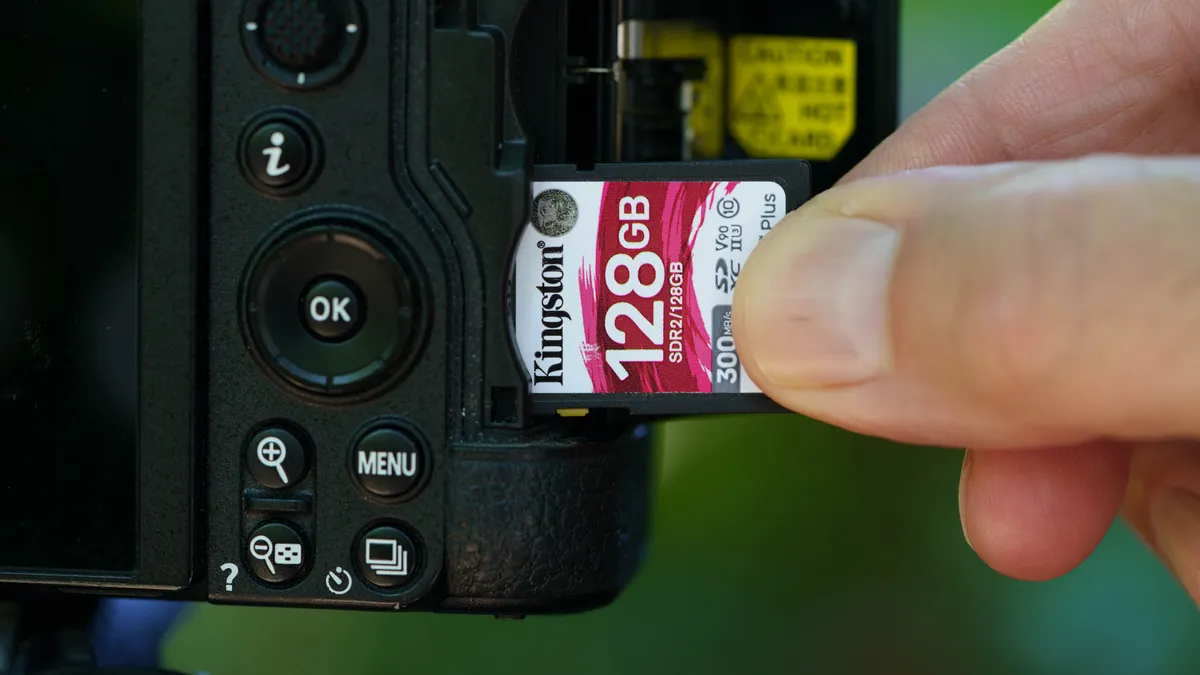
Kingston's range of memory cards isn't quite as large as some rival brands offer, containing only three SD card series and three microSD series. The Canvas React Plus series is the top tier of Kingston's SD cards and includes 32GB, 64GB, 128GB and 256GB capacity options.
During out extensive testing of the 128GB Kingston Canvas React Plus SD card, we found it to be totally reliable. Even when used in a high-resolution camera like our 45.7MP Nikon Z7 II at its fastest rate (10fps) and when shooting 4K video, the card performed flawlessly. We even tried recording some 8K video and the Canvas React Plus still held its own, though it won't handle the most demanding formats like 8K raw.
Read our full Kingston Canvas React Plus SDXC UHS-II review for more details
Lab results |
Score |
Rating |
|---|---|---|
Read speed |
249MB/s |
★★★★ |
Write speed |
204MB/s |
★★★★ |

PNY offers four distinct SD card series, with the X-Pro 90 SDXC UHS-II being the flagship model. It's available in three capacities: 64GB, 128GB and 256GB, with impressive maximum advertised read/write speeds 300MB/s and 280MB/s, respectively.
The card's V90 speed rating signifies that it's capable of a minimum 90MB/s write rate, making it suitable for recording 4K video and even low bit-rate 8K video, along with high-res stills at fast burst shooting speeds.
When we reviewed the X-Pro 90 SDXC UHS-II, we found it produced some of the best figures we've ever recorded from an SDXC card in software benchmarks, and it was super-fast when transferring images to a computer. In our real-world camera testing, the card also demonstrated excellent in-camera burst depths.
Read our full PNY X-Pro 90 SDXC UHS-II review for more details
Lab results |
Score |
Rating |
|---|---|---|
Read speed |
252MB/s |
★★★★ |
Write speed |
216MB/s |
★★★★ |

Offering read speeds of up to 300MB/s and write speeds of an equally impressive 260MB/s, this SanDisk UHS-II SD card is a top dog among memory cards. This spec makes it the best memory card for sports, wildlife, and news photographers, shooting bursts of rapid-fire stills, or videographers recording the moment in eye-popping clear 4K resolution.
When we tested the 64GB version of the SanDisk Extreme PRO 300MB/s SDXC UHS-II card, we found it delivered a respectable performance in our software speed test and returned good transfer rates.
However, when we inserted the card into our Nikon Z 7II test camera, it couldn't quite match the burst depths we achieved from some rival cards. Many photographers will be unaffected by this, but it could be a deal-breaker for avid sports and action photographers.
Read our full SanDisk Extreme PRO SD UHS-II review for more details
Lab results |
Score |
Rating |
|---|---|---|
Read speed |
252MB/s |
★★★★ |
Write speed |
207MB/s |
★★★★ |

Thought all SD cards were basically the same little plastic slivers, just with different speed and capacity options? Think again. With its Armor Gold card, Lexar has reinvented the humble SD card to be 37x tougher than a regular SD card, all thanks to its stainless steel construction.
Sounds like marketing hyperbole, but we've thoroughly tested Lexar's toughness claims, and the results were pretty amazing. Even with the weight of four house bricks concentrated across the center of the card, the Armor Gold barely bent. Immersion in water, extreme temperature, drops - it's no concern for this SD card. Even little things, like the write-protect switch, and ribs between the electrical contacts, have been removed, all in the name of increasing sturdiness.
It's not just ruggedness where this card impresses - transfer speeds are also respectable, at 280MB/s read and 205MB/s write. We couldn't quite match these, as our testing recorded 250MB/s read and 191MB/s write speeds, but they're still impressive results.
If your data is precious, or if you regularly shoot in adverse conditions where there's a real possibility of card damage, paying a little extra for an Armor Gold card is well worth it for peace of mind.
Read our full Lexar ARMOR GOLD SDXC UHS-II memory card review for more details
| Header Cell - Column 0 | Read (peak) |
Write (peak) |
|---|---|---|
Large single file |
236.7 (246) MB/s |
174.6 (181) MB/s |
Multiple small files |
231.6 (241) MB/s |
155.7 (165) MB/s |
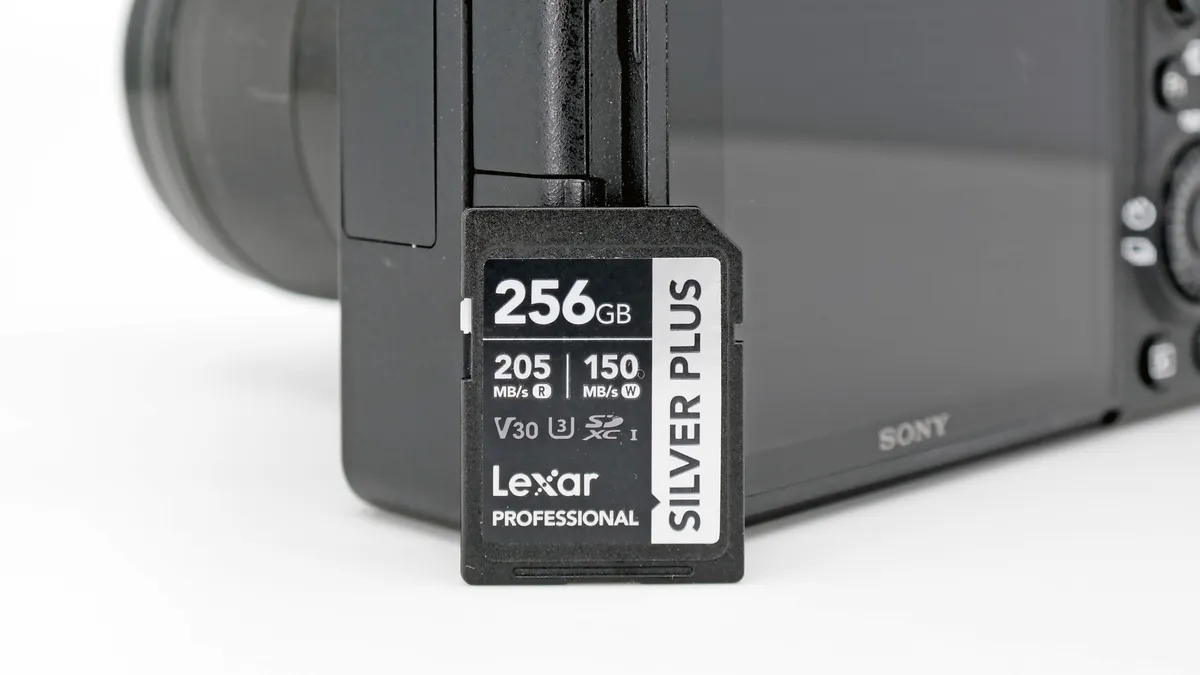
Lexar offers three tiers of Silver-series SD cards: Silver, Silver Plus, and Silver Pro. This Plus mid-range offering may be a 'standard' UHS-I SD card, but with 255MB/s read and 180MB/s write speeds, it'll give premium UHS-II cards a run for their money.
We tested an early generation of Silver Plus card rated for 205MB/s read and 150MB/s write speeds. Our real-world file transfer testing recorded 156MB/s read and 135MB/s write speeds - not quite up there with Lexar's advertised read speed, but still comfortable fast enough for working with uncompressed RAW files or high bit rate 4K video.
Factor the Silver Plus' decent range of capacity options (which tops out at 1TB), along with the cards' keen pricing, and this is a great all-round choice.
Lexar Professional Silver Plus full review
| Header Cell - Column 0 | Read |
Write |
|---|---|---|
Large single file |
156MB/s |
135MB/s |
Multiple small files |
142MB/s |
132MB/s |

If you’re shooting raw files you want a card that can handle sequential bursts of the highest quality imagery, as well as a capacity that allows for sufficient storage to avoid having to swap cards every five minutes.
With blisteringly swift read and write times of 285MB/s and 180 MB/s respectively, the Transcend SDXC UHS-II U3 has enough speed for recording high bit rate 4K video, or for capturing long bursts of raw files. Where most SD cards have V30 or V60 video speed ratings, this Transcend offering boasts a rare V90 certification, which means it can sustain at least 90MB/s write speed during video recording.
In our testing we recorded an even higher maximum read speed of 304MB/s in benchmarking software, and an equally impressive 193MB/s peak write rate. Real-world speeds were a little less as they always are, but this is still one of the fastest UHS-II SD cards you can buy.
The only downside is the relative lack of capacity options. Just 32GB and 64GB versions are available, which will soon fill up when recording the high resolution content this card is designed for.
| Header Cell - Column 0 | Read (peak) |
Write (peak) |
|---|---|---|
Large single file |
265 (274) MB/s |
164 (177) MB/s |
Multiple small files |
252 (260) MB/s |
132 (151) MB/s |
microSD
Smaller cameras like action cams use the microSD format, as well as drone, smartphones and tablets. Technically, it's just the same as the SD format, with similar capacities and speed ratings, just in a much smaller form.
See also Best microSD cards

This decent little microSD card is available at a really competitive price, and it boasts respectable 205MB/s read and 150MB/s write speeds, despite it not having the faster UHS-II transfer standard. Chose from 64GB, 128GB, 256GB, 512GB and 1TB capacities, though the 256GB card is the best value, offering the lowest price per gigabyte.
We've tested the entry-level 64GB capacity card, which has slightly slower write speed rating than the other available capacities (100MB/s, vs 150MB/s for the 128GB-1TB cards). However, our benchmarking app revealed even this base-capacity card is capable of a 143.64MB/s max write speed, and real-world transfer seeds proved to be almost as quick.
| Header Cell - Column 0 | Read (peak) |
Write (peak) |
|---|---|---|
Large single file |
153 (157) MB/s |
131 (135) MB/s |
Multiple small files |
152 (157) MB/s |
126 (131) MB/s |

This SanDisk microSD card strikes the right balance of good-enough performance at a reasonable price. Its 190MB/s maximum read speed is excellent for a UHS-I card, and though write speed is rated less - 130MB/s - it should cope with the vast majority of use cases. Hitting the A2 criteria is great news for phone users, as it means quicker app loading times, while the V30 rating guarantees a minimum 30MB/s write speed, enabling 4K video recording, albeit at lower bit rates.
We were sent the 64GB version to test. It has slower 170MB/s read and 80MB/s write speeds, though it's still V30 rated. We recorded a good maximum read speed of 167MB/s, though peak write speed was a little slower than advertised at 67.5MB/s.
The 64GB card we tested proved to be respectable, but we'd recommend going for the 256GB version, as it costs less per gigabyte and gives you more speed.
| Header Cell - Column 0 | Read (peak) |
Write (peak) |
|---|---|---|
Large single file |
149 (159) MB/s |
64 (67) MB/s |
Multiple small files |
137 (144) MB/s |
46 (51) MB/s |

If you need maximum capacity from your microSD card, the PNY Pro Elite Prime is for you. The range-topping 1.5TB version we've tested gives you more storage space than most full-size SD cards, let alone microSD cards! You also get high speed as well as high capacity, with read speeds topping out at 200MB/s, and write speeds of up to 150MB/s.
Our testing revealed PNY's write speed claim to be spot-on, and though we couldn't quite match the quoted 200MB/s read rate, the 174MB/s we recorded is still one of the fastest UHS-I microSD read speeds we've encountered. An A2 app loading speed rating also makes this card a good choice for supplementing your phone storage.
But if you're thinking about getting the 1.5TB flagship card, be careful: not all phones support microSD cards over 1TB, and very few dash cams do.
• Read our full PNY Pro Elite Prime microSDXC review
| Header Cell - Column 0 | Read |
Write |
|---|---|---|
Large single file |
171MB/s |
142MB/s |
Multiple small files |
168MB/s |
136MB/s |
CFexpress Type B
CFexpress is now the memory card format of choice for high-end stills and video cameras. Evolving from the XQD card format, CFexpress Type B cards share the same outer design as XQD cards, but pack faster memory inside, making them some of the fastest memory cards available today. Almost all cameras that originally supported XQD cards have now been firmware-updated to also work with CFexpress Type B cards, so cameras like the Nikon Z6 and Z7 are no longer restricted to XQD cards alone.
CFexpress Type A cards are physically smaller than the Type B standard, and therefore you can't use a Type A card in a camera designed for XQD/CFexpress Type B cards. You wouldn't really want to though, as the drawback of CFexpress Type A's compactness is a reduction in read/write speed, compared to Type B cards. Currently only full-frame Sony cameras utilize CFexpress Type A cards, most notably the Sony A7R VI, A1 II and a9 III.
• See also Best CFexpress cards

Lexar Professional CFexpress GOLD Series Type B cards can be had in capacities from 128GB all the way up to a huge 4TB. All capacities use the fastest CFexpress 4.0 standard, so are capable of blistering 3600MB/s read speeds and equally impressive 3300MB/s write performance. Sustained write speed, which is particularly important when shooting high bit-rate video at 4K or higher, is rated at 3000MB/s, which is incredibly quick. Just be aware that the 128GB and 256GB cards are only rated at 1000MB/s for sustained write speed.
We've reviewed a slightly older version of the Lexar Professional Gold Type B card. Despite having slower read/write speeds than the latest CFexpress 4.0 variant here, it had no trouble recording uncompressed 4K video footage during our testing. With so much extra performance potential from this CFexpress 4.0 card, you should stay future-proofed for years to come.
Read our full Lexar Professional CFexpress Type-B Card review
| Header Cell - Column 0 | Score |
Rating |
|---|---|---|
Read speed |
1691MB/s |
★★★★ |
Write speed |
1388MB/s |
★★★★ |

Delkin Device’s Black CFexpress Type B 4.0 cards are a bit more expensive than some of the competition, but if one should fail, a replacement card is promised within 48 hours, without you first needing to return the faulty card - reassuring.
Performance slightly varies depending on the capacity you choose, but all are capable of maximum transfer speeds of at least 3530MB/s read and 3200MB/s write. A minimum sustained write speed of over 2000MB/s also makes Delkin Black cards ideal for 8K, 6K and 4K raw video recording.
The latest Black-series cards (the 512GB, 1TB and 2TB versions) also boast VPG400 certification, meaning they're guaranteed to sustain at least 400MB/s when recording video, but the slightly older 3256GB, 650GB and 1.3TB capacities should also be similarly quick.
Read our full Delkin Devices Black CFexpress Type B 4.0 review
| Header Cell - Column 0 | Score |
Rating |
|---|---|---|
Read speed |
2562MB/s |
★★★★★ |
Write speed |
1695MB/s |
★★★★★ |
CFexpress Type A

CFexpress Type A cards are predominantly used by high-end Sony cameras, but the Type A memory card market is rapidly expanding, with new cards regularly being launched.
This Lexar offering is built to the latest CFexpress 4.0 standard, so it's twice as fast as the first generation of Type A cards. That means read speeds of up to 1800MB/s, an impressive 1650MB/s max write speed, plus a 1400MB/s sustained write rate - just the ticket for smooth 8K video recording.
This Type A card is also built to last, being temperature-proof, vibration-resistant, IP68 dust- and water-proof, 5m drop-proof, shock-resistant, bend-resistant, and 150N pressure-proof.
Capacity options range from 256GB up to a whopping 2TB, though you'll only get the aforementioned 1400MB/s sustained write speed with the 640GB capacity or above - the 256GB and 512GB versions can 'only' manage 1000MB/s sustained write speed.
Read our full Lexar Professional GOLD CFexpress 4.0 Type A card review
| Header Cell - Column 0 | Score |
Rating |
|---|---|---|
Read speed |
1688MB/s |
★★★★ |
Write speed |
1545MB/s |
★★★★ |
CompactFlash
There are still lots of cameras around that use the Compact Flash format, and it gets plenty of support from memory card makers. The new and upcoming formats for pro cameras are XQD, CFexpress and CFast (all listed further down), but the Compact Flash memory card format looks like it will be around for a while yet.

CompactFlash may be old school, but there’s nothing nostalgic about the SanDisk Extreme PRO CompactFlash’s 160MB/s read speed. It's also physically large by current memory card standards, but that doesn't mean CompactFlash can't pack enough capacity and speed to satisfy today’s DSLR users.
The SanDisk range offers capacities from a useful 16GB, up to 256GB, so you don’t have to keep swapping cards in the heat of the action. A write speed of up to 140MB/s at maximum 256GB capacity also impresses (and it's an even faster 150MB/s for the 128GB and lower capacities), making it eminently suitable for Full HD video capture. Its minimum sustained write speed of 65MB/s is even class-leading.
CFast
CFast is a high-speed memory card that looks very similar to CompactFlash. The CFast format is used mostly by high-end video equipment, such as professional cinema video cameras from Canon, Arri and BlackMagic. In terms of stills cameras, this type of card is currently only used in the Canon EOS 1-D X Mark II and Hasselblad H6D-100C. Here are the best CFast cards on the market right now:

Lightning fast transfer speeds make CFast perfectly suited to 4K video shooting. SanDisk are the ones to watch in this format, and this most-recent version of its CFast card offers a staggering write speed of 525Mb/s, along with an admirable 400 Mb/s read speed.
How to choose
The best memory cards demystified
It's worth remembering that, despite the wide variety of memory card formats, you don't actually need to worry about what type you should use. This is because this decision will have already been made for you by the camera manufacturers. This means that you're not going to be able to use a CFexpress card in a camera with a microSD card slot! However, it's still worth knowing what the benefits and drawbacks of each memory card format are.
SD
While SD cards might immediately come to mind when you think of memory cards, standard SD (Secure Digital) cards are actually no longer manufactured. This is because the technology has moved onto SDHC and SDXC cards, which are readily available. If you have some old SD cards knocking around, you can still use them in newer cameras that have the SD card format, but don't expect the same performance or capabilities offered by newer memory card generations.
SDHC
As an upgrade to the standard SD card, SDHC (Secure Digital Extended Capacity) cards offer memory capacities between 4GB and 32GB. This makes them great for everyday use and entry-level users who don't have large storage capacity needs.
SDXC
You'll find SDXC (Secure Digital Extended Capacity) cards with capacities of 64GB and over. Designed for cameras with large sensors, lots of megapixels, 4K video and other data-intensive applications, serious photographers and videographers will want to choose an SDXC card over SDHC. However, don't forget to check the read and write speeds to ensure you get the performance you need. To get a better understanding of these, read our article on understanding everything written on your memory card
microSDHC and microSDXC
microSDHC and microSDXC cards will offer a similar performance to their larger SDHC and SDXC siblings. However, they're around a third of the size and can be used in the best camera phones and best action cameras.
CFexpress
As an evolution of the XQD format, CFexpress is one of the best memory card formats around. However, it's currently only available with a limited number of high end cameras (mostly from Canon, Nikon and Panasonic). However, it's worth noting that the release of the Sony A7S III brought a somewhat confusing split into two different variants of CFexpress cards. Up until this point, all CFexpress-compatible cameras used CFexpress Type B cards (yes, 'B' does come before 'A' in this case!). Meanwhile, CFexpress Type A cards are smaller and slower. Crucially, Type B and Type A cards aren't interchangeable, so a camera such as the Nikon Z7 II won't be able to accept a CFexpress Type A card.
CompactFlash
CompactFlash used to be the preferred format for higher-end DSLRs. However, with the improved performance of SDHC and SDXC cards (and the introduction of newer memory card formats as well), this memory card format is growing more rare.
CFast
While CFast cards look similar in size and shape to CompactFlash cards, they're not compatible (so don't try to jam one in your old DSLR!). This high-speed memory card format will be found in some professional stills and video cameras.
Read more: How to understand everything written on your memory card
How we test
Where possible, at DCW we test memory cards in the field as well as subjecting them to benchmarking tests in order to verify a manufacturer's speed claims. We will set our host camera to its fastest burst shooting speed and highest video quality in order to see how a memory card handles the toughest possible stills and video scenarios. Our preferred memory benchmarking apps are Blackmagic Design Disk Speed Test and CrystalDiskMark, which give us a good numerical indication of the maximum read and write speeds that a card is capable of. We then weigh the performance results against a card's asking price to determine whether it represents good value.
Find out more about how we test and review on Digital Camera World.
