





Fisheye lenses were invented to enable meteorologists to keep a watch on the weather, capturing the whole sky with their 180º field of view. As a creative spin-off, these oddball scientific lenses soon found favor with more adventurous photographers. By taking advantage of that extreme viewing angle, fisheye lenses can give a whole new look and feel to your creative photography.
Even the widest of regular wide-angle lenses can't compete with the aesthetic of a fisheye lens. Whereas regular wide-angle lenses have a rectilinear design that aims to minimize distortion, the curvilinear nature of fisheye lenses produces extreme barrel distortion, giving images a bold and unique look.
Nowadays, fisheye lenses have grown popular for underwater shooting, extreme sports, astrophotography and even creating virtual environments. But what are the best fisheye lenses? The first thing you need to realize is that there are two main types of fisheye lenses: full-field diagonal fisheyes and circular fisheyes.



Diagonal fisheyes (also sometimes confusingly called ‘full-frame’ fisheyes) produce an image circle that’s large enough to cover the entire image sensor. Whether designed for a full-frame or crop sensor camera, the resulting image has a regular, full-sized rectangular shape. However, it only gives a 180-degree viewing angle when measured on the diagonal of the frame.
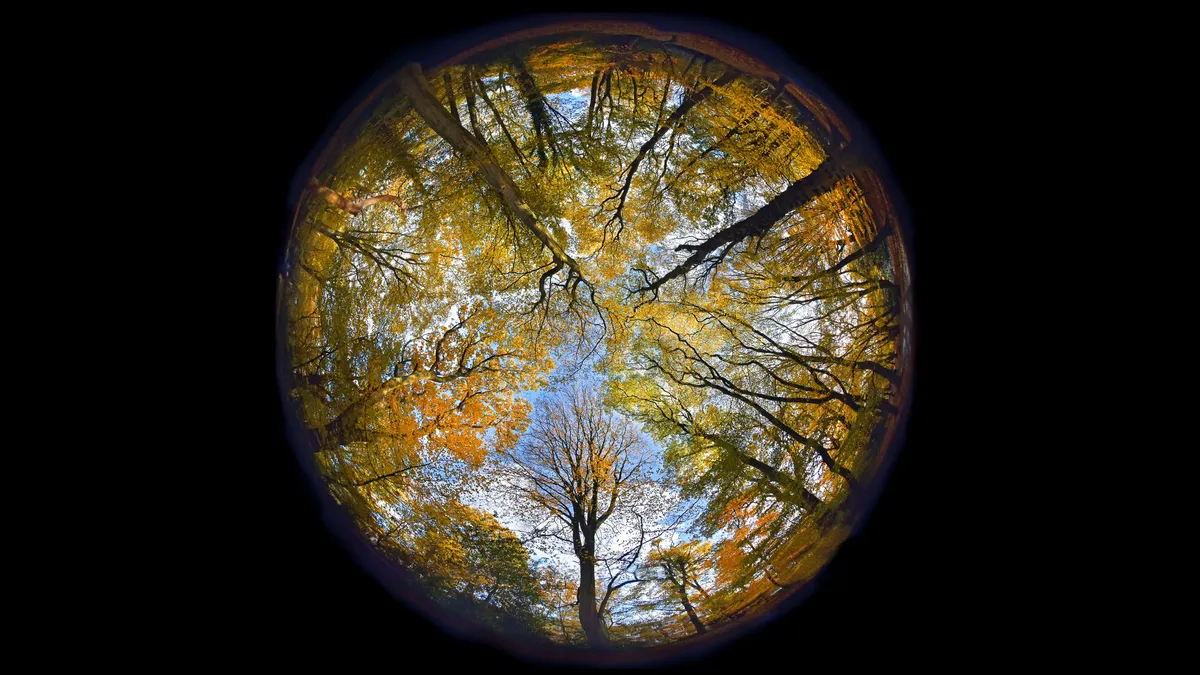
Circular fisheyes produce a smaller image circle that fits within the boundary of the image sensor. In this case, you end up with a smaller, circular image but with an even wider viewing angle, equating to a full 180 degrees in both vertical and horizontal planes.
Most fisheyes are primes, but there are also fisheye zooms, some of which transform from a circular to a diagonal fisheye at the short and long ends of the zoom range, respectively. Let's take a closer look at the bigger picture…

Matthew Richards is a photographer and journalist who has spent years using and reviewing all manner of photo gear. He is Digital Camera World's principal lens reviewer – and has tested more primes and zooms than most people have had hot dinners! In this guide, he has selected the best-buy fisheye lenses for a variety of different camera systems.
The best fisheye lenses
Why you can trust Digital Camera World Our expert reviewers spend hours testing and comparing products and services so you can choose the best for you. Find out how we test.
Best fisheye lens overall


I’ve seen some seriously small fisheye lenses over the years; they tend to be very much more compact and lightweight than rectilinear ultra-wide-angle prime and zoom lenses. This one is a comparative heavyweight, however, and comes complete with a tripod mounting ring that has an Arca-Swiss profile. I like that this ring is completely removable, and the lens comes with a rubber band that you can slip in its place, making it better suited for handheld shooting.
The optical design is relatively complex for a fisheye lens, based on 21 elements arranged in 15 groups. To boost performance, the optical path includes three SLD (Special Low Dispersion) elements and four top-grade FLD (‘Fluorite’ Low Dispersion) elements. The lens is also uncommonly fast for a fisheye, with an f/1.4 aperture. It's a seriously pro-grade lens with top build quality and performance – and a price tag to match.
See our full Sigma 15mm f/1.4 DG DN Diagonal Fisheye Art review
Best Canon fisheye zoom lens


Canon rewrote the fisheye rulebook back in 2011, with the launch of the Canon EF 8-15mm f/4L Fisheye USM. This amazing zoom lens was a world-first, in that it delivered a circular fisheye effect at its shortest zoom setting, turning into a diagonal fisheye at the long end. It was literally two fisheye lenses in one. That lens is now obsolete but has been replaced by the equivalent RF 7-14mm zoom, bringing the same 2-in-1 advantage to Canon’s R system cameras in a native mount lens.
The new RF lens is much more than just the old DSLR lens with an RF mount on it. The new version delivers better image quality, a faster aperture and a more extreme field of view, packed into a lighter build. It also brings the possibility of easily converting your imagery into 180-degree VR content.
Build quality is up to Canon’s typically epic standards for its L-series RF lenses, and the same goes for handling. I like that the lens has a detachable hood, which you can fit for minimizing ghosting and flare in diagonal fisheye shots, but naturally need to remove for circular fisheye shots.
Further handling extras include an AF/MF focus mode switch and a customizable function button. There’s also a Limit switch, which can lock the zoom ring at any position. The zoom ring comes complete with a 'C' marking to indicate where the lens achieves full diagonal fisheye coverage if you’re using it on an APS-C format R system camera body.
See our full Canon RF 7-14mm f/2.8-3.5L Fisheye STM review
Best value fisheye zoom


Taking its cues from Canon and Nikon DSLR lenses of a while back, I love that the Laowa 8-15mm f/2.8 FF Zoom Fisheye keeps my creative options fully open. That’s because it works as both a circular and diagonal fisheye lens, requiring just the twist of its zoom ring to switch between the two. I also like the fairly fast f/2.8 aperture, which is a real bonus for indoor and low-light shooting.
There’s no autofocus, but I don’t care – the depth of field is so vast that manual focusing is a doddle. However, with no electronics onboard, you also need to set the aperture manually, and there’s no lens-based EXIF data stored in images. That’s the same with all fully manual lenses, so I’m not the least bit surprised.
Considering that the Laowa is essentially two lenses in one, it’s terrific value at the price. Even more so, as image quality is very satisfying and handling feels really good. A further bonus is that, unlike independently manufactured autofocus lenses, this manual lens is available in the Canon RF mount, as well as Nikon Z, Sony E, and L-mount.
See our full Laowa 8-15mm f/2.8 FF Zoom Fisheye review
Best value fisheye for full-frame mirrorless


Who says a new lens has to break the bank? You can pick up this diagonal fisheye at a bargain price, yet still get the same bulging fisheye wow factor as you'd get from a much pricier optic. So what's the catch? Well, predictably, this is a fully manual lens, meaning you'll need to focus manually and set your aperture manually, as there are no electronic contacts to transmit exposure metering information.
However, this needn't be a deal breaker, as the depth of field is large enough at such short focal lengths to make manual focusing very easy. For general shooting with this lens, I tend to set the focus distance at 2m, the aperture at f/5.6, and just carry on regardless. Job done.
As a diagonal fisheye, the image circle typically covers the full area of a full-frame camera, giving you regular-sized rectangular images. Moreover, this lens is super-sharp right out to the extreme edges and corners of the frame.
See our full 7Artisans 10mm f/2.8 II Fish-Eye ED review
Best diagonal fisheye for crop-sensor cameras


This is essentially a crop-sensor version of the Samyang/Rokinon 12mm f/2.8 ED AS NCS diagonal fisheye for full-frame cameras. As such, it has a shorter focal length to enable a similar 180º viewing angle, measured on the diagonal of the frame.
Mount options are many and varied, including Canon EF-S and EF-M, Fujifilm X, MFT, Nikon DX, Pentax K, Sony A, Sony E, and Samsung NX. Strangely, the sibling Samyang 12mm full-frame-compatible lens is marketed in a range of mount options for crop-sensor cameras, whereas this crop-format lens can also be used on full-frame bodies.
With this in mind, a ‘DH’ (detachable hood) option has recently been added. Both versions are optically identical, but the DH edition avoids vignetting when shooting with a full-frame camera. As is often the case with Korean 'Samyang' lenses, it's sold under the Rokinon brand in the USA.
See our full Samyang/Rokinon 8mm f/3.5 UMC Fish-Eye CS II review
Best alternative full-frame diagonal fisheye


The AstrHori 12mm f/2.8 Fisheye lens offers an affordable entry into the world of fisheye photography for full-frame mirrorless camera users. Its all-metal construction provides a reassuringly solid feel, and it features a convenient clicked aperture ring that allows for easy on-the-fly adjustments. The lens also includes a handy 'focus to infinity' setting on the barrel, which is reassuring for achieving sharp landscape shots.
The lens delivers sharp images with impressive detail. The fast f/2.8 maximum aperture is a significant advantage, not only for shooting in low-light conditions but also for creating a subtle bokeh effect when shooting close-ups. However, the manual focus can present a learning curve for photographers accustomed to autofocus.
My only criticism is that in our review sample, a mysterious, intermittent blurring effect would show up and then disappear again just as quickly. Despite this, the lens's budget-friendly price point makes it an attractive choice for both beginners and experienced photographers on a tight budget, looking to experiment with the unique perspective of a fisheye lens.
See our full AstrHori 12mm f/2.8 Fisheye review
Best multi-mount full-frame diagonal fisheye


The Samyang/Rokinon 12mm f/2.8 ED AS NCS Fish-eye is a manual-focus lens that brings the dramatic, ultra-wide perspective of a diagonal fisheye to full-frame cameras in a wide variety of mounts at an affordable price point. It delivers excellent sharpness across the frame, even at its widest aperture of f/2.8. The inclusion of aspherical and extra-low dispersion (ED) elements in its 12-element construction helps to minimize chromatic aberration and ensure high-resolution images. Furthermore, the nano-crystal coating effectively reduces ghosting and flare, even in challenging, high-contrast lighting situations.
While the lens is primarily manual, with smooth and well-damped focus and aperture rings, the Nikon F-mount version offers the convenience of electronic aperture control directly from the camera body. This is a welcome feature for Nikon users, as it allows for easier and faster adjustments, as well as enabling use in the full range of PASM shooting modes.
Build quality is solid, with a robust construction that feels durable in the hand. The integrated, petal-shaped lens hood provides some protection for the bulbous front element, which, due to its design, cannot accommodate traditional filters. That's par for the course with fisheye lenses. Overall, the Samyang/Rokinon 12mm f/2.8 ED AS NCS Fish-eye is a compelling option for photographers seeking a high-performing fisheye lens without a premium price tag.
See our full Samyang/Rokinon 12mm f/2.8 ED AS NCS Fish-eye review
Best circular fisheye


Originally released for the Micro Four Thirds mount, this compact circular fisheye is now available for APS-C format Canon EF-M, Fujifilm X, and Sony E cameras as well. For the cost, you might expect a plasticky construction, but I was impressed by the build of this lens.
It is really small, so it's easy to carry around in a spare corner of your camera bag, just in case you find a use for it when out and about. Its angle of view is even wider than most fisheyes, offering a 210° view of the world – but this does mean you have to be careful to ensure that your feet don't creep into your pictures.
See our full Laowa 4mm f/2.8 Fisheye review
Best Pentax fisheye zoom


The HD Pentax-DA Fisheye 10-17mm f/3.5-4.5 ED is a versatile fisheye zoom lens designed for Pentax DSLR cameras, although it very much reminds me of a previously launched Tokina 10-17mm zoom. Its key selling point is its ability to transition from a full 180-degree diagonal fisheye view at its widest 10mm setting to a less extreme, but still dramatically wide, 100-degree perspective at 17mm. This zoom functionality offers a level of creative flexibility that is uncommon in fisheye lenses, allowing photographers to capture everything from immersive, distorted scenes to expansive, ultra-wide-angle shots without changing lenses.
The lens produces impressively consistent illumination across the entire image frame, a valuable characteristic for both indoor and outdoor photography. This evenness of light ensures that images are well-exposed from corner to corner, minimizing the need for post-processing adjustments.
However, the lens does have some drawbacks. I found its autofocus system, which is driven by the camera body, is noisy, choppy, and at times, hesitant. Additionally, the design of the lens, with its shallow, built-in hood, precludes the use of filters, which could be a limitation for landscape photographers who rely on them for exposure control and creative effects. But despite these limitations, the HD Pentax-DA Fisheye 10-17mm f/3.5-4.5 ED remains a compelling option for Pentax users looking to explore the dynamic and often surreal world of fisheye photography.
See our full HD Pentax-DA Fisheye 10-17mm f/3.5-4.5 ED review
How we test fisheye lenses
For most lenses, we photograph special test charts and use the Imatest Master testing suite to analyze sharpness, distortion, and chromatic aberrations. However, due to the enormous field of view of fisheye lenses, we'd need test charts the size of a large building, so it's simply not practical. You'll therefore see no graphs of lab test results in this buying guide.
Naturally, there's a lot more to it than just the technical side. Beyond the lab, our reviewers test lenses in real-world environments. We work with lenses both indoors and outdoors, in studio conditions and in natural light, with as many different subjects as possible (or appropriate – there's no point testing a landscape lens' ability to shoot a portrait!).
We take into account everything from handling and ease of use to autofocus speed and the overall quality of the images produced.
Find out more about how we test and review on Digital Camera World
Today's best prices compared