Digital Camera World Verdict
I reckon the Svbony SV28Plus HD is an ideal first buy. It’s a smart option if you’re not sure you’ll get a lot of use out of a spotting scope and want to give one a try without spending much money. It’s pretty sharp and clear, and boasts a fair few features, with a bargain-basement price tag.
Pros
- +
Astonishingly inexpensive
- +
25-75x magnification
- +
Variable relief eyecup
- +
Interchangeable eyepiece
Cons
- -
Feels a bit plasticky
- -
Flimsy mini-tripod
- -
Dodgy phone mount
Why you can trust Digital Camera World Our expert reviewers spend hours testing and comparing products and services so you can choose the best for you. Find out how we test.
Svbony is a Chinese company with a name that stems from its original intention, ‘Specialized Vision Bring Our New Yearning’. Maybe that loses a little in translation, but the outfit has been going since 2009, making astronomical telescopes and cameras, binoculars, spotting scopes, and optical accessories. Svbony has racked up more than 100,000 customers in over 100 markets along the way, so it’s definitely a global player with some star quality, especially when it comes to viewing the night sky.
The SV28Plus HD spotting scope that I’m reviewing here is advertised as being ideal for birdwatching, wildlife observation, target sports, camping, scenery and moon gazing, all of which is typical spotting scope territory. The ‘Plus’ is an upgraded version of a popular entry-level scope that adds new coatings, a detachable eyepiece, an improved mobile phone mount and retains the original’s tabletop tripod accessory and carrying bag. You’re potentially getting a lot for very little outlay, so long as it all works. It’s never going to be one of the best spotting scopes, but it’s certainly one of the most affordable.

Svbony SV28Plus HD: Specifications
Magnification |
25-75x |
Objective diameter |
70mm |
Type |
Angled |
Field of view at 1000 m/yds |
20-13m / 64-43ft |
Closest focusing distance |
8m / 26ft |
Eye relief |
Adjustable |
Weight |
772g / 27oz |
Length |
375mm / 14.8in |
Svbony SV28Plus HD: Price
The Svbony SV28Plus HD Spotting Scope typically costs around $62 / £82 / AU$109 in the USA, UK, and Australia, respectively, but it’s often discounted, so it can pay to shop around. How does that stack up against the competition? Most of the spotting scopes that we’ve reviewed start at around $359 / £459 / AU$699 for the Bushnell 20-60x65 Prime and $369 / £299 / AU$399 for the Celestron Hummingbird 9-27x56 ED Micro.
Prices can go up fast and far, with top-quality items like the Zeiss Conquest Gavia 85 costing $1,999 / £1,399 / AU$3,955, and there’s the Leica APO-Televid 65 / 25-50x WW ASPH eyepiece at $3,199 / £2,425 / AU$4,990. Taking the whole price range into consideration, the cost of the Svbony makes it pretty irresistible if you just want to dip your toe into spotting scope waters (and yes, it’s waterproof).
Svbony SV28Plus HD: Design & Handling
The first factor in the design that you come to, at least if you’re starting at the back, is the eyepiece. There are typically two choices when selecting a spotting scope: some have a straight eyepiece and others have a 45-degree angled eyepiece. I personally favor the 45-degree variety, and most other people seem to as well, as it tends to make for a more comfortable and natural viewing position. That’s a tick in the first box on my wish list for the Svbony.

Next up, I like that the Svbony has a generous magnification range of 25x through to 75x and everything in between, akin to a powerful 3x ultra-telephoto zoom range. For one thing, it gives plenty of versatility for viewing different kinds of subjects at varying distances. For another, when subjects like birds and small animals are difficult to locate through a scope, you can start with minimum magnification to get your bearings, then zoom in. Magnification is adjusted via a grippy, rubberized control ring on the circumference of the eyepiece.

There are actually two adjustments on the eyepiece. Whereas the magnification ring is fairly central, the second, at the rear, adjusts the eye relief. It’s basically a twist-action rubber eyecup that starts off fitting flush with the rear optical element and can be moved further back on a sliding scale. Not just a comfort consideration, it also helps to tailor the scope to people who do or don’t wear glasses.

I’ve talked mostly about the eyepiece so far, but I’m not done yet. An upgrade over the previous edition of the scope is that you can unscrew the eyepiece and remove it altogether. Why would you want to? Well, for one thing, it has a standard 1.25-inch thread, so you can easily swap it out for one with a different magnification or for specialist applications like astronomy, or maybe even fit a compatible camera.

Moving on from the eyepiece, there’s a forward-facing control knob extending from the top of the barrel for adjusting the focus setting. It needs to be precise, yet covers a fairly generous range from a minimum focus distance of 8m / 26ft to infinity (and beyond?). To enable sufficient precision and wide-ranging adjustment, the focus knob works through five full 360-degree rotations from its shortest to longest settings.

Although relatively inexpensive to buy, the Svbony is advertised as being fog-proof and waterproof, the latter with an IP65 rating. Those ‘Ingress Protection’ numbers mean that the scope scores a maximum of 6 for resistance to the ingress of dust. However, it only scores 5 out of a maximum of 9 for water resistance, so it should be waterproof against rain and low-pressure jets, but not against high-pressure power washers, and it can’t be continuously submerged in water.

Optical highlights include a Porro BaK4 prism, which means that the optical prism is made from high-quality Barium Crown glass and has good light transmittance to enable a bright, clear view. That’s also helped by the relatively large 70mm objective diameter of the front element. The scope is FMC (Fully Multi-Coated), another upgrade in the new ‘Plus’ version being that the lens coatings have changed from green to A5 wine red. The claim is that the red coloring can more effectively reduce glare when working against the light, helping to improve clarity and color rendition.

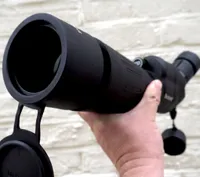
To further help reduce ghosting and flare, the objective element and its new coatings can be effectively shielded from angular light by an extended sunshade, or what I’d call a ‘hood’ in lens terminology. It’s easy to use; you simply pull it forward if and when needed.

A quick look at the underside of the scope reveals a tripod mounting plate. The rectangular plate has a textured rubber surface to enhance grip and a metal socket with a standard 1/4-inch thread, universally used for attaching cameras and other optical devices to tripods.

Svbony SV28Plus HD: Performance
To be honest, I wasn’t expecting much in the way of optical quality, considering the rock-bottom selling price of this scope. I was pleasantly surprised that it delivers a reasonably sharp, crisp, and bright viewing image, with fairly accurate color rendition. Birds, wildlife, sporting targets and pretty much any other subject you can think of appear well detailed even in dull, shadowy conditions as well as under bright sunlight. And for the latter, the coatings and extended sunshade work well to maintain clarity and contrast.
Both the magnification adjustment ring and focus knob work fairly smoothly. However, the scope lacks separate coarse and fine focus control knobs, so a lot of twisting can be required of the single focus control if you need to go from near to far, or vice versa.

The mini-tripod that’s supplied as part of the kit is comparatively disappointing. It looks and feels fairly flimsy, and its short, fixed height won’t be of much practical use out in the field. It’s actually described as a ‘tabletop tripod ’, which I guess is okay if you happen to have a table close at hand. On the plus side, the tripod has a tilt and pan head, although only the tilt mechanism can be locked in place.
The mobile phone mount is another part of the kit that’s been upgraded in the ‘Plus’ edition. I’ve seen some bad feedback regarding the earlier version, so I was hoping the new one would be good. Those hopes were unfounded, as it turned out. The mount is fiddly to use, and while its spring-loaded clamp grips the phone firmly enough, it relies on a simple plastic cup that slips over the eyepiece to hold it to the scope. It’s certainly not securely fixed in place, and I nearly suffered my phone falling off the scope twice. I lost faith in the phone mount after that and didn’t risk using it again.

Other push-fit items that are more likely to stay in place when you want them to are the front and rear lens caps. They’re non-essential parts of the kit, but I’m glad to see them included, considering the down-market price, as I’m a bit precious about my glassware no matter how much or how little I’m paying for it.

The performance of the ‘free’ carrying bag is pretty much on par with the rest of the extras. It just about does the job, but it looks and feels a bit flimsy, from the material it’s made from to the zipper that runs along its top side.

Svbony SV28Plus HD: Verdict
The Svbony SV28Plus HD is amazingly cheap to buy for a spotting scope, especially one that has Porro BaK4 prism optics, a generous magnification range, adjustable eye relief, and an interchangeable eyepiece. As a spotting scope, it simply works, and works pretty well. It delivers a reasonably sharp, bright, clear viewing image, and the magnification and focusing controls work well enough.
It lacks the luxury build, fancy features and quality design of up-market spotting scopes but, for casual and occasional use, I think it serves really well. The little extras are less impressive, namely the tabletop tripod, carrying bag and especially the mobile phone mount. All things considered, however, I reckon it’s an absolute steal at the price.
Features ★★★★☆ |
Smart features include Porro BaK4 prism optics, A5 red multi-coating, a 70mm objective element, 25-75x magnification range and an interchangeable eyepiece. |
Design ★★★½ |
The design is nothing special, the build quality feels a bit plasticky and the tripod and phone mount are flimsy, but the scope feels reasonably robust and has an IP65 dust/waterproof rating. |
Performance ★★★★☆ |
Considering the price, the viewing image is really rather pleasant, with decent sharpness, brightness and clarity. The zoom range is powerful but adjusting the focus setting can be a chore. |
Value ★★★★★ |
Even without any of the supplied extras, the Svbony is amazingly great value for money at the price. |

Alternatives