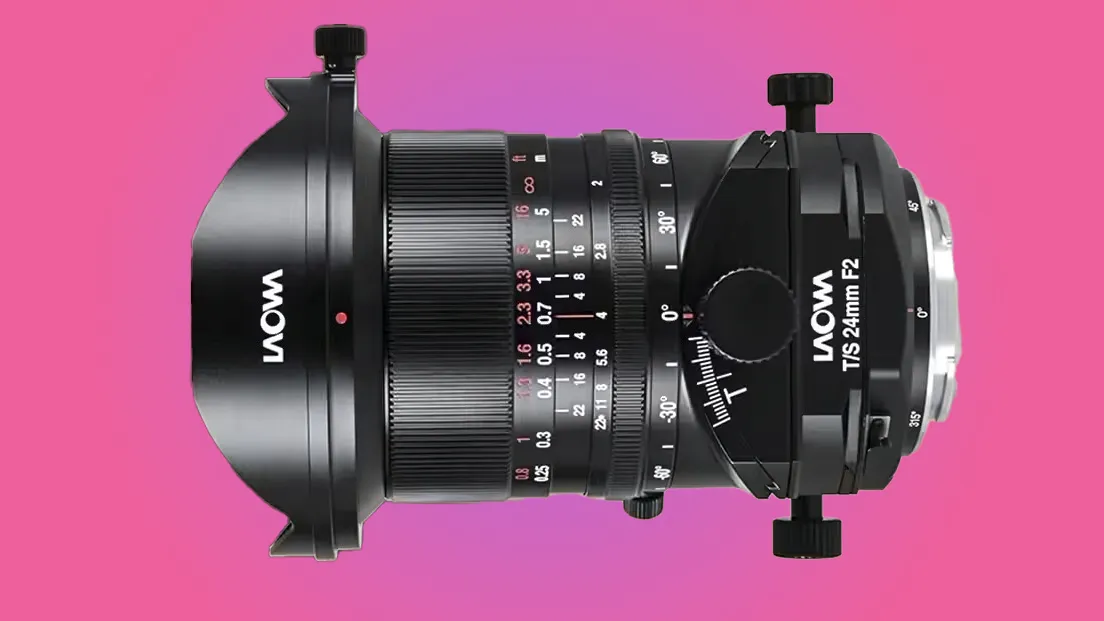
Tilt-shift lenses are the darlings of architectural photography. The shift function can correct the perspective error that makes tall buildings look like they’re leaning inwards towards the top. But that’s only half the story. The additional tilt function also makes them popular with landscape photographers and special effects creatives, who enjoy being able to monkey around with depth of field, independent of focal length, focus distance and aperture setting. Indeed, you can typically get anything from a huge depth of field for keeping near and far areas simultaneously sharp in landscape and cityscape images, to an ultra-thin depth of field for the ‘toytown’ effect.

The forthcoming Laowa 24mm f/2 Zero-D Tilt-Shift has an ideal focal length for architectural and cityscape photography. Very much more so than the recent Laowa FFII TS 100mm f/2.8 Macro 1X, the main strength of which I think is extending the meagre depth of field that you typically get in ‘full macro’ photography. And it doesn’t stop there. Venus Optics is so renowned as a purveyor of esoteric lenses that I feel Laowa would be top of the list if Inspector Gadget took up photography. Other oddball lenses include the Laowa 8-15mm f/2.8 FF Zoom Fisheye, Laowa 24mm f/14 2x Macro Probe, Laowa Aksen 5-10x Ultra Macro APO and Laowa 200mm f/2 AF FF, to name but a few. Okay, the last of these isn’t quite so ‘out there’ but 200mm f/2 lenses aren’t exactly run-of-the-mill.

Back to the new 24mm. Headline attractions include a generous +/-10 degrees of tilt and +/-12mm of shift, along with a similarly generous 108.8-degree wide-angle perspective. In keeping with modern lens designs, the Laowa is relatively compact and lightweight for its type. Unlike most, however, it claims to be a ‘Zero-D’ lens, with minimal optical distortion rather than relying on automatic in-camera correction.

The relatively fast f/2 aperture is another string to its bow, coming to the fore for the likes of twilight cityscape photography and architectural interiors, when lighting is low. Indeed, the Laowa claims to be the fastest tilt-shift lens ever made.

The Laowa is full-frame compatible and more besides. As such, it’s available in Canon RF, Nikon Z and Sony E and L-mount options for full-frame mirrorless cameras, while also delivering its full range of tilt-shift adjustability for select medium format cameras, thanks to Fujifilm GFX and Hasselblad XCD mount options. However, the L-mount version is incompatible with Panasonic Lumix S52, S52X, S1M2, S1M2E and S1R2 camera bodies.

Typical of tilt-shift lenses, there’s no autofocus facility but fancy glass includes five Extra-low Dispersion elements, two glass aspherical elements and four Ultra-high Refraction elements.

The launch of the Laowa 24mm tilt-shift lens is scheduled for November 5 and the US dollar price is set at $1,249. Pricing in other world regions is yet to be announced.