Digital Camera World Verdict
The K&F Concept ND1,000,000 is a 20-stop neutral density filter for long-exposure photography, but it performs surprisingly well for solar imaging with mirrorless cameras, producing pleasing images with visible sunspots and good contrast. Its compact screw-in design makes it particularly attractive for eclipse travelers seeking a lightweight alternative to fragile solar film systems. However, it is not a dedicated solar filter and should only be used for solar photography with mirrorless cameras or DSLRs in Live View mode – never for direct visual observing or use with an optical viewfinder. Dedicated solar filters from Baader and Thousand Oaks remain superior for safety, thermal management, and ultimate image sharpness, but for travel-friendly solar photography, casual eclipse imaging, and all-around creative photography use, the K&F ND1,000,000 is an impressively capable option.
Pros
- +
Compact and travel-friendly
- +
Simple screw-in design
- +
Tough and easy to clean
- +
Works well with mirrorless cameras
- +
Neutral yellowish-white sun ideal for post-processing
- +
Dual-purpose for long exposures and solar imaging
- +
Good value for money
Cons
- -
Not intended for direct visual observing (including optical viewfinders)
- -
Softer detail than Baader solar film
- -
Heat buildup during prolonged solar sessions
- -
Requires extra care with DSLR optical viewfinders
Why you can trust Digital Camera World Our expert reviewers spend hours testing and comparing products and services so you can choose the best for you. Find out how we test.
Photographing the sun safely has traditionally meant one of two things: building a DIY filter using specialist solar film, or investing in a dedicated astronomical solar filter system. The K&F Concept ND1,000,000 takes a different approach.
Rather than using a dedicated solar film, it’s essentially an extremely dark 20-stop neutral-density filter that reduces sunlight by a factor of 1,000,000. Designed primarily for ultra-long-exposure photography, it’s a convenient, durable, and straightforward screw-in design.

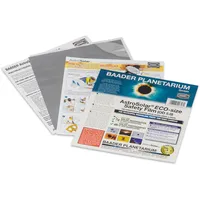
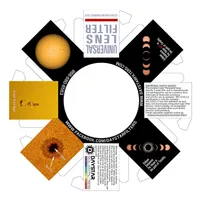
Compared to fragile Baader AstroSolar Safety Film or foldable universal filters like the Daystar Universal Lens Filter, the K&F filter is much easier to travel with. There’s no cardboard to crush in your luggage, no delicate film to puncture or stretch, and no tape-covered DIY construction rattling around your camera bag.
For this review, I tested the filter primarily on a DSLR camera with a 100-400mm telephoto lens. The results were surprisingly impressive – though not without important compromises and safety considerations.

K&F Concept ND1,000,000: Specifications
Filter type |
Threaded screw-in extreme neutral density filter |
Material |
Optical glass |
Density |
ND1,000,000 |
Transmission |
20-stop light reduction |
Certification |
Does not meet ISO 12312-2 transmission requirements for eclipse viewers |
Sizes available |
49-95mm |
Solar color |
Neutral to slightly warm |
Weight |
0.63 oz [18g] (2.89 oz [82g] in holder) for 77mm filter |

K&F Concept ND1,000,000: Price
The K&F Concept ND1,000,000 is simple and reasonably affordable. Available in 49mm, 52mm, 58mm, 62mm, 67mm, 72mm, 77mm, 82mm, and 95mm sizes, prices typically hover around the $50 / £38 mark for the 77mm size, and there are frequent discounts.
That’s competitive pricing considering the filter also doubles as a creative long-exposure tool outside eclipse seasons. Unlike specialist solar film that may sit unused for years between eclipses, the K&F ND1,000,000 can also be used for ultra-long daytime exposures, smoothing water, removing crowds, cloud streak effects, and minimalist landscape photography. So it should appeal to photographers worried about investing in niche eclipse gear.
However, dedicated solar filters still offer advantages in thermal management and safety certification. The K&F is ultimately a photographic ND filter first and foremost, not a purpose-built astronomical solar filter.

K&F Concept ND1,000,000: Design & Handling
Safety first. The K&F ND1,000,000 is a photographic filter, not a certified visual solar observing filter. You should never look directly at the sun through it – or via a DSLR's optical viewfinder. Mirrorless EVFs and rear LCD Live View systems are the safest workflows to use (besides, zooming in on a Live View image of the sun is the best way to manually sharpen the image).
The K&F ND1,000,000 feels surprisingly well-made for the money. The aluminum frame threads smoothly with no cross-threading issues, the grip texture is easy to handle even with gloves, and the included hard protective case is tough. It occupies almost no space in a camera bag and feels substantially more durable than solar film systems.

However, there are practical trade-offs. Glass solar filters absorb and retain heat far more than solar film systems do. After prolonged shooting sessions in direct sunlight – the definition of an eclipse shoot, which can last over three hours – the filter becomes distinctly hot to the touch. This makes removing the filter quickly before totality slightly trickier than with lightweight slip-on film filters, which typically rely on cardboard or tough plastic housings.
That said, you don’t necessarily need to fully tighten the filter during eclipse photography. Leaving it slightly loosened allows much faster removal just before totality while still remaining secure enough for shooting the partial phases.

K&F Concept ND1,000,000: Performance
Considering its intended purpose as a creative long-exposure filter rather than a specialist astronomy product, the K&F ND1,000,000 performs impressively well. Mounted on a Canon 100-400mm telephoto lens attached to a mirrorless camera, image quality was genuinely good. Contrast remained strong, flare was well controlled, and the filter introduced no obvious vignetting or focusing issues during testing. The ND1,000,000 should be the only filter mounted on the lens when imaging the sun to avoid ghost reflections.
Compared to DIY solar film filters, the screw-in design makes setup dramatically simpler, especially while traveling. There’s no concern about crushed filter cells, wrinkled film, or masking tape-secured housings. For lightweight eclipse expeditions, that convenience becomes extremely appealing. Dedicated solar film systems still hold a clear optical advantage.


With ISO100 and f/8 dialed in, exposures between 1/13 sec and 1/100 sec produce usable images, with 1/50 sec superior. Compared to Baader AstroSolar Safety Film, the K&F filter produces a yellow-tinted and slightly softer image of sunspots and the solar limb, as well as a little less contrast across the sun’s disk. The difference isn’t huge for casual use, but experienced eclipse photographers will notice it.
The K&F Concept ND1,000,000 ND filter gets hot. Dedicated solar film reflects much of the sun’s energy away before it enters the lens, whereas dense glass ND filters absorb more internally. Since prolonged Live View sessions in hot environments may increase thermal stress on both the filter and camera, it’s something to consider.
Without formal solar certification documentation, the K&F ND1,000,000 should be considered for occasional mirrorless solar photography with moderate telephoto zooms – thereby avoiding the need for optical viewfinders. With those caveats in mind, it works far better than many photographers might expect.
K&F Concept ND1,000,000: Verdict
The K&F Concept ND1,000,000 is not a replacement for dedicated astronomical solar filters, but that’s not really the point. What it offers instead is one of the most practical, compact, and travel-friendly ways to occasionally photograph the sun with a mirrorless camera. For eclipse travelers wanting a lightweight setup without DIY filter construction, it makes sense. Image quality is solid, handling is straightforward, and the screw-in design is dramatically easier to travel with than delicate solar film systems. The ability to repurpose it for creative long exposures outside eclipse season also helps justify the purchase.
However, the compromises are real. Dedicated solar film from Baader or Thousand Oaks remains cheaper, sharper, and better able to handle heat. This filter should also never be treated as suitable for direct visual observing.
For casual eclipse photography and lightweight travel kits, the K&F ND1,000,000 is an excellent option. But for publication-grade solar imaging at long focal lengths, specialist solar film still leads the way.
Features ★★★★☆ |
Dual-purpose functionality for both long exposures and solar photography makes this an unusually versatile occasional eclipse accessory. |
Design ★★★☆☆ |
Compact, durable, and exceptionally travel-friendly, though prolonged solar shooting causes the glass to heat up noticeably. |
Performance ★★★★☆ |
Very capable for mirrorless eclipse photography with decent sharpness and contrast, but dedicated solar film remains superior for high-resolution work. |
Value ★★★★★ |
Affordable, versatile, and easy to transport, making it one of the most practical options for occasional eclipse travelers. |
Alternatives