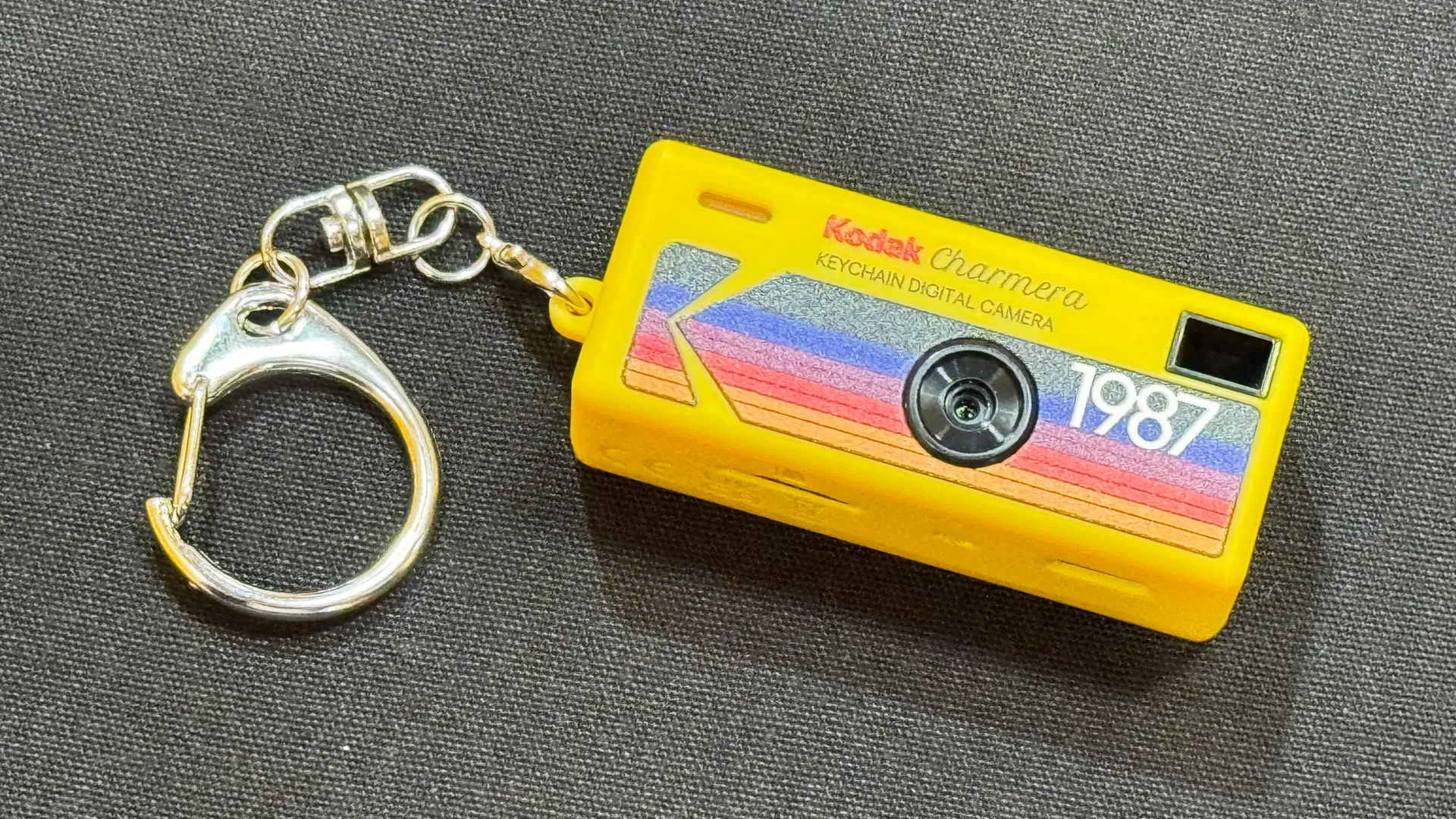
There is something wonderfully ridiculous about the Kodak Charmera. At a time when we are surrounded by cameras capable of recording astonishing levels of detail, computationally rebuilding our photographs and practically deciding when we should press the shutter for us, one of the cameras that has stolen the hearts of photographers and non-photographers alike is tiny enough to hang from a keychain. Better still, its photographs are technically pretty terrible – and I think that might be exactly why people have fallen in love with it.
The Kodak Charmera arrived in 2025 as a miniature digital camera inspired by Kodak’s past, particularly the carefree spirit of the Kodak Fling from 1987. Manufactured by RETO Production under license from Kodak, the Charmera is quite literally designed to be both a charm and a camera, something you can attach to a bag or keyring and carry everywhere. Its original launch proved just how powerful that idea could be, with the little camera reportedly selling out within a day before pre-orders reopened for another batch.
And yet there is almost nothing impressive about its specification sheet. The Charmera uses a tiny 1/4-inch CMOS sensor and produces 1.6MP images measuring 1440 x 1080 pixels, paired with a 35mm-equivalent f/2.4 lens. This isn't a camera chasing resolution, dynamic range or perfect corner-to-corner sharpness, and nobody is going to mistake its photographs for something captured on a Leica M11 or Fujifilm GFX. That, however, completely misses the point. The Charmera is about pressing a button and seeing what happens, rather than worrying about whether your shadows are recoverable by three stops in Lightroom.
That simplicity appears to have struck a nerve. The original Charmera was offered in collectible blind-box packaging with seven possible retro designs, turning buying the camera into part of the experience, while its intentionally lo-fi photographs look closer to something recovered from an old family album than an image captured by a modern smartphone. Reviews have repeatedly described the camera as viral, popular or even something of a cult hit, despite simultaneously acknowledging that its actual image quality can be extremely rough. Somehow, those imperfections have become part of its personality rather than something that needs fixing.
Sample images



I think that tells us considerably more about photography in 2026 than the Charmera's specification sheet ever could. We have spent the past decade making photographs cleaner, sharper, and more technically perfect, while smartphones have made taking a technically competent photograph almost effortless. The inevitable reaction appears to be a growing desire for photographs that actually look imperfect again. People are buying old compact cameras, rediscovering film, adding date stamps, embracing blown highlights and chasing the unmistakable aesthetic of early digital cameras. The Charmera compresses that entire movement into something that weighs almost nothing and can hang beside your house keys.
More importantly, it makes photography feel disposable again in the best possible sense of the word. Not disposable because the photographs are meaningless, but because every frame doesn't have to become a masterpiece. There is no pressure to perfectly expose the scene, select the right autofocus mode, or spend twenty minutes editing the resulting RAW file. You point it at your friends, your dog, an interesting street corner, dinner, a night out, or something completely mundane and press the shutter. Sometimes the photograph works, sometimes it doesn't, but that unpredictability is precisely what we seem to have engineered out of modern photography.
That might explain why this little camera has managed to reach people far beyond traditional photography circles. One recent account described using the Charmera while traveling with friends specifically because it allowed everyone to put their phones away and remain more present, while other users have talked about the enjoyment of transferring and curating its deliberately imperfect photographs afterward rather than allowing thousands of smartphone images to disappear into an endless camera roll. It transforms photography back into an activity rather than another feature buried somewhere inside the device we already use for absolutely everything else.
There is also something particularly fitting about the Kodak name being attached to it. Kodak is inseparable from generations of family snapshots, vacations, birthdays, and photographs that were rarely technically perfect but became priceless simply because somebody remembered to take them. The Charmera taps directly into that emotional history without pretending to recreate film perfectly. It instead offers something much simpler: a tiny digital camera that encourages you to photograph without thinking too hard about photography.

And perhaps that is the real reason the Kodak Charmera stole so many hearts. It isn't because 1.6MP suddenly became good enough, nor because photographers collectively stopped caring about image quality. It is because this tiny keychain camera reminded us that image quality and photographic enjoyment have never been quite the same thing.
Sometimes the photograph that makes you smile isn't the sharpest one, the cleanest one or the one with the greatest dynamic range. Sometimes it is the slightly blurry, strangely colored photograph taken on a ridiculous little camera hanging from your keys – and I rather love that photography has rediscovered the joy in that.
Shop the Kodak Charmera

