
The best camera bag for travel can mean a bag for hikers, for air travel, for city breaks, or a whole lot more. Ideally, a good travel camera bag should let you carry a decent amount of gear without adding too much weight. It should have decent weatherproofing, some padding for the kit inside, and well-padded straps and handles that make it comfortable to carry for extended periods.
So, quite a tall order, then! Fortunately, manufacturers have proven themselves to be up to the task, and there are loads of fantastic camera bags to choose from. So much so that it can be hard to know where to start, which is why I've divided my guide into different styles of bag, with options for holsters, sling bags, messenger bags, backpacks, roller bags, and hard cases, and picked what I reckon to be the very best choice specifically for the traveler. However, we have dedicated guides to the best sling bags, messenger bags, backpacks, roller bags, and hard cases, if you want to check out alternative options.
As I said, there's a lot of choice out there. So, let's dive straight into the best camera bags for travel you can buy!

Ben is the Imaging Labs manager, responsible for all the testing on Digital Camera World, and our go-to guy for technical insight. He's also the team's man-at-arms when it comes to camera bags, filters, memory cards, and all manner of camera accessories.
The best camera bag for travel
Why you can trust Digital Camera World Our expert reviewers spend hours testing and comparing products and services so you can choose the best for you. Find out how we test.
Best holster bag for travel

This clever holster from Matador is ideal for those who like to head out for wet-weather hikes. It packs in a clever waterproof cover, which scrunches down so small you may not notice it, but it can be pulled out at a moment's notice to cover the entire shell, making for a double waterproof cover for your gear.
Capacity-wise, the Matador Camera Base Layer is about average for a holster – it's not going to hold a full-frame DSLR with a telephoto lens, but it can stretch pretty well, and most lightweight mirrorless and compact setups should be fine.
The Matador Camera Base Layer is more about weather protection than impact protection and isn't padded to any great extent. It's therefore an excellent choice for hikers and country-walkers – perhaps less so for city explorers who might want some padding against knocks and bumps.
Read our full Matador Camera Base Layer review
Best sling bag for travel

This attractive option comes in a choice of four colors: black, stone, sage, and an eye-catching rust. But there’s a lot more to the Luma than good looks: the combination of a metal frame on the inside, to help retain the bag’s form, and weatherproofed Oxford weave on the outside gives reassurance that your gear is well-protected.
Dividers inside use a hook-and-loop system, giving you multiple configuration options for arranging your camera and lenses, while a mesh in the lid is perfect for holding loose accessories. I also enjoyed design touches such as the magnetic clasps, which hold the lid in place but enable you to quickly fetch a camera when you need to take a shot. A zip adds protection when the bag’s in transit.
Note that Gomatic is the European brand name for Nomatic – you may see this bag under either name.
Read our full Nomatic/Gomatic Luma Camera Sling 12L review
Best small sling bag for travel

The Manfrotto Uncover Messenger / Sling comes in 7L and 12L capacities, and I'm concentrating on the smaller 7L version here, which is ideal for a mirrorless camera and perhaps an additional lens. I found it to be an exceptionally versatile, eye-catching bag that transitions effortlessly between shooting days and daily errands. Its defining feature is a completely removable camera insert featuring a zippered top flap and carrying handle. Pulling out the insert instantly converts the bag into an everyday carry.
I love the innovative roll-top design. Rather than creating a messy roll, it utilizes magnetic folds to expand capacity seamlessly from 7.5 to 9.5 liters. Dual strap attachment loops let me position the seatbelt-style shoulder strap perfectly whether the bag is compressed or expanded. The Cordura FlexGrid front panel is another great addition for clipping on extra accessories, and the slim rear zipper pocket keeps travel documents safe.
My primary complaint is that the internal camera insert holds a modest setup – a camera body with one or two lenses – and accessing it requires extending the roll-top section first. Additionally, the 7L omits the side pockets, rear grab handle, trolley strap, and tripod fasteners found on the larger 12L model (more details on both bags in the full review). Still, if you need a sleek, adaptable everyday camera sling for a small amount of kit, it is a superb choice.
Read our full Manfrotto Uncover Messenger / Sling review
Best messenger bag for travel
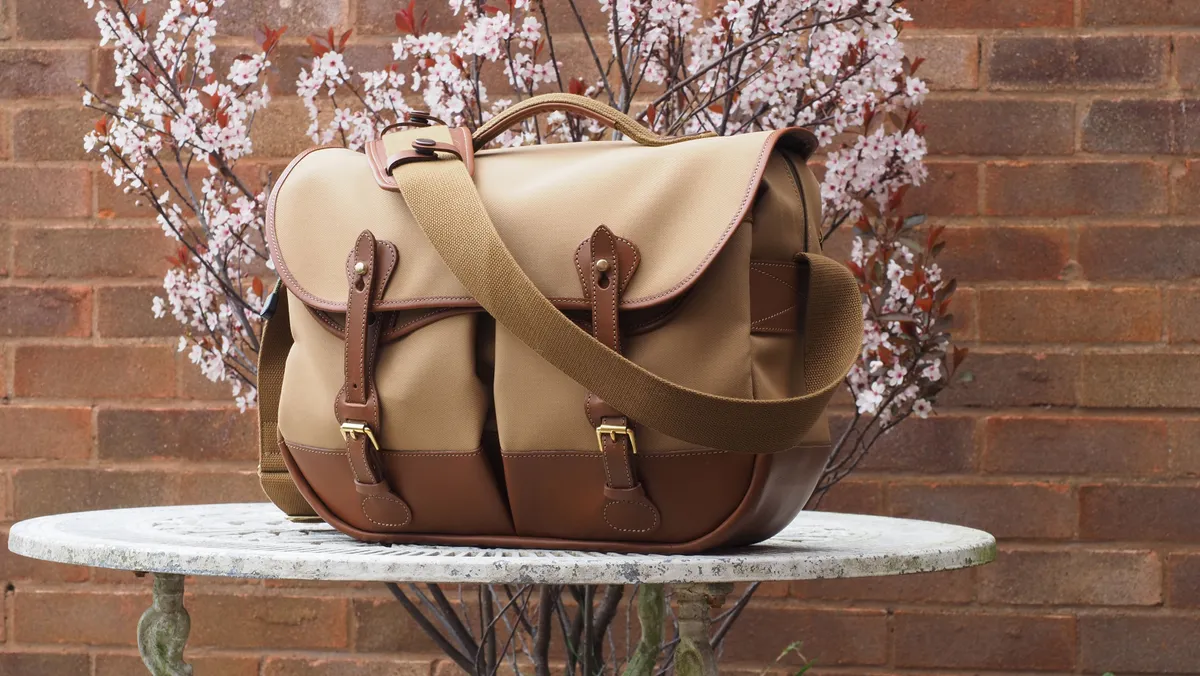
Let's get this out of the way now: if you're on a strict budget, Billingham camera bags aren't for you. They're premium products, hand-crafted and finished with fine materials, and they come with a price tag that reflects that. They're also made using real leather – so if you avoid animal products, best look elsewhere.
If neither of those criteria applies to you, the Billingham Eventer MKII is a top-tier camera bag. I was hugely impressed with the bag when it came in for a full review; it's superbly designed, with smooth dividers that keep your gear safe while allowing it to slide smoothly in and out. The two expanding front pockets are also amazing – they just swallow up gear, and keep swallowing it up with space to spare.
Read our full Billingham Eventer MKII review
Best backpack for travel

Camera backpacks have got a bit samey over the years, and we can all admit that the boxy black designs, while functional, are not the most exciting. The Morally Toxic range, a spin-off from tripod manufacturer 3 Legged Thing, is an attempt to blow some of the dust out and rethink what camera bags can look like – and its backpack, the Morally Toxic Valkyrie, is a triumph.
The smart design gives you access to your gear from all angles, without compromising security or weatherproofing, thanks to the tough zips. Also, the "Morally" in the name refers to the fact that the bags are manufactured responsibly, with minimal plastic, and recycled ocean plastics are used where possible.
Read our full Morally Toxic Valkyrie review
Most versatile backpack for travel

The third generation of Lowepro’s flagship rugged backpack series, the Lowepro ProTactic BP 350 AW III, is designed for photographers working in demanding outdoor environments. A distinctive hard-shell construction offers superior impact protection compared to soft-shell alternatives, and the bag maintains its shape even when empty. A four-point access system allows gear retrieval from the top, both sides, and a full-access rear panel. This latest-gen bag introduces redesigned padding for improved airflow and a removable waist belt, which comes into its own when switching between long treks and casual city use.
The bag is supplied with a few accessories (pouch, water bottle holder, and rain cover), but is expandable with modular add-ons, including phone holders and utility belts. Internally, the bag uses thin and space-efficient MaxFit dividers.
It's on the heavy side, at 2.3kg, and quite pricey, but for those who prioritize maximum protection, quick multi-point access, and the ability to customize the kit they carry via external modules, the ProTactic BP 350 AW III is a professional-grade workhorse.
Read our full Lowepro ProTactic BP 350 AW III review
Best roller bag

The Tenba Roadie v2 Spinner 21 Air Case offers ultimate protection for your valuable camera kit. I love its water-repellent 1680D ballistic nylon exterior, which feels soft to the touch and absorbs shocks far better than traditional hard cases. Beneath that soft shell lies a rigid internal frame so strong it can withstand up to 500 pounds – you can literally sit on it during airport delays!
It fits standard carry-on regulations yet easily holds two to three cameras, up to ten lenses, and a 16-inch laptop. The four WideTrak wheels roll smoothly and quietly, while the TSA-approved locks and built-in steel tether cable give excellent peace of mind.
The downsides are that it is on the pricey side, it's noticeably heavy even when empty, and while it converts into a backpack, those straps are sold separately. Even so, for an 'uncrushable', versatile travel companion, it is absolutely worth the investment.
Read our full Tenba Roadie v2 Spinner 21 Air Case review
Best hard case for travel

Hard cases for cameras offer the best possible protection for your gear, short of locking it in a safe, and they’re still fairly portable for traveling. Peli’s Air cases are more portable than most rivals, having been designed to be as much as 40% lighter than a regular Peli hard case.
With external dimensions of 55.8 x 35.5 x 22.8cm, this case has been designed to stay compliant with most airline cabin luggage rules. But if it does have to go in the hold, you needn't worry, as your gear will remain unharmed even if it encounters the most heavy-handed baggage handler. I did my best to burst the Air Case 1535, and while it does flex slightly more when crushed than some heavier hard cases, the difference is reassuringly small. This case is also fully waterproof in addition to being crushproof – your camera gear will stay dry even in a monsoon downpour.
The default interior option is diced foam, but you can also buy Velcro dividers or use Peli’s own TrekPak system. TrekPak is based around sheets of corrugated plastic; using the cutter provided, you can shape a sheet to fit around your specific equipment, linking pieces together with hooked pins. If you don’t mind the initial work, you end up with inserts that fit your gear perfectly, in a way you’d never achieve with dividers.
Read our full Peli 1535 Air review
How to choose the best camera bag for travel
What are the pros and cons of a holster bag?
A typical camera holster bag goes round your waist, perhaps clipping to your belt. They’re comfortable to wear and walk around in, to easy access to your gear, but they’re usually quite small, so don’t expect to be able to take much out with you.
What are the pros and cons of a sling bag?
Sling bags have a single strap, like a shoulder bag, but their design makes them more comfortable to wear on your back, like a backpack. Their biggest benefit is that you can bring them to your front easily, and without taking them off, so they’re great for rapid access.
The penalty for this convenience is size: there’s a limit to how big this design can comfortably scale, and therefore how much you can carry. But if you just want to take a camera and a couple of lenses you can bring out quickly, sling bags are well worth trying out.
There are plenty more options in our separate camera sling bag buying guide.
What are the pros and cons of a messenger bag?
Both shoulder and messenger bags use a cross-body design, with a single strap that you take over your head and rest on the shoulder opposite the bag itself, which helps the load feel balanced. The technical distinction between shoulder and messenger bags is that the latter have shorter straps and sit higher on the body – think of a messenger on a bike.
Messenger bags are convenient, with easy access to your camera gear, and are available in many sizes. Their main drawback is that they’re not ideal if you’re out all day or simply have a lot to carry: bearing the load on one shoulder can become tiring. But they’re great for shorter shooting assignments where you perhaps have one or two extra lenses you want to be able to access quickly.
For further choices, see our separate camera messenger bags buying guide.
What are the pros and cons of a backpack?
Backpacks have a strap for each shoulder, centering the load behind you for a comfortable feel. This means you can carry more at once, so backpacks are typically bigger than other designs. They are a great option when you plan to be outside for a long time or have a lot to carry. A typical camera backpack offers internal dividers to organize your gear and stop things from getting mixed up.
The main drawback of backpacks is access: you often have to take the backpack off and set it down to access its contents comfortably, so they don’t suit spontaneous shooting. But when you have a lot you need to take with you, this is the workhorse bag you need.
There are lots more bags in our dedicated camera backpacks buying guide.
What are the pros and cons of a roller bag?
If you're traveling by train, plane, or automobile, roller bags are essentially wheeled suitcases with extendable handles that make them ideal for navigating through busy transit centers while enabling you to bring your precious camera kit as carry-on, though do double-check dimensions, as some budget carriers are notoriously stingy. Designed to take the shocks and knocks of travel, you can expect a rigid back, base, and sides, and most designs also include exterior scuff protection in vulnerable areas.
But they are less ideal when you arrive at your destination, particularly when traveling off the beaten track. Some include straps to double up as backpacks, though they won't be as comfortable as a dedicated one. In short, you will undoubtedly need another bag to carry your kit when you get there.
Check out our camera roller bag buying guide.
What are the pros and cons of a hard case?
For the ultimate protection, a hard case combines a tough, solid shell with plenty of interior padding designed to take the worst that life on the road can throw at it. They can take a lot of abuse and typically feature replaceable wheels, while reinforced outer corners and undersides add longevity. Adaptable interiors include well-designed dividers or even cuttable foam to adapt to your specific kit.
But while some meet typical airline size restrictions of around 55 x 35 x 23cm or smaller to see you through most airline check-ins, many carriers won’t allow more than 10kg, and the case alone can easily eat up the lion's share of this. Always check your flight’s carry-on restrictions when you book. If you have so much kit that it has to go in the hold, a hard case is essential. And like roller bags, you will need another way to cart your kit around on arrival.
Also, check out our camera hard cases buying guide.
How we test camera bags
We thoroughly test the camera gear that comes our way. With camera bags, we look at build quality, capacity, weatherproofing, ease of use, and any other features that feel relevant to the photographers and videographers who will be using the kit. We have a team of in-house experts who take bags out into the field to see how they perform in real-world shooting scenarios, and we use their findings and opinions to inform our comments in buying guides.
Find out more about how we test and review on Digital Camera World
