Digital Camera World Verdict
I always enjoy testing Harlowe lights because they look great and produce a powerful key light. I was even more excited to test the Max Spectra thanks to its ability to generate thousands of colors at the twiddle of a knob, rather than being limited to six differently colored magnetic gels – Avant Max, I’m looking at you! I find that by using a continuous RGB LED, I can really elevate the production values of my portrait photography, especially when shooting in an urban location. As you’ll see from the stills and video clips illustrating this review, I certainly wasn’t disappointed with the Max Spectra’s performance.
Reasons to buy
- +
Stylish retro design
- +
Accurate color rendition
- +
RGB colors
- +
80W illumination
- +
Magnetic accessories
- +
Negligible fan noise
Reasons to avoid
- -
Expensive
- -
Effects don’t use RGB
Why you can trust Digital Camera World Our expert reviewers spend hours testing and comparing products and services so you can choose the best for you. Find out how we test.
Harlowe (formerly called Hobolite) produces distinctive-looking continuous LED lights designed to help filmmakers and portrait photographers create better-looking clips and stills. Harlowe lights are instantly recognizable thanks to the brown faux-leather panels inset into their blocky aerospace-grade aluminum housings. I’ve tested a wide range of Harlowe LEDs for Digital Camera World, from the Avant and Avant Mini back in March 2023 to the eye-catching designer collaboration Sol 30 Spectra in September 2026.
The subject of this review, the Harlowe Max Spectra, is an upgraded version of the Avant Max that I tested back in August 2024. That earlier incarnation was an 80W bi-color LED, so it could only emit light within a color-temperature range of 2700K to 6500K, which is relatively narrow compared with more modern LEDs. To produce more creative colors with the older 80W Max, I needed to magnetically attach the supplied colored domes to the front of the light. There were only six domes, so my creative color palette was correspondingly limited.

As the Spectra in its name suggests, the Harlowe Max Spectra is an RGBWC LED. This means that it combines red, green, and blue LEDs that can be mixed to produce thousands of creative colors, rather than the six offered by the old Max’s colored domes. The W and C stand for White and Cool White, referring to dedicated LEDs that enable the Max Spectra to produce more natural-looking white light across a range of color temperatures on the Kelvin scale, from the warm glow of candlelight to cooler daylight.
The Max Spectra is available in different versions – from the more affordable 40W Creator Kit to the 120W version. I was delighted to get my hands on the midrange 80W Max Spectra to test, because it gave me the perfect excuse to commission a model for an on-location portrait and video shoot.
Thanks to the Max Spectra’s built-in battery, I knew I’d be able to add a powerful key light in virtually any color and capture studio-quality portraits (and stylish-looking video clips) in the gloomy corridors of London’s famous Barbican Centre. More on that in the Performance section. Let's take a closer look to see whether it's worthy of a place among similar continuous LED lights in our best video lights buying guide.

Harlowe Max Spectra: Specifications
Power |
80W, 5,800 lm when set to 6500K |
Material |
Aerospace-grade aluminum with eco-friendly faux leather |
Dimensions |
169.4 × 97.3 × 99.9 mm [6.67 × 3.83 × 3.93 in] |
Weight |
887 g [31.3 oz / 1.96 lb] (with lens attached) |
Mounting point |
1/4-inch thread, V-mount |
Color |
1700K – 10000K |
CRI/TLCI |
96 |
Battery life |
1 hour 18 mins at full power |
Harlowe Max Spectra: Price
Okay, brace yourself… The 80W Harlowe Max Spectra Creator Kit that I tested officially retails for $1,099.99 / £1,099.99. That’s a substantial price, although the kit does include a useful range of accessories to help justify the cost, including barn doors, a Frosted Dome, a Honeycomb Grid, and a V-mount clamp.
If you like the Harlowe aesthetic but have a smaller budget, there’s also an $849 / £849 40W Creator Kit. However, the lower-powered model may struggle to provide enough fill light outdoors on a bright day, which is where the extra punch of the 80W version becomes useful. And for a brighter light (and higher price), there's the Max Spectra 120W at $1,199.99 / £1,199.99.
For an additional $100 / £100, I can step up to the Magic Kit, which includes everything in the Creator Kit plus Harlowe’s Magic Lens. This adds textured patterns to the light output, but I found the effect a little distracting, so I think most will be happier with the slightly cheaper Creator Kit unless you know you’ll make regular use of the Magic Lens (to add textured backgrounds, perhaps?).
As with any Harlowe LED, I’m paying for a product that combines form and function in a way that helps it stand out from similarly specced rivals. Cheaper RGB LEDs can produce broadly similar lighting effects, but they probably won’t look quite as cool on the shoot.
Harlowe Max Spectra: Design & Handling
At 887 g [31.3 oz / 1.96 lb], the Harlowe Max Spectra is a reassuringly weighty fixture that feels like a professional, well-made product. Attach the battery pack and that weight jumps to a hefty 1,476 g [52.1 oz / 3.25 lb]. The design of the LED itself reminds me of a boxy Hasselblad camera that a friend owned back in the mid-1980s (hello, Luke Hockley!).
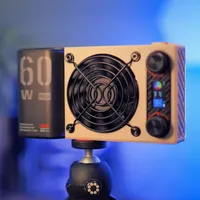
The Max Spectra’s body is essentially a square box, with pleasingly rounded aerospace-grade aluminum edges curving toward the top and bottom of the lens at the front. Textured brown faux-leather panels sit on either side, while the top and bottom of the main body feature silver metal ventilation grills designed to dissipate heat.
At the front is a detachable Lumina Intensifier Lens that focuses the output from the LEDs. The lens has a gray textured rubber grip that makes it easy to rotate and adjust the beam from wider to narrower. It also contributes to the Max Spectra’s classic-camera look and feel.

The 80W Harlowe Max Spectra Creator Kit ships with a couple of dockable modules. One is the power adapter, which lets me run the light from the AC mains. The other – and far more useful for location work – is the Max 99.36Wh Battery Pack. Both modules dock onto the rear of the Spectra’s square body and are finished with the same brown faux-leather panels. Once attached, they extend the length of the light and give it an even stronger resemblance to a retro camera.
Although the Max Spectra has a retro look, it boasts some modern – and essential – touches, including a color LCD panel on the side of the light that lets me view settings and menu options. Two adjacent silver metal knobs, which also double as clickable buttons, enable me to adjust a host of properties, including Hue, CCT, and the frequency of animated effects.
Next to the two control knobs are smaller mode buttons for Home, Effects, and Setup, the latter including Bluetooth settings for pairing the Spectra with the Harlowe smartphone app. A fourth button locks the current settings, so I don’t accidentally change a value while rotating or pressing one of the control knobs.

Harlowe Max Spectra: Performance
To test the Harlowe Max Spectra, I started in the studio with two iPhones capturing wide and close-up angles of my demonstration. The kit ships in a rigid gray carry case emblazoned with the Harlowe logo, which does an excellent job of protecting the light and its accessories. However, once I’d added a backpack full of iPhone accessories, tripods, and a gimbal, plus a separate Harlowe tripod bag, the combined weight became noticeable. After walking to and from the studio, I was certainly feeling it.
For my second shoot, which involved taking a train into London, I left the rigid case at home along with accessories I knew I wouldn’t need, such as the mounting clamp and AC power supply. Instead, I packed the Max Spectra with its fully charged battery attached into the supplied protective pouch and slipped it into my backpack. I carried the Harlowe tripod separately in its own bag.

That stripped-down setup made the journey to the Barbican Centre, including the longer walk from the station, considerably easier. It also underlined one of the Max Spectra’s key advantages for location work: I don’t need to carry the entire Creator Kit every time I head out on a shoot. I also left the Magic Lens at home, as I simply wasn’t a fan of the effects that it produces.
I doubled up on products for my location shoot and took two Harlowe lights with me: the Max Spectra, of course, and the smaller Harlowe Sol 30 Spectra. As requested, Maddy (Insta: @runway.voguish), the model, was dressed as a Bond girl, so I planned to use the more powerful 80W Max Spectra as my key light and the smaller Sol 30 Spectra as a fill light.
As both are RGB LEDs, I could set the Max Spectra to a warm color temperature that matched the Barbican Centre’s interior lighting, then set the Sol 30 to a cooler blue hue that complemented – while contrasting with – the warm key light.


I was delighted with the results. The strong, warm key light created defined shadows that helped sculpt Maddy’s face and give it a more three-dimensional look than I could have achieved with the available light alone. The cooler fill light reinforced that modeling while adding a cinematic color contrast. Since I started using continuous LEDs on location shoots, I’ve been able to raise the production values of my photography and produce noticeably better-looking portraits. (Shooting models also helps, as they know how to look good on camera!)
Using the full-size Harlowe tripod meant I could position the heavy Max Spectra exactly where I wanted it, but I was slightly nervous about setting it up inside the Barbican Centre. In the past, I’ve been asked by security staff to move on, even when using a much smaller gimbal tripod or light stick on a stand. I also made the mistake of attaching the LED directly to the tripod rather than mounting it via the supplied handle with its adjustable hinge. This meant I couldn’t tilt the light, so I ended up changing the tripod height instead – a schoolboy error on my part!
I also shot some video to test the Max Spectra’s animated effects, including Lightning. The additional illumination helped me capture clean, low-noise footage in the gloomy interior, and there was enough light for my iPhone 17’s Cinematic mode to add background bokeh without warning me that the scene was too dark.
One thing that surprised me regarding the Spectra’s eight animated effects was that they appeared to be limited to the bi-color LEDs. That’s fine for creating flashes of lightning or flickering flames, but there were no RGB animated effects, such as the red-and-blue flashes of an emergency services vehicle or a creative hue loop, for example. Other RGB lights, such as the Neewer HB80C 80W RGB, have a much wider (and more colorful) range of creative animated effects.
I started shooting with Maddy at 11:00 a.m., when the Barbican’s corridors were fairly quiet. By midday, however, more people were heading out for lunch and interrupting our shooting flow, so I decided to spend the second hour of the shoot on the streets around the Barbican instead.

Outdoors, I might have expected the Harlowe Max Spectra to make less of an impact, especially on a sunny day. However, the narrow nearby streets and alleys were mostly in shade, so I redeployed the Max Spectra on its lighting stand – this time with the tiltable handle attached.

I was then able to extend the stand to full height and angle the light down onto Maddy, effectively bringing a little "midday sun" into the alley while setting the LED to a daylight color temperature. The result was a series of street portraits with a more polished, professionally lit look. The extra key light from the 80W Max Spectra helped elevate my shots beyond straightforward street snaps and gave them the feel of studio-quality portraits captured on location.

Harlowe Max Spectra: Verdict
The Harlowe Max Spectra is a powerful and beautifully designed 80W RGBWC LED that combines serious lighting performance with the distinctive retro styling that has become Harlowe’s trademark. Its solid build, tactile controls, built-in effects, and broad color options make it versatile enough for both portrait photography and video, while the battery pack makes it genuinely useful on location (though it will run out of juice after continuous use at 100%).
I found it particularly effective as a key light, both indoors and outside in shaded streets, where its 80W output added shape, depth, and a more polished look to my model portraits. It also provided enough illumination for clean-looking video and creative effects work in gloomy urban interiors.
The downside is the price. At £1,099.99 / $1,099.99 for the Creator Kit, there are much cheaper 80W RGB alternatives. But with the Max Spectra, I’m paying for premium construction, elegant design, and a product that looks as good on set as the light that it produces.
Features ★★★★☆ |
The key improvement over the older Harlowe Avant Max model is the ability to produce thousands of colors at the twiddle of a knob. |
Design ★★★★☆ |
The Harlowe Max Spectra certainly looks impressive, with its silver aerospace-grade aluminum frame and eco-friendly faux-leather panels. The combination of buttons and LCD display makes it easy to control, too. |
Performance ★★★★★ |
This LED kept shining during my two-hour shoot (though it wasn’t on for the whole duration!). I particularly enjoyed changing colors and triggering animated effects using the Harlowe smartphone app. It certainly made my images look more professional. |
Value ★★★☆☆ |
This is a pricey product, but as they say, you get what you pay for. Its handsome retro looks are accompanied by an effective performance. |
Overall |
★★★★☆ |
Alternatives