




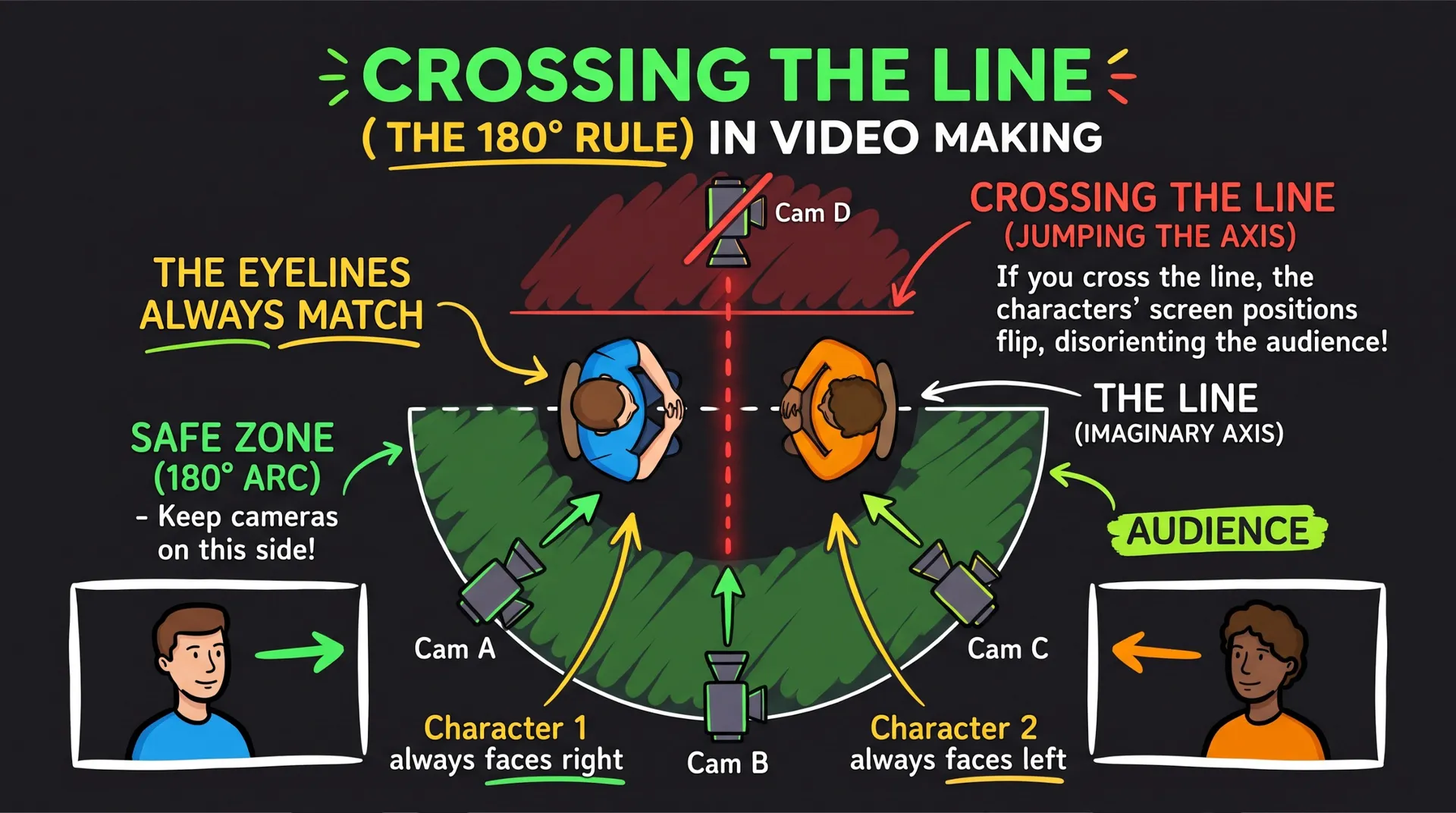
The 180 degree rule is one of the fundamental rules of filmmaking – and ensures that a scene keeps visual continuity, and that your audience does not get confused.
It is used when shooting two characters, or objects, in a single space. Picture this: a circle is drawn around the two characters and an imaginary line runs between them. Camera placements to film both characters separately should be on one side of that line, but not both. This way, the characters remain on the same sides of the frame, continually looking in the same direction through the dialogue, making it easier for the viewer to follow the film’s narrative.
Here’s an example of how that might work: Character 1 is on the left of the frame, and character 2 is on the right. Character 1 talks to character 2. In this scenario, a camera is placed over the shoulder of character 2 so we can see character 1 talk. Now, character 2 starts replying and we cut to another camera over the shoulder of character 1, looking toward character 2. In order to keep character 1 on the left and 2 on the right, we mustn’t cross over the "line" onto the other side of the couple.
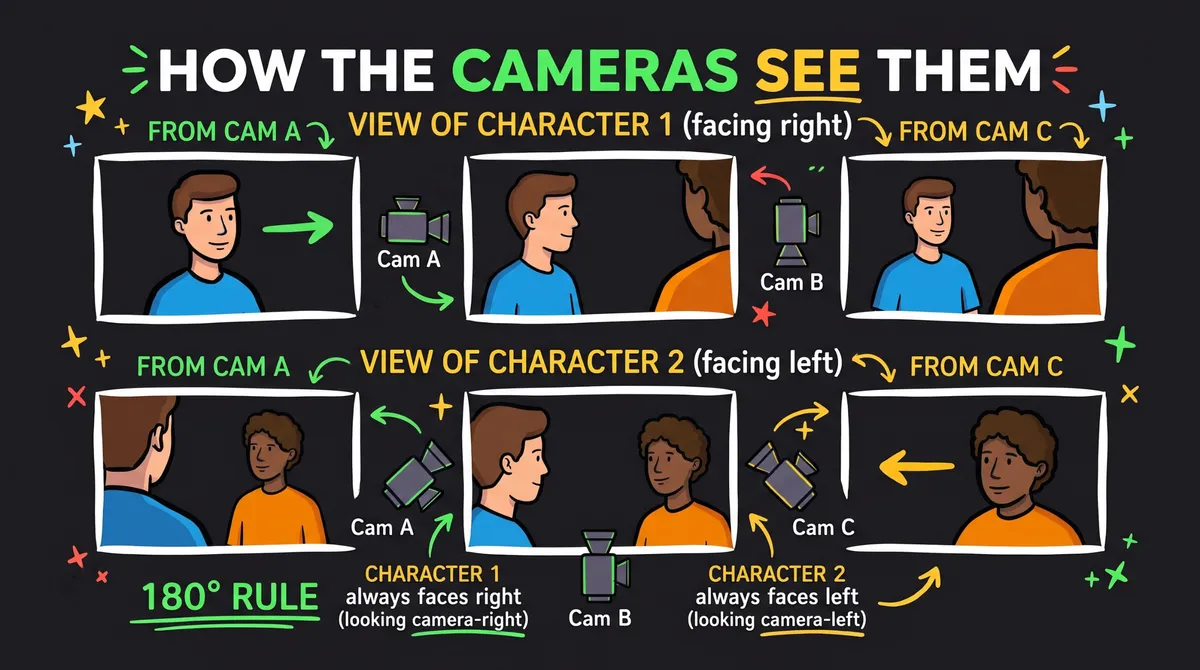
Using shots in pairs is a common way of connecting shots together. The second shot is known as the reverse angle shot of the first – and together they form a complementary pair.
But the same technique can be used even when you are shooting just one person. If the person is looking off-screen, we assume that the next thing we are shown on screen is what that person is looking at. Reverse angles can also be used to reinforce height differences between subjects – a shot looking down on a cat can be matched with a reverse angle shot of what the cat is looking up at, with the camera shooting up from ground level.
Similarly, if you are shooting a moving subject they should appear to move in the same direction in each shot. For instance, if you are videoing your family on a walk, they should always appear to move from left to right across the screen (or always from right to left). If the direction changes, the viewer's natural assumption is that they are now heading back from where they came.
If you are not careful, it is easy to end up with a video where the direction of movement is continually changing. The secret is to shoot from the same side of your subject throughout, and avoid the temptation to switch sides to get a more interesting view.
Some textbooks explain this rule by saying that there is an imaginary line that your subject is heading along – and at all costs you should avoid crossing this line – hence why it is known as the crossing the line rule. It is also known as the 180° rule – you can move from in front of your subject to behind them, but you cannot cross their path.
Sometimes you may have no option but to 'cross the line' and to change the direction of on-screen movement. If you really need to do this two possible solutions will make the change more acceptable to the viewer (although neither is perfect):
• Keep recording as you cross the line of action – so the walkers, say, look as if they are heading towards the camera, then move to the other side of the path as they approach.
• Insert a cutaway between the two opposite shots. For instance, at a football match, a brief shot of the crowd, or a shot of the scoreboard, could be used to provide visual relief from the main subject – and give you a chance to change on-screen direction.
Continuity of direction does not just affect action footage, it has its role to play in static subjects. Most importantly, if a person is looking from left to right in one shot, they should be looking in the same direction in the next.
See our other photography and moviemaking cheatsheets

