
A good camera slider is one of the easiest ways to give your videos a more polished, professional look without investing in a complete filmmaking rig. By introducing smooth tracking shots and controlled camera movement, a slider can instantly improve the production value of your footage and make even simple scenes feel more cinematic.
Modern sliders, along with the occasional compact camera dolly, come in a wide range of sizes and price points. Whether you are filming with a mirrorless camera, DSLR, smartphone, or action camera, there are plenty of options available to help you introduce more dynamic movement into your work.
A sturdy tripod and fluid video head remain essential tools for any filmmaker, but a slider offers something different. It creates a greater sense of depth and motion, adding energy to a shot while making the composition feel more deliberate and engaging.
Sliders are particularly effective for product videos, where a slow, controlled movement can highlight a subject’s shape, texture, and finer details as the light moves across it. Some models can also be mounted vertically, allowing you to create rising or falling shots that emphasize height and perspective.
Compact, practical, and capable of producing impressive results, a camera slider remains one of the simplest ways to make your footage look more considered and professional.

For nearly two decades, Sebastian’s work has been published internationally. In his spare time, he uses his trusted Leica M240 to document the world around him, usually in black and white. He also has extensive experience with professional video systems from ARRI and Sony and is a RED camera owner.
The best camera sliders in 2026
Why you can trust Digital Camera World Our expert reviewers spend hours testing and comparing products and services so you can choose the best for you. Find out how we test.
Best slider overall

✅You want a lightweight carbon fiber build that’s easy to carry without sacrificing stability.
✅ You want app-based control to fine-tune speed, direction and motion patterns with ease.
❌You want ultra-fast timelapse intervals, but the minimum settings are somewhat limited.
❌You want a premium carry case, though the included one feels fairly basic.
This carbon fiber slider offers great value, providing an impressive 80cm (31.5in) of camera movement along its 80cm (31.5in) rail. There is no physical controller provided, and instead you control the movement via an app on your phone. We were particulaly impressed on must how easy to use, and we were able to get it working without any need to refer to the instructions.
The ER1 comes with short built-in legs that are a total lifesaver for tabletop or ground-level shots, especially since the leveling feet help you get everything perfectly straight. It’s also super flexible when it comes to mounting; thanks to the standard screw threads on the ends and the bottom, you can easily pop it onto your favorite tripods or light stands. Whether you want to mount it right in the center, at a steep 45-degree angle, or supported at both ends for a rock-solid slide, you’ve got plenty of options to get creative.
Crucially, operation smooth and silent, with no jerking of the carriage carrying the camera. The build quality of the rail itself also very impressive, although the quality of the supplied case is not particulary great
For the price, this is an absolute steal – offering features that some rival manufacturers would charge you twice the price for.
Read our full Neewer ER1 Motorized Carbon Fiber Camera Slider review
Best slider with built-in controller

✅You want quiet, smooth brushless motor movement that delivers stable, professional-looking footage.
✅You want a solid payload capacity (4kg horizontally) that handles most mirrorless cameras.
❌You want longer travel distance options, yet the 60cm length can feel limiting for big push-in shots.
❌You want a locking mechanism for transport, but the slider carriage can still move when powered off.
The Accsoon Toprig S60 motorized slidermakes motion-controlled shots an absolute breeze - and can be used vertically as well as on the level to give you a crane shot.
The build quality is super solid with a nearly silent brushless motor. It can handle up to 4kg horizontally (2.5kg vertically) and has a great speed range. My favorite feature? A clever central bar that lets you easily dial in panoramic or parallax tracking shots to keep your subject perfectly centered.
The integrated controls are incredibly intuitive for setting your A and B points, and you can even use a handy phone app. Plus, the NPF battery life is insane—one small battery lasts for days! Just a heads-up: if you're using a heavier camera, you’ll definitely want extra support arms on your tripod to stop the ends from dipping.
See our full Accsoon Toprig S60 review
Best premium slider

✅You want an ingenious extendable rail design that gives much more travel distance while staying compact.
✅You want excellent load support that handles heavy mirrorless and DSLR rigs (up to ~20 lb/9 kg on a tripod).
❌You want a built-in motorised motion out of the box, but this is a manual slider requiring add-ons for powered performance.
❌You want integrated manual controls, yet most advanced functions rely on the companion app when motorised modules are attached.
The Edelkrone SliderPLUS v5 PRO Long is designed with movable rails that travel during a slide. This gives you extra travel distance while keeping the slider compact – perfect for tight spaces or when you need a compact solution while traveling.
Used on the ground or another surface, it has a travel length of 1.3 feet and supports up to 40lb. Mounted on a tripod, it provides a travel length of 2.6 feet with 20lb loads supported, so you can work with some pretty heavy camera rigs. The movable rail design also works well for dolly shots: since the rails move along with the carriage, they won't get in the shot as you dolly in and out.
The SliderPLUS v5 PRO Long is a manual ball-bearing slider, but it does support the optional Slide Module v3 attachment for motion control, and other Edelkrone motorized add-ons can be incorporated, for fully synchronized multi-axis motion control operated via a single iOS/Android app. So you’ve got a compelling upgrade path as your videography ambitions grow.
Best slider for smartphones
✅You want an impressive 24-hour battery life so you can keep motion going through long timelapse sessions.
✅You want Bluetooth app control so you can adjust movement, speed and loop modes straight from your phone.
❌You want very advanced motion features in the app, but the control options are somewhat limited compared with premium systems.
❌You want long travel distances, yet the 8″ (20 cm) travel is fairly short compared with larger sliders.
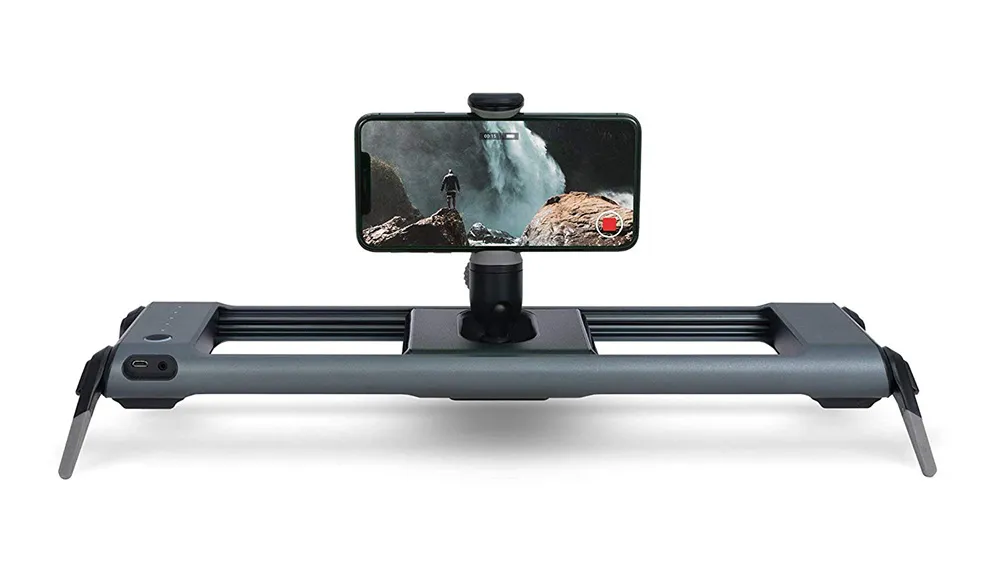
Rhino’s ROV Everyday is a beautifully crafted motorized slider that is the perfect fit if you’re after a high-quality option for your smartphone or action cam. With its unibody CNC milled rail, 24-hour battery life and lightweight body (clocking in at under 1kg), its specs read like a slider dream perfect for travel or just having in your bag, just in case it's needed.
The ROV accepts DSLRs and mirrorless cameras, but also ships with a handy phone mount, and it’s with smartphones that it really shines. Phones that feature three optical zoom ranges (such as the Apple iPhone 16 Pro Max), can take the limited sliding range of 20cm and work wonders with it.
There is an app for remote control, although that of course means that you’ll need a second phone or a tablet if you’re filming with your phone. But if you’re after a great automated choice to elevate your videography with your mobile or digital camera, it’s definitely worth checking out the ROV Everyday. If you need more range, the slightly pricier ROV Traveller offers a full 40cm of travel.
Best budget slider for smartphones

✅You want a complete kit with GorillaPod and ball head included so you can start shooting right away without buying extras.
✅You want added creative perspective in timelapse and b-roll clips to make otherwise static shots more engaging.
❌You want very stable support, though the included flexible GorillaPod can wobble or even topple if not positioned carefully.
❌You want serious cinematic slider performance, but it’s most effective for small phone moves rather than professional-grade motion shots.
A miniature slider designed for the smartphone filmmaker, the Swing doesn't give you a very long tracking range, or particularly fast camera movement. But what it does give you is a highly portable and easy-to-use slider system that comes with everything you need in the box. It's pretty affordable too, and the JOBY Motion app makes it easy for even total novices to get to grips with.
Using the app, you can precisely choose the start and end points of your motion, meaning your compositions can get very precise indeed. You can easily set the Swing up to run through a timelapse sequence, and the supplied GripTight ONE phone mount keeps your phone snug and secure on the slider.
Folding down to 17cm and expanding to a length of 42cm, the JOBY Swing is an ideal slider to throw in a kit bag and take out on a day's filming. It doesn't give you a great deal of versatility, but that's an unavoidable trade-off for such a compact slider. It always tracks at the same speed, which restricts your options, but does make it very easy to produce multiple shots with a consistent look and feel.
Read more: JOBY Swing Complete Kit review
Best dolly for smartphones

✅You want a motorized dolly system that gives smooth, controlled movement for dynamic footage.
✅You want wireless remote control operation so you can start, stop, and change direction from a distance.
❌You want a traditional linear slider feel, but this is a dolly on wheels rather than a rail-based slider.
❌You want serious heavy camera capability, yet it’s best suited to lightweight setups under about 5 kg/11 lb.
If portability coupled with affordability is what you are looking for, the Andoer L4 Pro is a three-wheeled wonder. It folds up small enough to fit in a small bag or even a big jacket pocket. Unfurl it, and you can thread on a ball head and a smartphone grip for an excellent mobile dolly.
Smartphones like the Sony Xperia Pro 1 and action cams like the DJI Action 4 have excellent image stabilization, and this makes them perfectly suited to the L4 Pro, which is only as smooth as the surface it’s traveling across.
Thanks to its size and remote control functionality, you can get fantastic motion shots in extremely tight spaces, and what’s even better is that with its repositionable wheels, it also offers a lot of versatility.
While it’s definitely best suited to smaller cameras – it won’t take a C500 cine camera with a 70-200mm lens – you’ll still be able to get a mirrorless camera on it with a 50mm lens onboard if the need arises.
In some countries, newer version - the Andoer L5I - is now available which is essentially the same but offer stepless speed adjustments (rather than three presets).
How to choose the best camera slider
This roundup covers a variety of slider designs, reflecting just how broad this category has become. One option is not strictly a slider at all, but a wheeled dolly system with adjustable components that allow for different types of camera movement. At the higher end, some sliders use precision bearings for exceptionally smooth travel, while more affordable models tend to rely on simpler friction-based systems.
Rail length is one of the most important factors to consider. Longer rails give you more travel, allowing for wider and more dramatic camera moves, but they are naturally heavier and less convenient to carry. Even so, you do not always need a long slide to make an impact. A short, controlled movement can still add a noticeable sense of polish and production value when used carefully.
Payload capacity is just as important, particularly if you are looking at motorized sliders. Every system has a maximum weight limit, so you need to consider the combined weight of your camera, lens, and any accessories. It is also worth remembering that payload ratings can drop significantly when a slider is angled or used vertically, and not every model is designed for crane-style movements.

