

Digital Camera World Verdict
The Seestar S50 Pro takes the wonderfully simple concept behind the original S50 and pushes it towards serious astrophotography. Its larger sensor, wider field, dual-camera design, and EQ mode make this a much more capable instrument, while retaining the automated setup that made Seestar successful in the first place. However, a much higher price means this is no longer an inexpensive shortcut into astrophotography.
Pros
- +
8.3MP resolution
- +
Easy to use
- +
EQ mode works well
- +
New Star Trail mode
- +
Computational photography features
- +
FITS files for external processing
Cons
- -
Much higher price than original
- -
EQ mode requires an accessory
- -
Still limited for planetary imaging
- -
Larger size than original
Why you can trust Digital Camera World Our expert reviewers spend hours testing and comparing products and services so you can choose the best for you. Find out how we test.
The original Seestar S50 was the first really popular smart telescope, succeeding because it removed much of the friction from astrophotography. By putting everything into one chassis, it made deep-sky capture less about assembling a complicated, expensive rig and more about simple software. The Seestar S50 Pro is more ambitious. It’s a similar 50mm f/5.2 telescope, but this time it feeds a considerably larger 8.3MP sensor, while a second camera handles wide-field imaging that even approaches computational photography, removing much of the complexity from nightscape photography. Add an optional EQ mount for 60-second exposures, 128GB storage and a much larger battery, and this begins to look less like an upgraded S50 and more like an attempt at an all-in-one rig to please all kinds of night photographers. However, the S50 Pro is slightly taller, noticeably deeper and about 300g heavier than the original. It’s no longer quite as portable, and it's not as affordable. Does its new higher price take away the entire attraction of a smart telescope in the first place? Here’s everything you need to know about our tie-in with the Seestar S50 Pro.
Seestar S50 Pro: Specifications

Sensor |
1/1.25in OmniVision OS08B10 |
Resolution |
8.3MP (3840 x 2160) |
Aperture |
50mm / 2 inches |
Focal ratio |
f/5.2 |
Focal length |
260mm / 10.2 inches |
Optics |
Quadruplet apochromatic lens with ED glass |
Solar filter |
Seestar magnetic solar filter |
Filters |
UV/IR-cut, dual-band OIII/H-alpha, dark-frame |
Storage |
128GB eMMC |
Connections |
USB-C, Bluetooth and WiFi |
Mount |
Alt-azimuth (EQ mode supported) |
Battery |
10,000mAh |
Dimensions |
140 × 149 × 268mm / 5.5 × 5.9 × 10.6 inches |
Weight |
2.8 kg / 6.17 lb. |
| Row 14 - Cell 0 | Row 14 - Cell 1 |
Seestar S50 Pro: Price

The S50 Pro’s regular $999/£999 price is arguably its biggest weakness because it puts the telescope into territory where buyers can reasonably consider modular astrophotography equipment instead. That makes the question less about whether the S50 Pro is better than its predecessors – on paper, it clearly is – and more about whether those improvements justify the premium. EQ mode matters here, though accessing that feature requires an additional purchase. For example, Seestar’s TH10 fluid head costs a further $99/£99.
Seestar S50 Pro: Design & handling

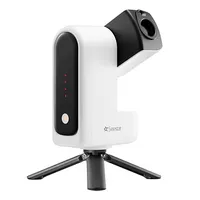
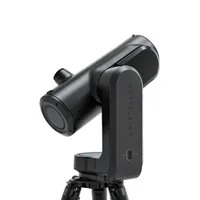
Despite its new capabilities, the S50 Pro retains the fundamental attraction of the Seestar concept — an enormous amount of astronomy hardware squeezed into one portable unit. The telescope weighs 2.8kg and folds to 140 x 149 x 268mm, which is relatively small. However, it is slightly larger than the original S50. In our tests, we found that it didn’t quite fit as easily into our camera bag. At least the carbon-fiber tripod it comes with remains small and easy to pack, yet solid enough to hold the S50 Pro steady.
The biggest change in how the S50 Pro works isn’t obvious at first glance. Instead of the original S50’s narrow imaging area, the Pro records a rectangular 2.8-degree field of view using its 3840 x 2160 pixel resolution main camera.

Its second 63-degree wide-angle camera is perhaps even more impressive because it enables wide-field night-sky and landscape imaging, making the S50 Pro a considerably more versatile photographic device. We’re huge fans of its new Milky Way mode and Star Trail mode, which use advanced features — autofocus, wide-field live stacking, panorama and time-lapses — that help it operate as an imaging system in its own right. It even engages in real-time computational photography, freezing the foreground while exposing for the night sky.
Elsewhere, it works the same as always, with plate solving, auto-aligning, centering, focusing, tracking and live stacking removing most of the work of astrophotography. In our tests, we got the S50 Pro up and running and successfully stacked a deep-sky exposure within five minutes of switching it on. But the longer you leave it to stack, the better the results.
Seestar S50 Pro: Performance

For deep-sky work, the S50 Pro’s new 4K sensor is critical, but perhaps not for exactly the reason many might think. Yes, the 3840 x 2160 pixels produce more detail, but don’t confuse 4K with a fourfold improvement in fine detail. The real advance is largely the substantially larger imaging area. You get more sky around a target, more freedom when composing and potentially more latitude for cropping field-rotation-affected edges. That helps with targets like the Andromeda galaxy (M31), one of the largest targets in the night sky, as well as many large nebulae. You can extend its field of view with Mosaic Mode, which you enable by reframing an object in the app; the S50 Pro then automatically captures overlapping fields to create larger compositions.
The 50mm aperture is important, too. It gathers almost three times as much light as the S30 Pro's 30mm aperture, while the longer 260mm focal length gives smaller galaxies, globular clusters and compact nebulae more image scale. There’s still not enough focal length for planets, but that doesn’t stop the app from listing them as potential ‘best tonight’ targets.
In our tests, we were impressed not only with how the new 1/1.25in sensor captured fine detail, but also with what the app can do with that data. There’s now an AI enhancement mode and plenty of other in-app tweaks to take an image and make it look sharp and colorful against a deep black starfield. The results straight from the S50 Pro are impressive, given how little technical knowledge or manual intervention they require.

The built-in dual-band filter is particularly useful for emission nebulae, isolating hydrogen-alpha and oxygen-III wavelengths while suppressing much of the background glow from light pollution. There’s also a UV/IR-cut filter for broadband targets such as galaxies and star clusters, plus automatic dark-frame calibration. An integrated dew heater also helps keep the objective clear during long sessions.
Previously tested on the Seestar S30 Pro, EQ mode is potentially even more important on the S50 Pro. It only takes a few minutes to set up. It’s then necessary to go into Expert Mode and select how long you want exposures to be — we went straight for 60 seconds, the maximum available. Since most star trackers allow about three minutes, it’s obvious that the S50 Pro's ease of setup comes with a trade-off in accuracy. That’s underscored by the app’s built-in walk-through pages for tweaking the TH10 mount's position in EQ, which allows a little leeway in the exact orientation. EQ mode also requires the tripod legs to be splayed wider to keep the S50 Pro from toppling over — though only if you live at around 52 degrees north or south of the equator.

The S50 Pro's key feature is what it can produce without doing anything remotely complex, but it also has something for experienced imagers who want the finest images possible. FITS access lets you take the underlying data into dedicated third-party astrophotography software to see how much more you can extract. That becomes particularly interesting in EQ mode, where longer individual exposures and the absence of field rotation should provide better source data.
The second wide-angle camera is another major change. Its 63-degree field of view transforms the S50 Pro from a device primarily designed for individual deep-sky objects into something capable of capturing constellations, large areas of the night sky and the Milky Way. We’re huge fans of its new Milky Way and Star Trail modes, which add a completely different kind of astrophotography to the Seestar experience. During our test, we left the S50 Pro for two hours to compile an impressive star trail that nearly matches a camera and wide-angle lens.
Seestar S50 Pro: Functionality
Despite its added capabilities, the S50 Pro works much like previous Seestar telescopes. Plate solving, auto-aligning, centering, focusing, tracking and live stacking remove most of the work traditionally associated with astrophotography. In our tests, we got the S50 Pro up and running and successfully stacked a deep-sky exposure within five minutes of switching it on.
The Seestar app is central to that experience. It effectively acts as the telescope’s control system, planetarium, camera interface and image-processing software. Choose a target and the S50 Pro can locate it, slew to it, center it and begin collecting exposures, with the resulting image gradually appearing on a smartphone or tablet as those exposures are stacked. For beginners, that remains the main attraction of Seestar. The app can also create imaging plans, allowing the S50 Pro to move between targets automatically during a session. Crucially, imaging continues even if you close the app, making long or unattended sessions much more practical. However, without weatherproofing, leaving the S50 Pro overnight to collect data will be too risky for most users.


In addition to the app's excellent processed images, users can access FITS files – both the composite finished image and (via USB-C) the original stacked images – and process them with third-party software. This creates a useful progression from near-fully automated astrophotography to more involved image processing, without replacing the telescope itself. EQ mode takes that progression further.
The larger 10,000mAh battery is another practical upgrade. That matters because long integrations, EQ sessions, and wide-field imaging encourage users to keep the S50 Pro running much longer than a basic grab-and-go observing session. In our tests, the battery never ran out, and it lasted well over six hours.
Seestar S50 Pro: Verdict

The Seestar S50 Pro is best viewed not as a higher-resolution S50, but as a more versatile imaging platform. The wider 8.3MP sensor, 50mm aperture, wide-angle camera and EQ capability give enthusiasts considerably more room to experiment, while beginners retain the brilliantly automated Seestar workflow. It’s particularly attractive as a compact second telescope or travel imaging system. Anyone wanting traditional visual observing, serious planetary imaging or an upgradeable system should look elsewhere, while value-conscious beginners will find the original S50 difficult to beat. Either way, the S50 Pro is easily the most interesting Seestar yet.
Features ★★★★★ |
An outstanding all-in-one feature set, with an 8.3MP 4K main camera, second wide-angle camera, FITS export, EQ mode support, automated live stacking and dedicated Milky Way and Star Trail modes. |
Design ★★★★½ |
Compact and impressively self-contained for a 50mm smart telescope, with a sturdy carbon-fiber tripod and large 10,000mAh battery, though its increased size and 2.8kg weight make it less camera-bag friendly than smaller Seestar models. |
Performance ★★★★½ |
Excellent automated deep-sky imaging, with the larger sensor providing a much wider field of view and plenty of detail, while EQ mode significantly expands its astrophotography potential. The uncooled sensor and limited planetary abilities remain compromises. |
Value ★★★★☆ |
At $999/€999, the S50 Pro is considerably more expensive than previous Seestar models. It enters serious astrophotography territory, but its larger imaging area, dual-camera design and EQ capability make it substantially more versatile. |
Check out our full guide to the best smart telescopes

