Digital Camera World Verdict
The Rove RS2 comes with an ultra-slim probe that’s IP67 waterproof, making it a great borescope to consider for a range of trades. There are useful features ranging from adjustable lighting and automatic focus to digital zoom and video capture, although the images captured can be grainy in certain circumstances, which can make it unsuitable for precision work. Another issue is that while the controls on the display can be operated using just one hand, it’s on the heavy side and feels clunky. Ultimately it comes down to price. This device is significantly more expensive than its competitors and it’s hard to justify the additional expense unless you’re looking for an ultra-slim probe.
Pros
- +
Ultra slim articulating 6.2mm probe for tight spaces
- +
Display designed to be operated using one hand
- +
Adjustable zoom and brightness for improved visibility
Cons
- -
Articulation doesn’t work well if the cable isn’t completely straight
- -
Image resolution can be poor
Why you can trust Digital Camera World Our expert reviewers spend hours testing and comparing products and services so you can choose the best for you. Find out how we test.
A borescope is an essential bit of kit for those who work in the automotive, plumbing or construction industries. It allows you to peer into tight spaces with a camera probe, so you can identify the problem and a possible fix without opening everything up. There are plenty of options on the market, ranging from sub-£50 devices that are geared towards hobbyists to ones that come in at over £100 for professionals. The new Rove RS2 sits firmly on the premium end of the scale.
If you haven't heard of Rove before, it's because it's a new entrant to the professional tools sector. The company is best known for making dash cams for the consumer market and the RS2 is its first foray into borescopes. And it's targeting mechanics, plumbers, HVAC technicians, electricians, home inspectors and serious DIY users with the device’s extensive features.
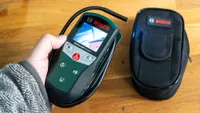
But how does it stack up against existing products on the market like the Depstech DS500 or the Bosch UniversalInspect? Is it worth its premium price tag? And does it deserve a spot on the list of the best borescopes? I’ve been testing the device to find out.
Rove RS2: Price and availability
The Rove RS2 only launched in May 2026 so its availability remains limited. It’s currently retailing exclusively on Amazon US with an RRP of $159.99. This puts it at the premium end of the market; similar two-way articulating borescopes generally sit around the $120 to $140 mark.
At first glance, it’s hard to justify buying the device based on price alone. Afterall, borescopes with very similar specifications from more established brand Depstech costs significantly less. Take the Depstech DS650. Its specs are broadly identical to the Rove RS2 but it’s $30 cheaper.
However, several of Rove RS2’s features aren’t found on similarly priced models. The camera angle of view is up to 90 degrees on the Rove RS2, for example, whereas this is just 70 or 80 degrees on competitor models. It also offers up to 4x digital zoom with autofocus, while most models offer just 2x digital zoom. And then there’s the ultra-slim probe, which, at 6.2mm, is small enough to fit into standard plug holes. There are devices that tick off the Rove RS2’s features individually but none that covers all of them.
Rove RS2: Specification
Specification |
Details |
|---|---|
Resolution |
1080P / Full HD video |
ISO sensitivity |
ISO 100 – 6400 |
Macro focus range |
20 mm to 100 mm (0.8” to 3.9”) |
Display |
10.9cm (4.3-inch) LCD display |
Probe diameter |
6.2mm (0.2”) |
Probe length |
1.6m (5.25 ft) semi-rigid gooseneck |
Articulation |
up to 210 degrees, two-way |
Lights |
6 LEDs on probe, 2 LEDs on display |
Battery |
2600 mAh rechargeable |
Runtime |
Up to 4 hours per charge |
Charging |
USB-C |
Storage |
Included 32GB microSD card; supports up to 64GB |
Waterproofing |
IP67 waterproof |
Weight |
553 g |
Dimensions |
W 13cm x D 4.8cm x H 23cm (W 5.12” × D 1.9” × H 9.06”) |

Rove RS2: Build & handling
The Rove RS2 is similar to other borescopes on the market so it won’t feel alien to use if you’re replacing an existing device. For new users like me, it’s intuitive enough that you don’t need to refer to the user manual. Unlike cheaper alternatives, this is an all-in-one device where the articulating probe is attached to the display. That means there’s no need to connect it to your phone or download an app to use it, which is helpful if you’re at a work site where things can easily get dirty or if there’s limited wifi connectivity.
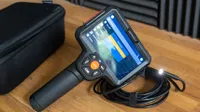
The main body houses the 4.3″ IPS LCD display plus a compact control panel on the handle with buttons that you can easily operate using one hand. These let you adjust the focus and lighting as well as record videos and take photos. Sitting between the buttons is a wheel for controlling the probe articulation. The wheel is accessible on both the front and the back of the handle. On one side of the main body there’s also a USB C charging port, a slot for microSD card and a hard reset button should the device malfunction. The 2600 mAh rechargeable battery, providing up to 4 hours of power, is behind a screwed-in panel in the handle.
Protecting the display is a hard black plastic casing that has been reinforced for drops, dust and general wear and tear. It feels sturdy but it would have been nice to have a rubber coating on the handle for improved grip and on the rest of the casing to reduce noticeable scratches. The Rove RS2 does come with a cushioned carry case so you can keep it with other tools without worrying too much about accidental damage.

What really distinguishes this device from its competitors is the probe. At 6.2mm, it’s among the slimmest available - most others are upwards of 7mm - which means you can insert it into plug sockets, with the mains switched off, of course. At the probe head is a camera that's surrounded by a cluster of six LED lights. Immediately behind the camera head is about an inch of nylon braiding that protects the probe while allowing it to be flexible enough for articulation. The rest of the probe is a semi-rigid gooseneck that makes it easier to insert the camera into crevices. At 1.6m, it's long enough for most exploratory situations.
The probe is two-way articulating, which means you don’t need to remove and reinsert it for a better view in many situations - just adjust the articulation. Rove expects the probe to withstand upwards of 8,000 bends with correct usage. You should double-check the degree of articulation if this is a key feature for you. On my device, the articulation was up to 180 degrees but it seems Rove has since updated its devices to 210 degrees.

In terms of accessories, Rove includes a 32GB microSD card that comes installed in the ready-charged device so you can use it straight out of the box. There’s also a spare probe cap, two lens cleaning cloths and a USB C cable that can be used to charge the device to transfer data from the microSD card to a laptop. There are no hooks or magnets though so this device can only be used for visual inspections.
Rove RS2: Performance
There’s a lot to love about the Rove RS2. In particular, it was helpful to be able to adjust the brightness of the lights to get the right contrast depending on whether the camera was pointed at a smooth, reflective surface or in total darkness. It’s also possible to digitally manipulate the image on the device. I could, for example, play around with the zoom and the orientation of the image to get the best view. And despite the slightly clunky feel of the handheld display, I was able to operate it using just one hand with minimal effort, which was necessary when adjusting the probe for a better view.


However, there were some limitations in the image quality. In some testing scenarios, the visuals on the display were extremely grainy. Initially I thought it was just an issue with the display but after checking the saved images and videos, it seems to be an ISO problem where the camera just isn’t coping well with the low light conditions. The video setting offered slightly clearer visuals than even the display for diagnostics but smaller issues might be obscured by the graininess. Some of this can be mitigated by adjusting the positioning of the probe or the lighting, but it can be frustrating to do if you’re not already a pro.
There are two other things that might be worth bearing in mind. The first is that the device weighs over 500g, which is near the heavier end of the spectrum. You could reasonably control it using one hand, but the extra weight might put you off from doing so for long periods of time. Also worth noting that the probe articulation becomes harder to adjust when the gooseneck is slightly bent so you’ll struggle to reach the full articulation promised.

Rove RS2: Overall verdict
For a new entrant to the borescope market, the Rove RS2 ticks off a lot of features that will suit professionals and serious hobbyists. It’s intuitive to use and requires virtually no setup so you can hit the ground running even if it’s your first time picking up a borescope. However, while the price point places this device firmly on the premium end of the market, I’m not sure the price is entirely justified - especially if you’re just an occasional user.
A big let down for me was the graininess of the imaging, which affected both the live display and photos captured using the device. The video resolution was better but it’s more hassle to constantly transfer the recording to a laptop for viewing. It also lacks magnet and hook attachments, which means you can only use the device for diagnostics. It’s not an issue for every trade but it’s certainly a useful feature to have.
For me, the only reason you should pick the Rove RS2 over competitor brands is for the ultra-slim probe. Otherwise you could buy something very similar for quite a lot less money. That said, if you spot a good deal then it’s certainly still worth considering.
Features ★★★★☆ |
The device ticks off a broad spectrum of features including IP67 waterproofing and adjustable lighting that makes it a strong competitor against similarly priced borescopes. |
Design ★★★★☆ |
The handheld display feels clunky but it’s easy enough to use with one hand and intuitive enough that you don’t need the manual. |
Performance ★★☆☆☆ |
The video quality was decent but image capture was a let down so it’s best in scenarios where you don’t need to see a lot of detail. |
Value ★★☆☆☆ |
This device is significantly more expensive than similar borescopes but the features will only justify the higher price for some users. |
Alternatives