
Digital Camera World Verdict
Everything about this camera speaks premium. The new 1/1.1-inch square sensors bring low-light quality, the new body shape is practical and useful, and extra features like storage, 10-bit color science make this a category-winning 360-degree camera. The software – on board and off – is also well ahead of the game, especially if speed is essential, too. If you can handle the price, this is absolutely the 360-degree camera to have.
Reasons to buy
- +
Useful compact new form factor
- +
1-inch sensors perform well in low light
- +
Bright OLED display easy to see outdoors
- +
New power extension pole and improved batteries
- +
Microphone array capable of picking speaker's voice from crowds
Reasons to avoid
- -
For existing users, getting used to new button positions takes time
- -
Price puts the camera at a premium
- -
Resolution is adequate for relatively close shots, but can't replace new dual-lens gimbal cameras (like Insta's own Luna Ultra)
Why you can trust Digital Camera World Our expert reviewers spend hours testing and comparing products and services so you can choose the best for you. Find out how we test.
Insta360 has over 70% of the 360-degree camera market, and its last few generations of cameras have been as recognisable as they were functional. There have been ten years of development, before the 'X series' has settled on a rough shape and incremental improvements that make for a 360-degree camera that can also be an action camera.
In recent months, though, the dominant X-series has faced more competition than ever before, in the form of the DJI Osmo 360 and the GoPro Max 2. Insta360 has responded by shaking things up in a number of ways for this new generation – it is a new shape, it brings more power – both in terms of battery life and computational abilities, and it has bigger image sensors to make it more capable in low light.
Insta360 is also keen to help make 360-degree creation easier, bringing more AI features to the table.
The question is: Has Insta360 done enough to stay ahead of the much tougher game? I have been lucky enough to get early access to one of the cameras and have been out testing it to answer exactly that question.
Price
The Insta360 X6 launches at a category-topping $699 / £619 (or $799 / £709 for the 'Essentials Bundle' which adds the near-essential selfie stick as well as other probably-less-necessary accessories like a fast-charge case and extra battery).
That is some way in excess of the GoPro Max 2, or the DJI Osmo 360, a premium Insta360 understands too. The X5 and X4 Air will remain for sale, with the X6 sitting at the top of the range.

Specs
Resoulution v max frame rate |
8K50 |
Sensor size |
1/1.1" Square Sensor |
Stills resolution |
120MP |
Single Lens mode max |
5120x3840 (5K) at 60fps Or 1:1 for FreeFrame: 6016x6016 (6K) |
Color science |
10-bit I-Log, Dolby Vision |
Timelapse resolution max |
16K (15360×7680) |
Battery Life |
140 minutes |
Connectivity |
USB-C, Bluetooth, Wi-Fi |
Storage |
47GB Built-in + MicroSD |
Screen size |
2.32'' OLED |
Weight |
196g |

Build and handling

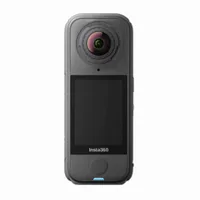
For the first time in several generations, Insta360 has changed the form factor of the camera. The X3, X4, X4 Air and X5 are all virtually the same height and width, placing buttons beneath the screen and the back-to-back lenses at the top.
The new X6 dispenses with those two physical buttons, opting to add a pressure-sensitive display which can be pressed (even when wearing a glove) to act as a shutter button, while moving the mode button to the other side.

The two main buttons on the screen are easily pressed, so starting and stopping recording is straightforward (and you can enable a pressure sensitive screen start-stop for gloved hands).
While the camera remains compatible with Insta360's magnetic mount system, four contacts for pogo pins mean that new accessories – including a version of the selfie stick that has a battery in the handle and keeps the camera running for much longer, ideal for a long shoot or an extended timelapse.

This re-imagination of the design makes a lot of sense because the more compact form factor is easier to use for action situations. The camera nevertheless now packs ambient light sensors and an AdaptiveTone 2.0 system to meter each camera separately.
The X6 is also better equipped to record action, boasting faster 8K50 fps (its predecessor maxed out at 30fps). There is support for Dolby Vision HDR and 10-bit color.

In terms of rugged strength, the camera feels convincing, all the ports behind sealed doors. It is waterproof to 20m/60ft without a case, and new '2.0' lenses are easier to replace in the field (and priced lower than before too).
Performance
Perhaps I should start by saying that pulling content from the device to assemble clips was as painless a process as I've experienced with a 360-degree camera.
The Studio app was my tool of choice, though it can also be done on the phone, and files copy over surprisingly fast thanks to the Wi-Fi 6 connection.


I can see in my first tests that the investment in larger image sensors has been worth it – the image quality, both stills and video, is markedly improved from the previous versions, and that shows in footage I was able to capture in locations like Times Square, where detail was captured in the rapidly flashing lighting, while the darker area


I was definitely sure that the 1,200-nit (peak) 2.32-inch OLED display achieves the level of brightness needed to cope in sunny environs, too, and Insta360 are right to be proud of the battery improvements – charging to 80% in 24 minutes seemed easily achieved.
Operating the menus is snappy and straightforward, but that's not the only evidence of the new processor chip.
The most significant improvement is active subject tracking, meaning the X6 can also work a lot like a gimbal camera, creating flat 4K video which keeps a nearby subject in frame as you go – usually meaning you, the person holding the selfie stick! There is also the option of 360 Video Backup – shooting a spherical video as well as a flat video simultaneously, so you have the flat video quickly and can reframe. This, though, is let down by the fact that 1080P and 5.7K is the limit.
The device will also start making an AI edit when left alone and plugged in, which is a step forward from other cameras.
Software

Insta360 has provided its usual Insta360 Studio for desktop and a phone app which can also serve as a remote control, as well as plugins for Premiere and the like, all of which go to making the workflow of the 'shoot first, frame later' creator as smooth as possible.
Admittedly, I'm uncertain that the app absolutely needs 2.2Gb of my Mac's overpriced drive space, but Insta360 does not set Apple's storage prices, and that's a minor issue. However most video editors prepared to invest time in after-the-fact will find a range of easy-to-grasp tools built around a timeline, and subject tracking can be added at this stage.
The phone app will show you ready-edited compilations – the above is what it did with the same set of clips I had from New York. Clearly it can't make a coherent edit of my talking to the camera, but it does seem capable of identifying the most action even in images with relatively little going on. Despite the fact these shots were made more with testing quality in mind, you can see the beginnings of an edit you could post on socials.
Overall verdict
To be honest, I still don't feel I've had enough time with this camera despite all the time I've had and all the shots I've made. Why? Because it might actually be well on the way to being as capable as Insta360 would like to suggest.
Has the company completely solved the potential time to spend perfecting a shot after-the-fact? No. I'd wager that is impossible. But most of the drawbacks of 360 photography are consigned to history, especially if you choose your mode sensibly. I'd love to report you can do absolutely everything, but because 360 Video Backup mode is not yet at maximum resolution, it's still best thought of as a gimbal camera OR an action camera OR a 360-degree camera at any one moment.
As a pocket gimbal camera, it dispenses with vulnerability, which will give it an edge for many. Despite the name, that product category has small motorised components that tend to be better kept in a bag than your pocket, while the rugged nature of this design feels like a success for anyone into more sports-like activity than gentle walk-and-talks. Sure, you don't get the lens blue for background subjects, but action camera users expect deep depth of field.
The 360-degree stills seem spectacular to me as an idea, but it's difficult for someone used to shooting and editing slowly to trust it. For most people, though, I can see just how liberating it is to have a camera so quickly prepare the highlights for your social feeds – it's not like you can't take a look at the originals.
Overall, though, this isn't a cheap device, but it really delivers on the promise of replacing or extending the capability of action cameras, and makes a fair stab at being a pocket camera (with some caveats), and is, of course, an excellent 360-degree camera. Three-in-one? Definitely. And all three are good cameras, in their own way.
Features ⭑⭑⭑⭑⭑ |
With the gimbal mode, Dolby Vision, 10-bit, the 5K flat video or 4K120 video – wherever you look the spec sheet thoroughly impresses. The AI features are powerful too; edit as you charge could change a lot. |
Design ⭑⭑⭑⭑⭑ |
A shorter (slightly more portly) X series with additional contacts for accessories seems more flexible and robust design, while the bigger sensors are an undeniable improvement. Rugged to the max. |
Performance ⭑⭑⭑⭑⭐︎ |
Image quality is excellent, surprising me at how much could be pulled from an 8K sphere. Battery life impressed me too, though the battery handle is an even better addition. |
Value ⭑⭑⭑⭑⭐︎ |
This is definitely the most flexible and powerful 360-degree camera, but it comes at a high cost, whereas the company's own X4 Air offers much of the same possibility for significantly lower investment. |
Alternatives
How I tested the X6
As someone who has tested a large number of 360-degree cameras and assembled a guide to the best 360-degree cameras and the best action cameras (not to mention some 360-degree drones), I know there is only one useful way to test a device like this: to get out there and use it. That is what will expose quirks of the system as well as gather enough useful shots in different situations.
After that, of course, it's equally vital to put the software through its paces.
Insta360 trusted me with a pre-release X6, so I could get a head start testing the camera, and I tried it in a number of locations, including New York, London, and in Spain for the total solar eclipse, which happened the same day the device was launched.

