Digital Camera World Verdict
The Laowa Aksen 1-5x Ultra Macro Apo takes me where I’ve seldom been before, into the twilight zone between macro photography and microscopy. It can reveal levels of detail that are invisible to the naked eye and is capable of excellent image quality. The groundbreaking ‘parfocal zoom’ mechanism makes the lens easier to use than it might otherwise be, but it can still be a fiddly test of perseverance.
Reasons to buy
- +
Huge magnification
- +
Nice handling
- +
Good build quality
Reasons to avoid
- -
Small, fixed focus distance
- -
Fiddly to use
- -
Fully manual
- -
No EXIF lens data
Why you can trust Digital Camera World Our expert reviewers spend hours testing and comparing products and services so you can choose the best for you. Find out how we test.
Venus Optics is the company behind Laowa lenses and I’ve been impressed by its somewhat oddball offerings over the years. There are conventional stills and cine lenses in the Laowa catalog but it’s the more esoteric options that catch the eye, like high-magnification macro and macro probe lenses, tilt/shift optics and even a fisheye zoom.
I’ve reviewed a few of these myself, including the Laowa 90mm f/2.8 2x Ultra Macro Apo, Laowa FFII TS 100mm f/2.8 Macro 1X and Laowa 8-15mm f/2.8 FF Zoom Fisheye.
The relatively recent Laowa Aksen 1-5x Ultra Macro Apo kicks off with full 1.0x macro magnification and zooms in to no less than 5x magnification at full stretch. I say ‘stretch’ but the physical length of the lens remains the same at all settings, as does the fixed focus distance.
That makes the Laowa easier to use than some high-power macro lenses, like the now-obsolete Canon MP-E 65mm f/2.8 1-5x Macro. All in all the Aksen and simultaneously launched Laowa Aksen 5-10x Ultra Macro Apo (with even greater powers of magnification) aim to be among the best macro lenses on the market.

Laowa Aksen 1-5x Ultra Macro Apo: Specifications
Mount options |
E Z RF L F EF X MFT |
Full frame |
Yes |
Autofocus |
No |
Image stabilization |
No |
Lens construction |
13 elements in 9 groups |
Aperture range |
f/2.8 to f/11 |
Diaphragm blades |
11 |
Working distance |
41.35mm / 1.63in |
Macro magnification |
1x to 5x |
Filter size |
None |
Dimensions |
70x121mm / 2.8x4.8in |
Weight |
599g / 1.32lb |
Laowa Aksen 1-5x Ultra Macro Apo: Price & Availability
A kind of cross between a camera lens and a scientific tool, the Laowa Aksen 1-5x Ultra Macro Apo is a high-precision instrument that’s meticulously engineered.
As such, it commands a fairly serious purchase price of $749 / £799 (Australian price TBA) despite being a fully manual ‘dumb lens’ with no electronics. The sibling 5-10x lens lists at the same price in the USA but costs more in the UK, coming in at $749 / £899.
Venus Optics also offers a twin lens bundle at $1,399 / £1,679, while little extras listed in the USA include a tripod collar with rods at $80, a Leofoto MP-180S macro focusing rail at $139 and a WeMacro electronic slider bundle for $599.
A USB Coaxial Light is also available for $50, but that’s only compatible with the 5-10x lens. As with many other pursuits, a serious macro habit can ramp up in cost.
Laowa Aksen 1-5x Ultra Macro Apo: Design & Handling
The Laowa Aksen 1-5x Ultra Macro Apo has a focal length of 45mm and an aperture range of f/2.8 to f/11. Like other macro lenses, light transmittance through the lens drops off at shorter focus distances, or in this case at greater magnification / zoom settings.
I make the point because this lens actually has a fixed focus distance and an internal zoom mechanism that alters the magnification ratio between 1.0x and 5.0x.

Theoretically, once you position the camera and subject to achieve ‘correct’ focus, it should stay the same regardless of changes in the magnification / zoom setting.
Venus is keen to point out that its fixed focus distance and groundbreaking parfocal zoom mechanism mean that focus remains locked on the subject as you change magnification, so you can sweep through the zoom range without needing to reposition your camera or lighting.

The focus distance itself, or rather the working distance between the front of the lens and the subject, is quoted as 41.35mm / 1.63in. The fact that the working distance is specified to a tolerance of 1/100th of a millimeter gives more than a subtle hint as to just how precise your positioning needs to be to attain in-focus results.
I found the lens virtually impossible to use without at least the addition of a macro focusing rail and, while I didn’t opt for the Leofoto MP-180S which is offered as an optional extra, I do own the excellent NiSi NM-200s Macro Focusing Rail, which serves the same purpose. More on that when we get to Performance.

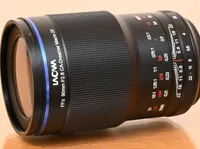
Build quality feels very good, combining high levels of precision with a robust metal barrel. The lens is fully manual, so there are no electronics at all.
Naturally, there’s no autofocus because there’s actually no focus mechanism of any kind. However, the lack of electronics also means that you have to set the aperture manually and that no lens-based EXIF data is recorded in image files.
A bonus of having no electronics is that it’s relatively simple to make the lens in a large variety of mount options, which include Canon EF, Canon RF, Nikon Z, Nikon F, Sony E, L-Mount, Fujifilm X and Micro Four Thirds. Pentax K is a notable omission.
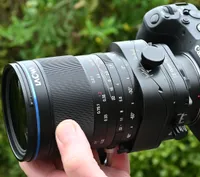
From a handling perspective, the zoom control ring operates smoothly and is clearly marked with white numbering.
Like the zoom ring, the aperture control ring has a nice tactile feel and is clearly marked. It rotates in full f/stop click steps, from f/2.8 through f/4, f/5.6 and f/8 to the narrowest available aperture of f/11. The aperture diaphragm is very well-rounded, based on 11 curved blades.

The optical layout features 13 elements in 9 groups, whereas the 5-10x lens has an additional 4 elements and 3 extra groups. The 1-5x lens includes 3 ED (Extra-low Dispersion) elements and 4 UHR (Ultra High Refraction) elements, aiming to boost clarity and minimize color fringing.
Indeed, this claims to be an Apo (Apochromatic) lens that eliminates color fringing as well as delivering ultra-high resolving power.

The lens has a relatively small-diameter protruding front section, as shown in the image above. This enables the easy fitment and removal of a slip-over hood, as shown below.
There’s no filter attachment thread, which doesn’t surprise me as space between the front of the lens and the subject is at a premium, and there’s not even enough room to attach macro lights or a ring light via a filter attachment thread.

Continuing the theme from the barrel and hood down to the mounting plate, the lens has metal rather than plastic mounting plate.
Again, as a fully manual lens, there are no electronics, so none of the various mount options features any data contacts and there’s no need for a USB port for applying firmware updates. Perhaps a more disappointing omission is that the mounting plate also lacks a weather-seal ring.

Laowa Aksen 1-5x Ultra Macro Apo: Performance
To test the lens, I used a Canon EOS R5 mounted on a sturdy Peak Design Pro Tripod and the NiSi NM-200s Macro Focusing Rail that I mentioned earlier. The fixed working distance of 41.35mm / 1.63in means that lighting can be a challenge, but I used LED light panels to supply sufficient illumination.
Naturally, as the focusing distance is fixed, you need to move the camera and / or the subject to achieve focus, and you can’t use the lens as a portrait prime or for other longer-distance shots, like you can with the vast majority of regular macro lenses.
I shot a range of subject matter including a small section of pixels on my 27-inch 1080p LCD computer monitor and a variety of objects, as shown in the gallery below.
One thing became immediately obvious, in that accurate focusing is absolutely essential – especially towards the largest magnification factor that’s on offer. Even using a sturdy tripod and a macro focusing rail, focusing is a fiddly business due to the incredibly tight depth of field.

To give a sense of scale, this pair of shots of a small section of pixels on my 1080p computer monitor screen was taken at 1.0x and 5.0x magnification
Image credit: Matthew Richards

Compared with the image on the left, this shot graphically demonstrates how much extra magnification you get at the long end of the zoom range
Image credit: Matthew Richards
Even touching the camera can result in small positional changes that can affect the accuracy of focusing. Extreme magnification, especially combined with a magnified live preview in a mirrorless camera, also reveals that the camera can take a long time to settle after being touched.
I used a ten-second self-timer delay and fully electronic shutter to keep movement at bay. Even then, I noticed vibrations caused by passing traffic on the street in front of my house.
With a lot of care and painstaking setup, the lens is capable of very pleasing results. True to its claims, there’s excellent sharpness and clarity on tap, along with minimal color fringing. Distortion is also of a very low order, which is a good thing as automatic in-camera correction is unavailable.
Ultimately, the image quality of the lens rewards the effort that you need to put in to get satisfying shots.
Laowa Aksen 1-5x Ultra Macro Apo: Sample Images
The following gallery consists of a series of pairs of shots, each pair taken at both the lens’s minimum 1.0x magnification and maximum 5.0x magnification.
Subject matter includes standard-sized body text (Aptos 12pt) printed onto plain paper with an inkjet printer, a postage stamp, a wristwatch day / date mechanism, a leaf, colored pencils, a textile flower and a nutcracker ballet doll.


Laowa Aksen 1-5x Ultra Macro Apo: Lab Results
Due to the fixed and very short focus distance of the lens, it’s impossible to take shots of the test charts that we use for capturing and processing lab test data for regular lenses. As such, we’re unable to provide any lab test results for this lens.
Laowa Aksen 1-5x Ultra Macro Apo: Verdict
I feel that the Laowa Aksen 1-5x Ultra Macro Apo raises the bar for high-magnification macro photography, leaving regular 1.0x ‘full’ macro lenses trailing behind.
The maximum 5.0x magnification enables you to capture incredibly fine detail in tiny objects, and to massively enlarge it when viewing the resulting images on screen or in print.
However, all that magnification comes at a cost – not just financially, but in the painstaking effort that it demands to get things ‘right’ when taking each and every shot. Thankfully, the performance of the lens is sufficient to make all that hard work pay off.
Features ★★★★☆ |
The internal zoom mechanism for enabling 1-5x macro magnification is a standout feature but the lens has a fixed focus distance and no electronics. |
Design ★★★★★ |
The design features a groundbreaking ‘parfocal zoom’ facility and a high-precision, robust construction, earning the lens TIPA 2026 and Cine Gear Expo 2026 Camera Technology awards for its efforts. |
Performance ★★★★½ |
The lens is capable of excellent image quality and jaw-dropping results but can demand a lot of effort and patience in the process. |
Value ★★★★½ |
Sure, the Laowa is a ‘dumb lens’ with no electronics but it’s still very good value considering the high-end design and all-round quality. |
Overall |
★★★★½ |

Alternatives