







Digital Camera World Verdict
The Flex-S-Dark is a reliable cellular trail camera with a fully integrated solar panel (instead of a flimsy wired addition). It's easy to set up after an initial charge, the starter pack comes with a microSD card and the free cellular package includes 100 monthly image downloads. But I found image quality average compared to recent Browning models I tested, with dim and uneven nighttime illumination despite this being Spypoint’s No-Glow model. It's brilliant for usability, but loses points for image processing and dynamic range.
Reasons to buy
- +
All-in-one solar panel design
- +
Spypoint app makes previewing and downloading clips easy
- +
Choice of No Glow or Red Glow light
Reasons to avoid
- -
Animals often captured with motion blur, day and night
- -
Cellular transmission has a sync lag
Why you can trust Digital Camera World Our expert reviewers spend hours testing and comparing products and services so you can choose the best for you. Find out how we test.
Spypoint's Flex-S-Dark isn't the only trail camera on the market to combine a cellular connection and a solar panel built into the case, though the brand was certainly an early pioneer of the design.
And it makes sense – the appeal of the best cellular trail cameras is being able to leave them in a remote location and have clips and images sent to your phone from afar. But that's no good if your batteries keep dying, so a solar panel is there to top up the power – again to stop you having to keep checking and maintaining the camera.
The Flex-S-Dark is the successor to the original Flex-S, and keeps the core chassis, dual-SIM cellular connectivity and built-in solar tech of the original model – but upgrades the unit by adding invisible No-Glow LEDs for nighttime shots and the ability to trigger the camera on-demand from the app, rather than waiting for the next scheduled sync interval.
These improvements make it a real all-rounder, and the Flex-S-Dark sits at the top of Spypoint's flagship trail cam lineup. Its specs also position it at the premium end of the cellular market: 40MP stills, FullHD video with sound and a fast 0.3-second trigger speed.
To me, its main selling point is total hands-off maintenance. The solar panel (in theory) feeds an internal lithium battery to power the camera indefinitely without blowing through batteries, while a pre-installed SIM automatically latches onto whichever mobile network signal is strongest in your local area.
Still, it faces stiff competition from the recently reviewed Browning Defender Pro Scout Max Solar (46MP stills and smoother 30fps FullHD video) and the Tactacam Reveal SK (with a slower 0.5s trigger speed). But while Browning relies on a separate solar panel unit wired to the camera, Spypoint is pitching the Flex-S-Dark as a cable-free, cellular option.
But does it really offer a seamless solar setup and smartphone integration? And is that enough to offset the trade-offs in image specs?
As is usual for my trail camera reviews, I left the Flex-S-Dark camped out in a local UK woodland for several weeks to see how it fared capturing the badgers, foxes, deer and squirrels of the habitat – night and day.


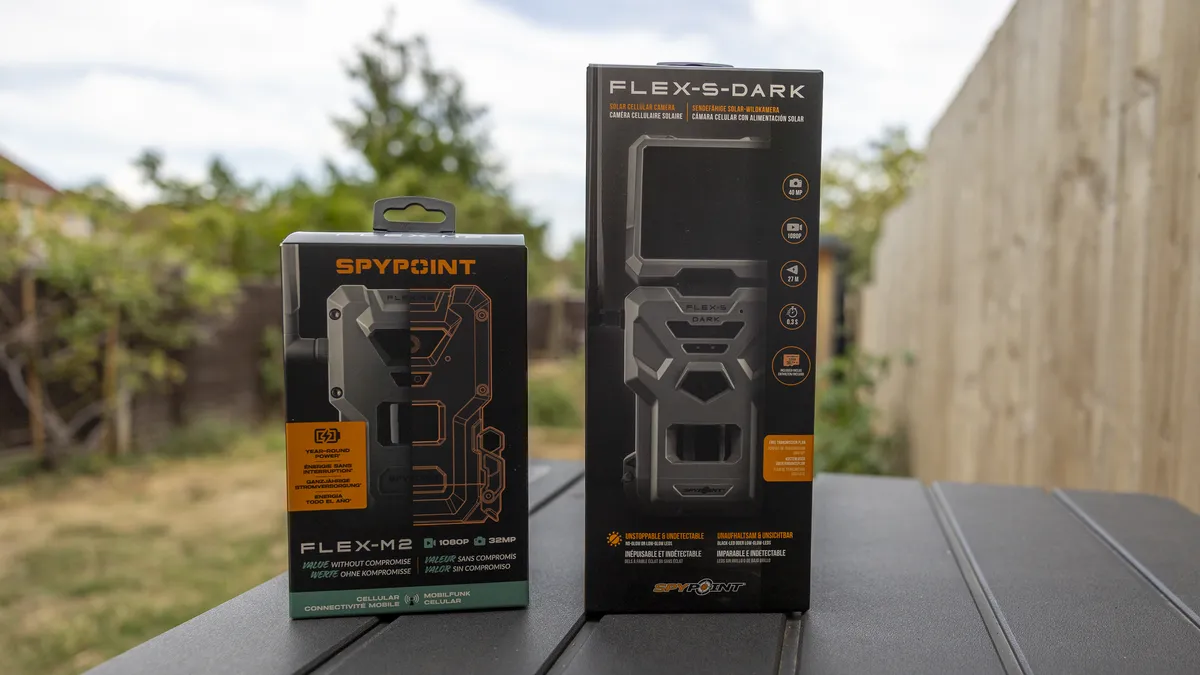


Spypoint Flex-S-Dark: Specifications
Photo Resolution |
40MP |
Video Resolution |
FullHD with Sound |
Trigger Speed |
0.3 seconds |
Detection Range |
100 ft. (30 m) |
Flash Type & Range |
Undetectable No-Glow LEDs (Customizable Low-Glow option) / 100 ft. range |
Cellular Connectivity |
Dual-SIM LTE Multi-Carrier Auto-Connect |
Power |
Integrated Solar Panel with Internal Rechargeable Lithium Battery (Backup: 8 x AA or LIT-22 Battery Pack) |
Display |
None (Setup & Control via SPYPOINT App / In-Camera Status LEDs) |
Storage |
MicroSD Card up to 512GB (Included with Starter Pack option) |
GPS Geotagging |
Yes (In-App GPS Location Tagging) |
Features |
On-Demand Instant Mode, Built-In Solar Panel, BUCK TRACKER AI Species Filter, Over-the-Air Firmware Updates |
Warranty |
2 Years Limited Warranty |
Spypoint Flex-S-Dark: Price
The Spypoint Flex-S-Dark is near the top of the cellular trail cam market at about $190 / £220 / AU$550, depending on where and when you shop.
For that higher initial investment, you get a combination that fewer rivals can match: an integrated solar panel with a built-in rechargeable lithium battery and invisible, customizable no-glow dark LEDs.
The closest direct competitors are the Tactacam Reveal X-Pro and the Browning Defender Pro Scout Max Solar (a camera I tried and liked).
Browning’s solar setup offers a higher native image resolution, but comes with a much stricter, cap-heavy video transmission plan (something I really didn’t like). The Tactacam offers reliable cellular connectivity for slightly less money upfront, but lacks an integrated solar panel out of the box.
Some competitors require you to buy solar add-ons separately, but the built-in panel here handles daily charging automatically.
Spypoint also offers a free 100-photo per month plan, which I think makes ongoing costs more optional rather than mandatory if you have fewer triggers. Paid plans scale to $15 / £10 per month for unlimited photos (videos aren't mentioned), which is cheaper than rival Browning.

Spypoint Flex-S-Dark: Design & Handling
Older cellular trail cameras sometimes added bulk and size to house their radios, but the Spypoint Flex-S-Dark has a relatively compact footprint.
The main camera body actually sits slightly lower on a tree trunk than non-cellular units like the Bushnell Core S-4K, though its screw-on antenna at the side adds some extra vertical clearance (and is best removed when the camera is travelling to its location in your bag).
As trail cameras spend most of their lives strapped to trees and posts, not living in a camera bag, I don’t think a few extra grams or centimeters will bother most buyers – and the Flex-S-Dark is still low-profile and easy to tuck into cover.
The unit is clad in a utilitarian matte gray casing, a stark change to the traditional patterned camo print on many trail cams. Obviously, users aren’t all going to be using it in the same location as me.
Still, I found it far more noticeable to a passerby skirting the woodland footpath than other camo-printed models like the Browning Strike Force HD Pro X1080 – and that made me nervous to leave it alone.


To me, the unit feels reassuringly solid for life outside – and it doesn’t have any brittle plastics or rattly latches that I often notice on budget alternatives.
The defining physical feature is its roof-integrated solar panel. Unlike the Browning Defender Pro Scout Max Solar, which has a separate solar panel and runs a trailing wire up a trunk, the Flex-S-Dark builds the solar array into a top sloping face of the camera body.
It’s a clean, wire-free design that eliminates dangling cables that squirrels or weather could damage. You can also drop a tray of eight AA batteries or an optional LIT-22 lithium pack into the bottom compartment as a secondary backup, and this too feels solid.
There’s no button to eject the battery compartment, so it’s a case of yanking it out and back in again – a less smooth and satisfying experience. At the back of the cam, you’ll find a rubber-sealed 12V DC external power jack.
A flexible cellular antenna screw securely onto the side of the unit, and can be rotated and angled through 360° rather than being fixed in place. I found this flexibility practical in the field, allowing me to adjust its angle so it didn't get snagged on nearby branches.


Opening the heavy-duty latch reveals a departure from many traditional trail cam control panels. There’s no LCD screen for framing shots or navigating menus, which helps with keeping the overall size down.
Spypoint has stripped the layout down to a bare-bones interface: a power switch, a battery level indicator, a network signal meter, a format button for the microSD card and a physical Test button.
This minimalist layout meant I could prep in the field is thus: turn it on, wait for the LED bars to confirm cellular connection and format the card. But as ever, not having a screen means mounting the camera is a bit of a guessing game.
To check if the lens is pointed where you want it, you have to hit the Test button, wait for the photo to transmit to the Spypoint app on your phone, check the image and adjust the strap accordingly.
It’s not too much of a hassle during initial setup, as long as you have the Spypoint app set up and don’t leave it until you’re standing out in the rain like me. Once the camera is anchored with the included nylon strap (and excellent clamp), the unit does feel locked down and ready for long-term deployment.


Spypoint Flex-S-Dark: Performance
ABOVE: Sample clips from the Spypoint Flex-S-Dark trail camera
After woodland-testing the Spypoint Flex-S-Dark for several weeks, I’m left feeling both impressed and disappointed. The camera is mostly a reliable, well-connected scouting unit, but its video and stills performance fell short of my expectations.
The dual-SIM connectivity is the camera’s strongest asset. When I deployed it in a mixed woodland, I simply added it to the Spypoint app by adding in a serial code, and it picked up local UK networks without fuss.
The camera will automatically lock onto the strongest available signal without requiring manual configuration and let you know the status of the signal in the app.
There’s built-in GPS, too, which can plot exact camera placements onto an in-app map to help you keep track of camera deployments. Not something I needed, but I can imagine this being very helpful on larger estates and areas of land.
The headline roof-integrated solar panel needs some realistic expectations. When I had it mounted in my open garden with direct summer sunlight, the solar roof kept the internal battery sitting at 100% indefinitely.
Once it was tucked under woodland trees and a few days of overcast weather, the panel generated more than a trickle charge, but the battery status was still listed as High (and showing as full) after a week or so.


Being a cellular trail camera, the Flex-S-Dark required navigating via the Spypoint app.
This offers a really smooth and neat experience, with clear dropdown menus that make it simple to adjust sensor sensitivity, toggle capture modes, or even build weekly operational schedules to pause triggers during high-traffic human hours.
I liked being able to check the remote status tab of the camera from the app’s main screen; it instantly reports on signal strength, storage and levels for the internal solar battery and the backup AA tray.
What’s less pleasing is that setting changes made on your phone don't apply instantly, and updates are applied during the camera's next scheduled cellular transmission cycle.


Spypoint advertises a rapid 0.3-second trigger speed, a metric that applies to still photos. When set to record video, I felt like the camera suffers from a wake-up delay.
In several of my test videos, animals crossing the detection zone were already mostly out of the frame by the time the recording started – noticeably different to the Browning that caught subjects squarely in the center.
The Flex-S-Dark may well boast 40MP photo resolution and 1080p video capture, but like many trail cams, I think these numbers feel (and look) artificially inflated by sensor interpolation and heavy digital processing.
On captures where the woodland was in bright daylight, the scene suffered from highlight clipping and sunlit leaves becoming blown-out. And in flatter, evening light, the color saturation dropped off, giving mid-tones an unnatural yellow-green tint.


In the video footage, which I set to the maximum setting, artefacts are visible in the moving background vegetation, and the low 15fps frame rate created some motion smearing.
The Flex-S-Dark offers you the choice of two flash options: No-Glow for total stealth or Low-Glow, which can be detected but generally ranges further. Using the invisible No-Glow IR array, I was able to capture a foraging muntjac calm and unaware.
However, here the IR beam has a narrow hotspot in the center, rendering nearby foreground brambles as harsh, blown-out highlights. Subjects looked a bit soft and hazy unless they passed directly through the central sweet spot of the frame.
I don't think anyone would buy a trail camera for award-winning picture quality, but I was still left unsatisfied with the hit rate of my triggers – how often animals were blurred, cut off or hard to identify.

Spypoint Flex-S-Dark: Verdict
The Spypoint Flex-S-Dark definitely delivers on the promise of the best cellular trail cameras: easy, long-term deployment.
Its roof-integrated solar panel means no wires or cables to consider, and the multi-carrier connectivity and an intuitive companion app make remote monitoring simple. What takes the model further than competitors is also having those invisible No-Glow IR LEDs (or Low-Glow if you want them) and on-demand app triggers.
But while all this convenience is fantastic, I’m still underwhelmed by the overall image quality. My daylight captures often looked overexposed (where other cameras have handled the same high-contrast woodland scene well) and heavily processed.
And despite the unit's undetectable night flash, uneven illumination created some bright central hotspots that left surrounding areas hazy and prone to motion blur. Fast-moving subjects occasionally slipped past the frame, too.
I thought the camera's app was great – streamlined, responsive and easy to use. It also incorporates Spypoint's Buck Tracker AI species recognition, a feature that automatically scans and tags photos as they arrive.
North American users might appreciate the free antler-detection filter for quickly sorting deer; however, UK wildlife enthusiasts (like myself) will need a paid Insiders Club subscription to unlock tags for other animals or human activity filters.
If your priority is pure set-and-forget utility with long battery and simple app management, the Flex-S-Dark is a highly practical choice.
But for wildlife enthusiasts who want tack-sharp stills good enough to identify individual animals, fluid video clips, or wide dynamic range may find the overall image output underwhelming compared to class rivals.
Features ★★★★☆ |
Dual-SIM transfers to phone at intervals, No and Low-Glow LEDs, built-in solar panel for ongoing power. |
Design ★★★★☆ |
Solid build; lacks an LCD screen for easy framing, nice app interface. |
Performance ★★★★☆ |
Fast 0.3s trigger and solid signal, but some heavy highlight blowout and blurred subjects. |
Value ★★★½☆ |
Great wire-free solar setup, unlocking over the 100 free monthly photos is still affordable. |
Should you buy the Spypoint Flex-S-Dark?
✅ Buy this if...
- You want to toggle between low-glow (for maximum flash distance) and invisible no-glow IR night modes
- The location is hard to get to and you want true wire-free long-term deployment
🚫 Don't buy this if...
- You plan to rely on the free tier, which caps photo transfers at 100 per month
- You want instant photo alerts on every detection without rapidly draining the internal battery
Alternatives
Check out our full guides to the best trail cameras, and also the best cellular trail cameras

