







Digital Camera World Verdict
The Browning Strike Force HD Pro X1080 is a fast, traditional trail camera without a cellular connection but with great reliability and battery efficiency. Well designed, with an adjustable bracket and a color LCD screen to review captures in the field, it can freeze fast-moving wildlife mid-stride well with enough light. This is a great, mid-priced choice for more local scouting.
Reasons to buy
- +
Market-leading trigger speed freezes wildlife in good light
- +
Integrated bracket simplifies mounting
- +
Highly efficient six-battery design lasts months
Reasons to avoid
- -
Soft resolution lacks micro-detail
- -
Harsh daylight highlights are easily blown out
- -
Recessed battery tray button is incredibly stiff to release
Why you can trust Digital Camera World Our expert reviewers spend hours testing and comparing products and services so you can choose the best for you. Find out how we test.
Over the past few years, I’ve noticed the wildlife surveillance market splitting – between more expensive app-driven cellular models and cheaper, unbranded basic ones. As some trail camera users push back against monthly data plans or just don’t need them, there’s still room for the best trail cameras without cellular coverage and ongoing fees.
The Browning Strike Force HD Pro X1080 lands here: an unplugged, reliable option for users who either want to position close to home or don’t mind hiking out to pull their SD card and review footage. Of course, the on-board storage approach works best if you’ve got smaller patches of land to survey, more time to fetch the camera, or a smaller budget.
Browning is a brand with a long reputation for making rugged and reliable trail cameras – in fact, it was one of the first brands I used a decade ago. The Strike Force HD Pro X1080 isn't a completely new design, but an evolutionary replacement for the older Strike Force HD Pro X. This line bridges the gap between their entry-level text-only cameras and bigger, higher-resolution units. It has 1080P Full HD video with sound, a 24MP sensor, low-glow night illumination, a built-in color screen for reviewing footage, and one of the fastest trigger speeds on the market.
I was eager to take this game and motion-activated camera out into the woods to see if its blazing 0.18-second trigger speed lives up to the hype for capturing wildlife, or if you're better off saving your money and sticking with an older, simpler model.

Browning Strike Force HD Pro X1080: Specifications
Photo Resolution |
24 MP |
Video Resolution |
1080p Full HD @ 30fps with Sound (5 sec. to 2 min. length) |
Trigger Speed |
0.22 seconds (0.18s for photos / 0.30s for video) |
Recovery Time |
0.35 seconds |
Detection Range |
100 ft. |
Flash Type & Range |
Low-Glow Infrared LED ("RADIANT 6" Technology) / 120 ft. range |
Cellular Connectivity |
None (Standard SD-card trail camera) |
Power Supply |
6 or 8 AA Batteries depending on production run (Supports 12V External Power Jack) |
Built-in Display |
1.5" Color View Screen |
Storage Capacity |
Supports up to 512GB SDXC Memory Card (Not Included) |
Mounting Type |
All-Steel Adjustable Tree Mount Bracket |
Special Features |
Adjustable IR Flash (Power Save, Long Range, Fast Motion), Illuma-Smart Technology, Smart IR Video, Timelapse Plus |
Warranty |
2 Years |
Browning Strike Force HD Pro X1080: Price
With an RRP of $149/£159, the Browning Strike Force HD Pro X1080 is at the higher end of traditional, non-cellular trail cameras. The market is flooded with far more entry-level Amazon game cameras under $50/£45 now, but this is a model that I feel confidently offers a better design and build quality to justify the extra investment.
The rugged construction has some tropical-grade weatherproof seals designed to lock out moisture from rain and deep-wood exposure, and the internal hardware is meant to be very efficient on batteries, quoted at squeezing up to a year of field life from a single set of six AA batteries (I haven’t tested it that long to say for sure). Being a trail camera that relies on SD card storage, there are zero subscription costs here.
If I compare the price with mid-to-high-tier rivals like the Bushnell Core series or Spypoint's non-cellular range, the Browning has a good price-to-performance advantage thanks to its industry-leading 0.18-second photo trigger speed. If you’re a land manager or wildlife photographer, I’d say the Strike Force HD Pro X1080 is a cost-effective and reliable tool for tracking.

Browning Strike Force HD Pro X1080: Design & Handling
The Browning Strike Force Pro X 1080 comes packaged in a pretty compact, neatly organised box. In fact, the first thing I noticed was just how small but sturdy it felt in my hand. One of the most important things in a trail cam is to blend in – a hard task given the varied landscapes you could deploy one in – and this product is especially well suited to woodland. The chassis is covered in a busy, textured camouflage pattern that does a brilliant job of vanishing against tree bark.
Given that you’ll be leaving a trail camera outside for weeks or months, hardiness against the weather is also vital. Browning doesn’t publish an official IP waterproofing rating for the Strike Force Pro X 1080, suggesting that maybe it just hasn’t been officially tested. But the exterior has reassuring rubber seals, with a primary side clip that snaps shut with a deeply satisfying mechanical click. For some reason, I had total confidence that it could survive a torrential downpour and a misty morning without fogging up the lens internals or damaging the SD card.
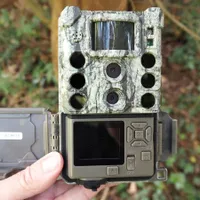
With the front unclipped, the camera has a few simple features and buttons. The forward-facing 1.5-inch color LCD screen – while not large or detailed enough to view your footage closely – is just about passable for setting up a composition or reviewing clips without removing the SD card.
As far as controls go, you’ll find an on-off toggle, an M button to bring up the menu, a 4-way navigation keypad and a button to eject the battery cassette, which pops out at the bottom of the unit. I found these buttons responsive, and I like that they light up when touched, making it easy to navigate if you set up or review the unit after dark. The menu itself is simple to toggle through on-screen, too. I was able to set up the camera to my liking in just a few minutes without needing to look at the paper manual in the box.
I’d decided to trudge to my local woodland to mount the camera, hoping to review it regularly for wildlife sightings while walking my dog. The camera and strap were easy to carry in a small shoulder bag, and I found mounting the camera very straightforward. The included nylon tree strap is incredibly long – so long that I found myself wrapping it around a narrower trunk multiple times – but the webbing is so strong that it kept the camera locked rigidly in position. After a few nights of unseasonably strong winds overnight, when I returned to the camera a few days later, it was still solidly in place.

The Browning Strike Force Pro X 1080 comes packaged in a pretty compact, neatly organised box. In fact, the first thing I noticed was just how small but sturdy it felt in my hand. One of the most important things in a trail cam is to blend in – a hard task given the varied landscapes you could deploy one in – and this product is especially well suited to woodland. The chassis is covered in a busy, textured camouflage pattern that does a brilliant job of vanishing against tree bark.
Given that you’ll be leaving a trail camera outside for weeks or months, hardiness against the weather is also vital. Browning doesn’t publish an official IP waterproofing rating for the Strike Force Pro X 1080, suggesting that maybe it just hasn’t been officially tested.
But the exterior has reassuring rubber seals, with a primary side clip that snaps shut with a deeply satisfying mechanical click. For some reason, I had total confidence that it could survive a torrential downpour and a misty morning without fogging up the lens internals or damaging the SD card.

With the front unclipped, the camera has a few simple features and buttons. The forward-facing 1.5-inch color LCD screen – while not large or detailed enough to view your footage closely – is just about passable for setting up a composition or reviewing clips without removing the SD card. As far as controls go, you’ll find an on-off toggle, an M button to bring up the menu, a 4-way navigation keypad and a button to eject the battery cassette, which pops out at the bottom of the unit.
I found these buttons responsive, and I like that they light up when touched, making it easy to navigate if you set up or review the unit after dark. The menu itself is simple to toggle through on-screen, too. I was able to set up the camera to my liking in just a few minutes without needing to look at the paper manual in the box.
I’d decided to trudge to my local woodland to mount the camera, hoping to review it regularly for wildlife sightings while walking my dog. The camera and strap were easy to carry in a small shoulder bag, and I found mounting the camera very straightforward.
The included nylon tree strap is incredibly long – so long that I found myself wrapping it around a narrower trunk multiple times – but the webbing is so strong that it kept the camera locked rigidly in position. After a few nights of unseasonably strong overnight winds, when I returned to the camera a few days later, it was still solidly in place.
What’s thoughtful in the design is that Browning has incorporated an adjustable steel tree bracket into the back of the case. With traditional trail cameras, I’ve been used to playing a frustrating game of balance, sometimes forcing bits of twig and stick behind the housing to angle the lens in just the right way down towards a footpath or trail.
This solid steel pivot gives you about 30 degrees of leeway, so you can adjust the downward tilt to frame the exact area of ground you want before walking away and leaving the camera to do its monitoring.
One design element does let down the seamless experience, and that’s the battery compartment. Browning claims this to be an exceptionally efficient camera (I say claims because I haven’t got to the performance section yet!), running on six AA batteries rather than the eight standard cells demanded by its competitors. But I found popping them in and swapping them out to be very fiddly.
Pressing the recessed eject button releases the internal drawer, but it doesn't bring the batteries out enough to change them, so you really have to yank them. I used this unit in the height of a hot British summer, but I think if you were trying to service the camera on a cold winter’s day with numb fingers, you’d have to apply some effort to pry the batteries loose. It's a minor complaint in an otherwise highly rugged tracking tool that seems to favor quick, hassle-free field deployment over unnecessary buttons.

Browning Strike Force HD Pro X1080: Performance
Above: Sample clips from the Browning Strike Force HD Pro X1080
I strapped the Browning Strike Force HD Pro X1080 to a tree in my local English woodland for two weeks. Being a non-cellular option, I reviewed the captured media every few days, as the location was near home, and I swapped between stills and video clips regularly. I set both media types to their highest quality setting, so I could fully assess where this traditional model wins and whether any areas are affected by its reasonable price.
At a quoted 0.18-second photo trigger speed, the Strike Force HD Pro X1080 sits among the fastest trigger speeds available on the current trail camera market. Looking closely at the captured images, these specs do seem to translate to real-world performance. In one of my favourite daylight frames, a hare was captured mid-bound, frozen in the air quite neatly. But that was in bright sunlight, and on darker days or at dawn, you get more ghostly motion blur when a fast animal speeds across the lens. The rapid response of the camera is critical for tracking fast-moving wildlife; I’ve tested older, slower cameras that often capture an empty frame or the trailing edge of a tail.
The camera captures 24MP stills, though this resolution is achieved via digital software interpolation rather than a native high-megapixel sensor. It’s worth noting, though, that I couldn’t see half the detail or quality compared to test images from one of Browning’s 48MP models.


In most of my test shots, the subject was easily identifiable, even though the background of a busy woodland meant sometimes having to look more closely. In one clip of an owl landing, for example, I had to watch the clip on a laptop screen to be able to make out the species from the leaves behind. The camera also struggles significantly with harsh, high-contrast lighting.
On sunny afternoons, any spots where direct sunlight pierced through were almost blown out. The overall white balance was okay, as far as trail cams go, with a noticeably warm, yellow-green cast that might be signature to Browning cams. The summer woods did look more artificially vibrant than they appeared to me when walking through.


When the Strike Force Pro X 1080 transitions to night mode, it delivers pretty good videos and has a longer flash and detection range compared to its predecessor. My after-dark captures of a bumbling badger – a subject easy to overexpose because of its white-black markings – had a balanced look. The camera's auto-exposure prevented the badger's lighter fur from blowing out and kept its stocky shape recognisable with some softness around the shuffling legs. In another night capture where a badger was foraging along the far edge of the frame, the animal was almost lost to the deep shadows due to the sharp light fall-off at the perimeter.
You have the option to print image info onto your images and clips. While helpful for monitoring the time and temperature of sightings, my experience is that the temperature gauge was often a few degrees out. In other words, don’t rely on the bottom data strip if you're trying to track highly precise patterns, but for pure wildlife identification, the hardware remains effective.

Browning Strike Force HD Pro X1080: Verdict
After a month overall in the field, the Browning Strike Force HD Pro X1080 proves that you don't need a cellular subscription or a solar setup to get serious wildlife tracking done. It is a straightforward, exceptionally quick camera that prioritises catching fast-moving targets over expensive tech. Its six-battery efficiency means you can still leave it out for months without worrying about a dead unit, but of course, you won’t be able to review footage until you go and manually pick up your SD card.
Performance-wise, the Strike won't win awards for its image quality. The tendency to blow out highlights in direct sunlight and the soft background interpolation mean it has some clear technical limitations. But this isn’t unique to the Strike Force HD Pro X1080, and if anything, it works exceptionally well as a general record of sightings. As a pure scouting tool, its ability to capture animals of varying speeds, shapes, and colors is still impressive.
If you want a rugged, reliable trail cam that works instantly out of the box and you don’t need the convenience of a remote cellular connection, the Strike Force HD Pro X1080 offers a good balance of value and performance for both beginner and advanced users.
Features ★★★★☆ |
Tracking options like Timelapse Plus and Smart IR video nice, no solar or cellular |
Design ★★★★☆ |
Rugged, camo housing with adjustable tree mount, LCD is small |
Performance ★★★★☆ |
0.18s photo triggers fast action, detailed night illumination |
Value ★★★★☆ |
Good value if you prefer SD card storage with no added fees |
Should you buy the Browning Strike Force HD Pro X1080?
✅ Buy this if...
- You want a relatively affordable option that's compact and easy to use
- You're looking for a fast trigger speed to capture wildlife
🚫 Don't buy this if...
- Your area is hard to reach, and you want to check in remotely
- You need invisible night LEDs to avoid disturbance
Alternatives
Check out our full guides to the best bird feeder cameras and the bird box cameras.

