
Digital Camera World Verdict
The Spypoint FLEX-M2 makes cellular tracking genuinely affordable, offering near-instant transmission and an easy app. I had to avoid certain storage and power settings to prevent battery drain. But after careful setup, I found the camera delivers reliable remote updates and decent night clarity for a good price.
Pros
- +
Entry-level price for a dual-SIM cellular unit
- +
Reliable transmission with fast instant app pings
- +
Even night illumination
- +
User-friendly app with free 100 monthly photos
Cons
- -
Daytime motion blur in images
- -
No LCD screen for easy framing or playback
- -
Low-Glow infrared LEDs noticed by some subjects
Why you can trust Digital Camera World Our expert reviewers spend hours testing and comparing products and services so you can choose the best for you. Find out how we test.
Cellular trail cameras were once reserved for high budgets, for wildlife watchers and trackers who couldn’t keep returning to a location to check their footage. The Spypoint FLEX M-2 sits at the budget end of the market and is the most affordable cellular entry point in Spypoint's lineup. It replaces the original 2024 FLEX-M, with the same dual-SIM connectivity as Spypoint's broader FLEX lineup but without built-in solar panels or setup LCD screens, keeping costs down and value high.
For many nature lovers or land managers, this stripped-back approach makes total sense. By paring the unit to a minimalist, sub-$100 frame, Spypoint is trying to make it realistic to buy and deploy multiple cameras across vast areas rather than affording one flagship option in one spot.
The FLEX M-2 is a modest upgrade on its predecessor, with a 32MP photo resolution and 1080p Full HD video with audio, but the same 0.4-second trigger speed and 90-foot detection range. Like the rest of the cellular FLEX range, it also includes Spypoint’s free 100-photo-per-month cellular plan to get you going.
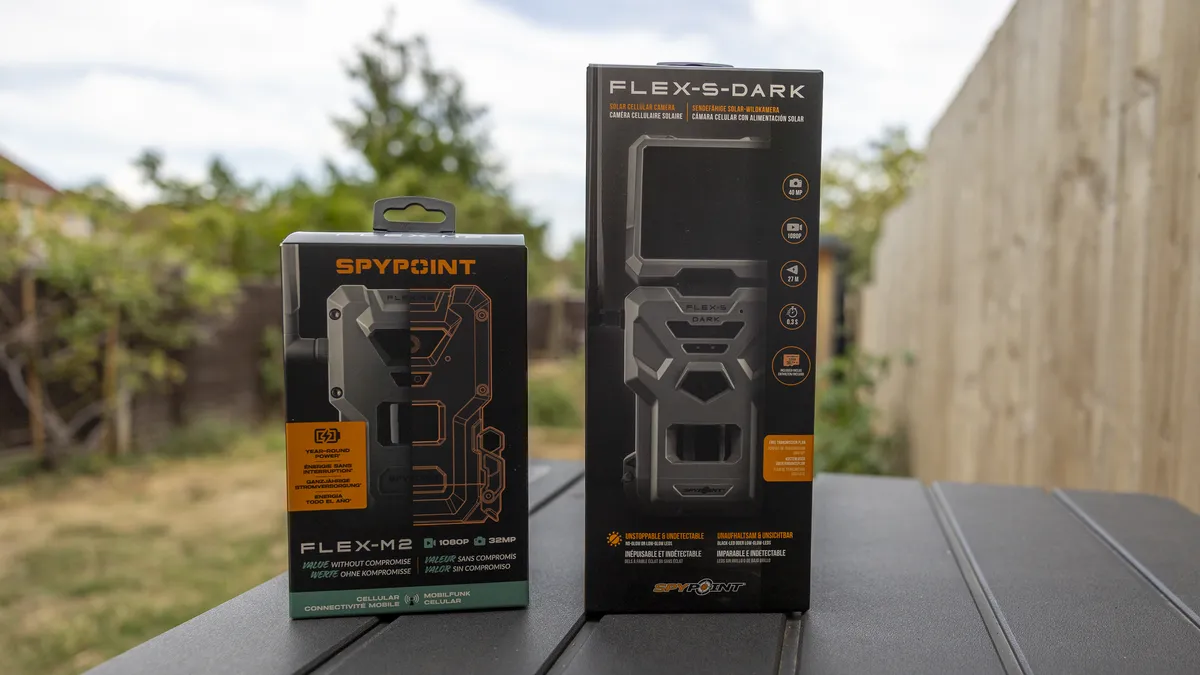
Unlike the premium FLEX-S-DARK, there isn't a roof-mounted solar panel for continuous off-grid power, so you’ll need to rely on 8 standard AA batteries or add an external solar setup. The FLEX-M2 also faces competition from entry-level rivals like the Tactacam Reveal X-Pro, which does offer an integrated LCD screen for easier framing in the field.
So can a pared-back budget cellular camera still deliver smooth app performance and reliable field captures? I was also intrigued to see the image quality of such an affordable model. To find out, I deployed the FLEX M-2 in my usual woodland testing area (near Bath in the UK) for about a month to track how it captured the native wildlife and occasional dog walker, day and night.
Spypoint FLEX-M2: Specifications
Photo Resolution |
32 MP |
Video Resolution |
1080p Full HD with Sound (Up to 15 seconds) |
Trigger Speed |
0.4 seconds |
Recovery Time |
Optimized / Fast-Response |
Detection Range |
90 ft. |
Flash Type & Range |
Low-Glow Infrared LEDs / 90 ft. range |
Cellular Connectivity |
Dual-SIM LTE Multi-Carrier Auto-Connect |
Power |
8 x AA Batteries (Compatible with LIT-22 Rechargeable Battery Pack or 12V External Source) |
Display |
None (Setup & Control via SPYPOINT App / In-Camera Status LEDs) |
Storage |
MicroSD Card up to 512GB (Not Included) |
GPS Geotagging |
Yes (In-App GPS Location Tagging) |
Features |
Dual-SIM Auto-Switching, BUCK TRACKER AI Image Recognition, Remote OTA Updates, Test/Format Buttons |
Warranty |
2 Years Limited Warranty |
Spypoint FLEX-M2: Price
The Spypoint FLEX-M2 is positioned very neatly as a budget-friendly gateway into cellular trail cameras, at a very accessible $80 / £100. For that, you get 32MP photo captures and 1080p HD video (a basic standard for trail cameras at this price).
The FLEX-M2 has dual-SIM architecture to automatically select the strongest local network (AT&T or Verizon) without any manual setup, meaning it should be reliable in spotty, low-signal areas where more expensive cameras can drop offline (obviously this is to be tested). Paired with Spypoint's free 100-photo monthly tier, it offers a low barrier to entry among the major cell cameras.
Key competitors in the under-$100 cellular market include the Moultrie Edge and Muddy Morph, neither of which I’ve tested yet. The Moultrie Edge has built-in memory (eliminating the need to worry about card formatting), but lacks the FLEX-M2's 32MP image resolution and dual-SIM reliability. The Muddy Morph is similarly cheap, but falls behind Spypoint's 0.4-second trigger speed and polished app.
The main concessions you have to make at this price point are power and stealth. The FLEX-M2 takes 8 AA batteries rather than solar, and uses low-glow infrared LEDs instead of invisible dark flash (no-glow). But if you’re looking for an inexpensive way to deploy multiple remote cameras, or want to try a trail camera for the first time, the FLEX-M2 looks like a valuable way to do so.
Spypoint FLEX-M2: Design & Handling
Like its more premium sibling, the Spypoint Flex-S-Dark, the FLEX M-2 looks dull and drab, but this isn’t a complaint. Its utilitarian, solid matte gray casing (a change from the traditional patterned camouflage print seen on many rivals) can catch the light at certain angles. Mostly, though, I found the neutral tone dull enough not to draw attention from passersby, and it should blend easily into many natural settings.
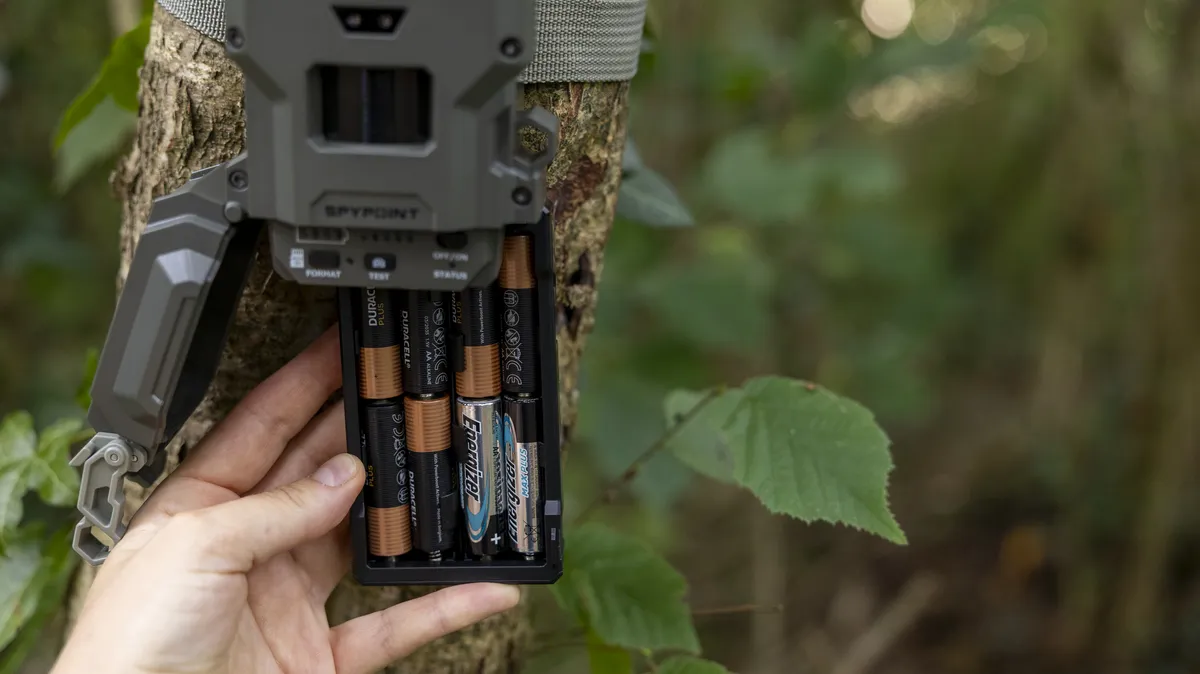
The FLEX M-2 is compact, without a solar panel or LCD to add bulk or height. When you open the heavy-duty articulated latch (which feels stupidly secure) on the right side, you’ll find a stripped-down button layout at the bottom: a power toggle, card formatting button, Test button, and status LEDs indicating signal strength and battery level. The battery compartment and MicroSD slot sit on the underside.
Because all of the camera settings are managed remotely via the Spypoint app and synced at scheduled intervals, manual handling on the unit itself is basic. Personally, I enjoy having a screen, even on cellular trail cams, to check framing and set up the camera instantly in the field. But this isn't strictly necessary on a cellular model like this since captures are sent directly to your phone anyway, and leaving it out likely keeps the unit's price tag down.
You can't see a live feed of the camera in the app, so composition is a guess unless you take test shots and hope they send through quickly to your phone while you're setting up the angle.


Setting up the camera was speedy, and I linked it to the Spypoint app in a few minutes by inputting a unique serial code. Once the connection is established, the yellow and black mobile interface is your control panel for checking the camera status, changing settings, reviewing the gallery and toggling between multiple cameras if you're running a larger setup.
I never found the app laggy or difficult to navigate, though a few settings are less obvious to find. Fine-tuning motion sensor sensitivity or adjusting cellular transmission schedules meant digging through nested sub-menus within the individual camera’s settings tab, rather than on the main dashboard. But you soon get used to where everything lives.
The build quality is solid, and I particularly love the robust claw-like clip on the camera strap to tighten it; many trail cameras require you to tie both ends of the strap together. The only area of the hardware that feels less well-made is the battery compartment. Unlike some Browning and Bushnell models that feature a dedicated button to eject the battery tray, with the FLEX M-2 I just gave it a firm yank out and pushed it back in again once the 8 AA batteries were loaded. It takes a bit of force, and I never felt completely sure the battery compartment was back in properly, though checking the internal status lights helps confirm a solid connection.

Screwed into the top-left of the casing is the antenna, and its ability to rotate 360 degrees is particularly helpful for angling around nearby tree branches during setup. You can also remove it whenever you need to pack the camera in a bag, which sounds like a small thing but one that adds up to less chance of damage.
Spypoint doesn't publish an official waterproof rating for the FLEX-M2, but the build feels reassuringly rugged – even though noticeable screws look to secure the front and back of the housing together. To me, this is a camera that could feasibly sit out in rain, wind and more for months (way beyond the weeks I tested for).
Spypoint FLEX-M2: Performance
Above: Sample clips from the Spypoint FLEX-M2 trail camera
I attached the Spypoint FLEX-M2 to a tree in my local woodland at the same time as the solar-powered FLEX S-Dark for testing, but this review took several weeks longer because I ran into some immediate battery issues.
The brand-new batch of 8 x AA batteries I put in the camera for its first deployment drained in about a week to ten days in standard image mode. I couldn't believe it when the power level suddenly dropped to low on the app, and the camera stopped syncing altogether. Having to trek out to retrieve the camera and check it over isn’t ideal for a cellular model – the entire point is remote convenience.
I decided to try a fresh pack of batteries, and at this point, I also swapped out the Spypoint-supplied microSD card so I could check my footage at home while leaving the camera in situ. This turned out to be an expensive mistake. Using another card (which I later found to be unformatted and unreadable) caused the camera to run continuously, draining my next set of batteries within 24 hours.
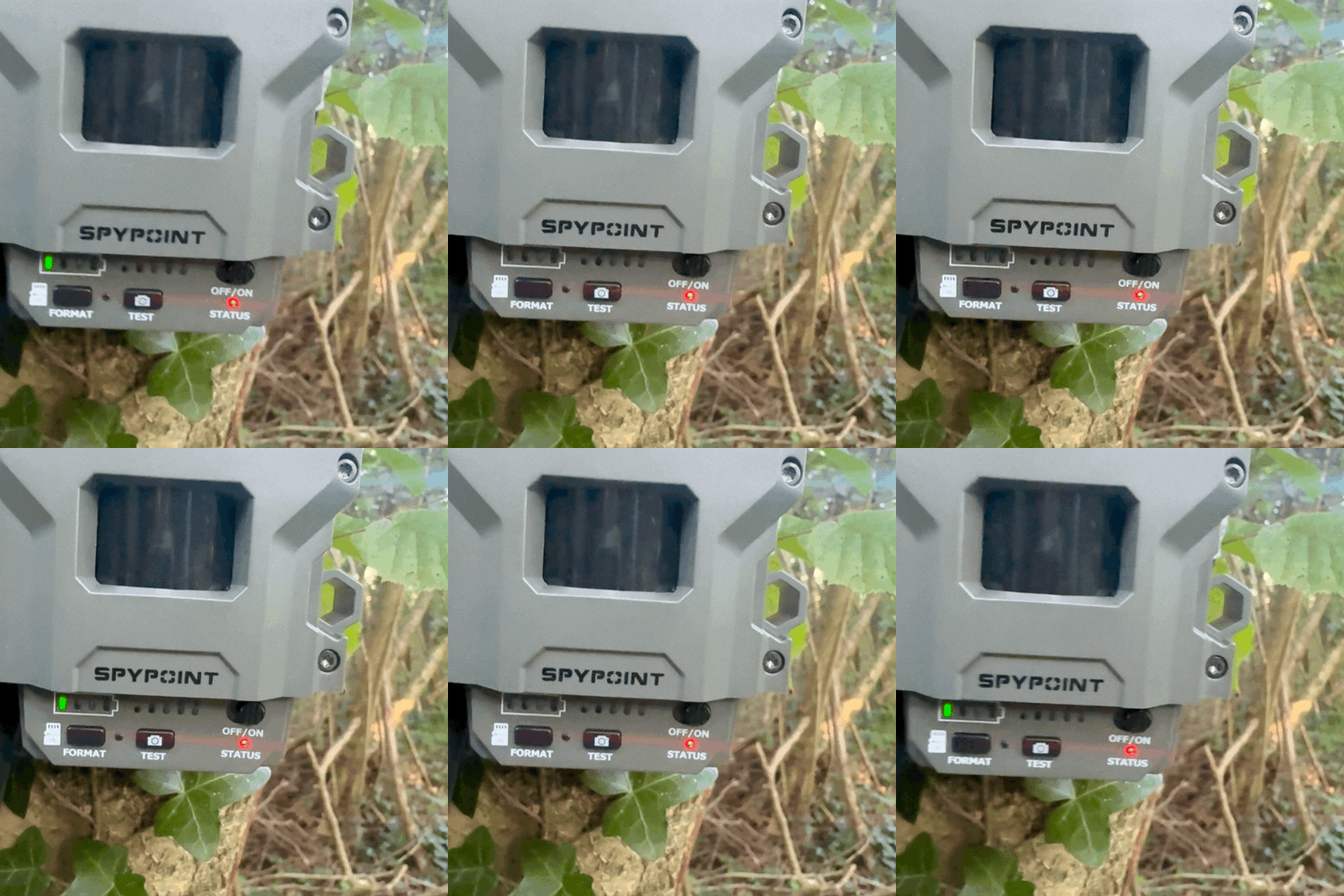
When I reported the issue to Spypoint customer support, I’m happy to say that they got in contact quickly to diagnose and help, explaining that using a card that's too big or not formatted properly can cause the camera to glitch. As far as I understand, it tries to write and save captured images to missing or unreadable storage, failing repeatedly and causing the rapid, severe battery drain.
Able to access my settings remotely, they also advised me to set the battery type to "Auto" in the Spypoint app, rather than the "AA Alkaline" setting I thought I was being helpful by selecting. I’m not sure why the option to customize the battery is there if this is the case, but it did solve the problem.
I know every camera has its own rules, but it feels like this trail camera has more parameters to understand than others I've tested, and these aren't super clear out of the box. I've gone through three sets of batteries in a month, and that isn't practical or feasible if you've left the camera in a long-range location.
At the time of writing, I've had the last fresh batteries installed for four days, and the level still shows as full in the Spypoint app. Fingers crossed. Of course, you’re not strictly limited to using AAs. Spypoint sells a dedicated LIT-22 rechargeable lithium battery pack ($50 / ~£45) that slots directly into the tray, and there’s a power port on the bottom if you want to plug in a Spypoint external solar panel. This is an added cost, but one I'd invest in for peace of mind.


As for the cellular connection, it sounds obvious, but it's important to ensure that the rotatable antenna is screwed in as tightly as it will go for the best signal. When I tested the transmission set to Instant, I was always impressed that I'd get a ping from the app anytime I walked away from the camera after resetting the batteries (and triggering it). In other words, transmission really is instant.
But setting the sync intervals further apart conserves battery, and I mostly kept it at six times a day. Right on cue, every four hours I'd get a notification and an updated batch of clips to look through on my phone, and I very much trust the cellular transmission here.
Again, you can check the signal strength from your phone. The Spypoint app is quick to set up and smooth to use day-to-day for reviewing shots or managing settings, as long as you don't run afoul of the microSD and power parameters. I think I was just unlucky to start with, and I have still been able to capture a menagerie of clips and images from the device.
The app also includes Spypoint's so-called BUCK TRACKER AI species recognition, which automatically scans and tags incoming photos. I didn't try this feature during testing, as the free tier is tailored toward North American antlered bucks rather than general UK woodland species, and unlocking broader animal or human activity tags requires a paid Insiders Club subscription. For hunters or land managers targeting specific game, it feels like a helpful sorting tool.


In terms of image and video quality, I found the night range and clarity surprisingly good for a budget unit. The illumination across the frame looks relatively even rather than severely blown out in the center, and I could easily make out a fox trotting through the leaf litter and a deer foraging with clear eyeshine.
Trigger speed and detection on night video proved solid, and I was delighted to capture a badger emerging from the far right of the frame to the left several nights in a row. I’ve started to build a picture of this creature’s habits, and now I’ve established the path he takes, so I'll consider moving the camera closer for a better view on my next trip to the woodland.
In bright daylight, clips of the green woodland look mostly natural and well-saturated; however, motion blur was still a clear weakness. When a squirrel darted around the frame, it was sometimes more of a streak than a clear clip.
It's worth remembering that the FLEX-M2 uses Low-Glow infrared LEDs rather than invisible No-Glow dark LEDs; in a few of my night video clips, visiting deer looked straight at the camera unit, appearing to spot the red glow of the array. It didn't spook them off completely, but it could affect skittish subjects or their natural behavior.


In images, the motion of other animals like a deer and fox was readable, although fast movements showed up as ghosting and smearing. The hare in my first color image above is barely recognisable. I also noticed a slight wake-up lag issue in a few clips; when a deer entered from the right edge of the frame during the day, it exited almost immediately within the first few seconds, so I only caught the tail end (literally) of the movement.
Compared to a dual-sensor flagship camera like the Bushnell Core S-4K No Glow, the FLEX M2’s budget sensor shows its limitations, especially for daytime stills. The FLEX M2’s colors are mostly accurate if a little cold in full shade, but I found the sensor struggles with high-contrast woodland light, and subjects are harder to make out in bright sunlight.
I couldn't find anywhere that Spypoint states the frames per second (fps) figure for the FLEX-M2, but I've found it far less able to freeze moving subjects than the aforementioned Bushnell or the Browning Defender Pro Scout Max Solar. The FLEX-M2 is more than adequate for functional species tracking and understanding what time animals visit or pass through an area.
It won't give you the crisp action captures of higher-end non-cellular cams, and it's harder to identify individual subjects without more image detail and clarity. For its price, though, the visual performance is reasonable.

Spypoint FLEX-M2: Verdict
The Spypoint FLEX-M2 lowers the price barrier to entry for cellular trail cams, giving users remote tracking at a price that makes multi-camera deployment more accessible. I found that its dual-SIM multi-carrier connectivity reliably picks up local network signals and transfers clips instantly when set up. The Spypoint app is responsive and makes reviewing clips, checking status, and scheduling transfers easy (although settings changes aren't immediate).
However, the FLEX-M2 has quite a few compromises, and it wasn’t a case (as a seasoned trail camera user) of love at first sight. Image processing suffers in high-contrast daylight, slow shutter speeds induce heavy motion blur on fast-moving animals, and a slight video wake-up lag can sometimes miss the start of the action. Night illumination is surprisingly even for an entry-level camera, though, and gave me impressive range for tracking nocturnal species in the background of the frame.
What let the unit down was some power issues at the start, namely, inserting an unformatted MicroSD card or selecting manual battery settings threw the system into a loop that drained eight AA batteries twice.
Nature enthusiasts who want sharper, action-freezing daylight stills should look toward higher-end, dual-sensor alternatives. But if you follow Spypoint's formatting guidelines carefully, the FLEX-M2 offers good scouting value for under $100.
Features ★★★★☆ |
Dual-SIM auto-switching, 32MP photos, 1080p video with audio, BUCK TRACKER AI tagging. |
Design ★★★★☆ |
Rugged build with 360-degree rotating antenna; lacks setup screen and uses a force-pull battery tray. |
Performance ★★★☆☆ |
Reliable transmissions and good night LEDs, offset by motion blur and battery sensitivity. |
Value ★★★★★ |
Hard to beat pricing with no mandatory subscription tier for basic use. |
Should you buy the Spypoint FLEX-M2?
✅ Buy this if...
- You want affordable remote scouting and free monthly transfers
- You want reliable, instant cellular updates
🚫 Don't buy this if...
- You need action-freezing daylight stills and best-in-class dynamic range
- You want no-fuss power management and can't get back to your location easily
Alternatives
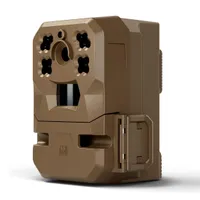
Check out our full guides to the best trail cameras, and also the best cellular trail cameras

