







Digital Camera World Verdict
The Green Feathers WiFi camera is a versatile, compact performer for bird and hedgehog boxes that easily converts traditional nest boxes into the digital age. You get sharp 1080p footage, clear night vision, and don't have to spend on a monthly subscription. If you're looking for a more naturalistic product than AI-powered options and don't mind a modest setup, it will give you a clear, stress-free window into garden wildlife and its behavior.
Reasons to buy
- +
Compact fits for wildlife boxes
- +
No mandatory subscription fees
- +
Sharp, natural 1080p footage and IR night vision
Reasons to avoid
- -
Power cable need routing
- -
Highlights clipped in bright daylight
- -
No species recognition or smart features
Why you can trust Digital Camera World Our expert reviewers spend hours testing and comparing products and services so you can choose the best for you. Find out how we test.
While the broader smart-nature market has spent the last few years focusing on chunky bird feeder cameras that record outdoor garden visits, a distinct branch of wildlife tech remains dedicated to the nesting season. When I was starting out in wildlife photography, capturing the moments inside an enclosed habitat like a nest box meant running physical cables to a monitor or recorder. Today, the best bird box cameras include high-definition, wireless nest boxes you can view remotely.
I was keen to review the Green Feathers WiFi Bird Box Camera (3rd Gen), as I've watched the brand from afar for many years as a nature nerd. Green Feathers is UK-based and has spent over a decade creating dedicated habitat surveillance options. This tiny bird box camera is specifically designed to capture bird habitats and looks nothing like the recycled indoor security cams you get in some bird feeders. It’s an upgrade to the 2nd Gen model and now links to the free Green Feathers mobile app.
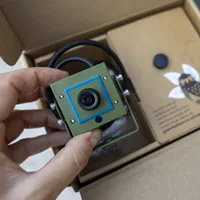
In the past, I’ve struggled with oversized cameras that crowd out nesting spaces. The camera itself is a 44 x 44 x 33 mm metal cube that mounts to the ceiling of a bird box, leaving plenty of room for the feathered subjects inside. On-paper specs don’t always explain much, but here they include 1080p (Full HD) resolution, a wide-angle 2.8mm lens with a 103-degree field of view, and a built-in microphone. There are also four invisible infrared LEDs for night vision without disrupting the birds' sleep.
As mentioned, the camera is designed to be used in combination with the official Green Feathers app to send you real-time motion detection alerts, taking it a step closer to the AI-powered options from the likes of Birdfy. Are most nature-lovers really better served by an all-in-onesetup like the Birdfy Nest Duo, or does this tiny camera provide greater versatility and value? Sadly, I’ve missed the thick of spring – and UK nesting season – but I'll still be testing the camera thoroughly over several weeks to bring you the verdict.

Green Feathers WiFi bird box camera: Specifications
Sensor |
2MP 1/3" CMOS image sensor |
Lens |
2.8mm |
Resolution |
Main stream: 1920×1080; Sub-stream: 640×480 |
Frame Rate |
15fps |
Compression Format |
H.264 |
Audio |
Built microphone. Speaker used in setup only |
Storage |
microSD card up to 128GB (not included) |
Recording Modes |
Continuous, motion detection |
Night Vision |
Invisible infra-red 4x LEDs (1m night vision range) |
Shutter |
1/50(1/60)-1/100,000sec |
White Balance |
Automatic |
Network |
2.4GHz and 5GHz Wi-Fi (Dual Band) |
Operating Temperature |
−20 – 50°C |
Dimensions |
44 × 44× 33 mm |
Power |
DC 12V input, 2.1mm jack |
App Supports |
iOS 10.0 or Android 5.0 and later |
Weatherproofing |
IP54 rating |
Green Feathers WiFi bird box camera: Price
The Green Feathers WiFi HD camera comes in at the more premium price point end of the nesting market, at around £149 (approx. $195) on its own and currently £184 (approx. $240) for a starter pack that includes Green Feathers’ well-built nesting box, ten-meter power extension cable, and a daytime LED lamp to boost the light on dark days. This is the bundle I'll be using and reviewing.
Unlike cheap and cheerful generic indoor smart cams that users try to retrofit outdoors, this camera is a specialized option. It’s ultra-compact, and its IP54-rated housing is designed to survive tight, humid nesting environments without overheating. There aren’t any ongoing subscription fees either, which I love, keeping the long-term running costs at zero.
If I compare this WiFi HD camera bundle to its closest competitors – the dual-camera Birdfy Nest Duo springs to mind – this device strikes an interesting balance. It trades off advanced features like AI species recognition for a stripped-back focus on reliability.
What you get is a great 1080p digital stream, and I think it's a very fairly priced intermediate option for wildlife enthusiasts who want modern phone integration but still want a more traditional-looking setup.


Green Feathers WiFi bird box camera: Design & Handling
The foundation of the system is the Green Feathers Wi-Fi camera, a delightfully small (green) 44 x 44 x 33mm cube. While I tested this as part of the Starter Pack, it's worth making clear that the camera is sold as a standalone unit that you can easily retrofit into an existing wooden nest box or a hedgehog house – Green Feathers sell these too – if you already have one set up in your garden or designated wildlife area.
Despite its pinch-sized footprint, the camera’s physical details are cleverly thought through for life inside an animal habitat. Underneath the body is a microSD slot, which Green Feathers helps you to protect with the inclusion of a thick, heavy-duty sticker cover. It’s a simple way to keep bird debris and feathers from mucking up your storage over time.
The centrally-positioned camera lens on the front comes with a protective rubber cap for transit and installation, which easily pops off and stows away once you're ready to set up. Attached to either side of the camera is a robust metal bracket that arches forward and back on a smooth rotating mechanism. This has one central screw hole, so mounting it into any wooden structure requires just one easy fixing point. It looks almost identical to Green Feathers' TV connection bird box camera, but with a green square around the lens instead of blue.


On top of the camera you’ll find a top-mounted Wi-Fi antenna (which to me does feel a little flimsy but is unlikely to be disturbed inside the box) and a thick power cable. Because this is a mains-powered setup, you'll need to route the trailing lead out of your box. Green Feathers includes a 10-meter power extension cable in the starter pack, giving you plenty of slack to reach a shed or even an indoor plug socket, but this is very different to the Nest Duo that runs off a rechargeable battery and can be topped up with solar.
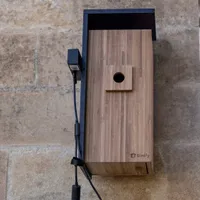
Buying the camera solo is one option, but opting for the WiFi Bird Box HD Camera Starter Pack only adds around 20% to the cost, and I think it’s worth it as you get a purpose-built, complete housing right out of the box. The bundled bird box is a super sturdy piece of woodwork. With a solid timber thickness of over 2cm and a generous height of 47cm, it feels substantial and provides ample head height between the top-mounted lens and the nest floor.


To look at, I actually prefer it to the sleeker, molded look of the bamboo Birdfy Nest Duo. Although heavier, its traditional construction feels more naturalistic when mounted against a tree trunk or garden shed. The only minor trade-off is the entrance hole. It comes as a standard 32mm opening, meaning you don't get the interchangeable size plates that bird boxes like the Nest Duo include to target specific species.
Getting the camera installed inside the Starter Pack box is fairly straightforward, though it requires minor DIY. I started by removing the top two front panels with a standard screwdriver to open up the space. Inside, at the top-back, there’s a pre-drilled central hole; I simply needed to align the camera bracket and push the included screw through the exterior wood to lock the unit in place.
The cavernous interior layout makes it easy to get your hands inside to tilt and fine-tune the downward camera angle toward the nest floor. My advice is to make sure you're totally happy with your framing before reattaching the wooden front panels. You’ll also need to thread the trailing power lead out through the specially designed air ventilation slots positioned just under the roofline, but the fit is neat – something another nestbox might not have.

Before closing everything up, it’s best to pair the camera with your smartphone while you still have clear sight of the printed QR code label on the power cable. This code triggers a step-by-step walkthrough of instructions in the free Green Feathers app to pair the camera to your Wi-Fi network. I’d guess that from unboxing and hunting down screwdrivers to reading the manual (which is laid out brilliantly and simply) and getting the unit fully wired up, the whole assembly process took me around 45 minutes.
When it comes to mounting the completed bird box kit to a wall or tree, Green Feathers has supplied two long metal fixing plates and screws. Compared to the heavy-duty wall plate included with the Birdfy Nest Duo, these brackets feel a little less substantial – especially considering the weight of the thick timber box. But while they lack chunkiness, they seem more versatile, and can be configured in three different orientations, giving you plenty of flexibility to secure the box regardless of your chosen tree or wall layout.
Once you’re mounted, day-to-day operation is handled by the basic (in a good way) Green Feathers app. I found it refreshingly clear and straightforward to navigate, with the device shown on the home screen, and one tap needed to bring up the live feed. This is also clean, with highly responsive ‘buttons’ for instantly grabbing a snapshot, triggering a manual video recording, or changing settings like motion and sound detection. Pushed notifications stack on your phone if allowed, making the live feed feel practical and stress-free to monitor throughout the day.
Green Feathers WiFi bird box camera: Performance
Above: Sample clips from the Green Feathers HD bird box camera
Note: As I'm testing this system outside of the UK's bird nesting window, the clips and images demonstrate the perspective, focal depth, and image clarity inside the timber nest box. Sadly, there were no live subjects.
I’ve had the Green Feathers WiFi Bird Box HD Camera Starter Pack set up in my garden for several weeks now. Sadly, testing this out of nesting season means I’m still waiting for my first feathered residents to move in, but putting the hardware through its paces has still given me a clear picture of how this system would perform in terms of image quality and everyday usability.
One quick win for me is the responsiveness of the Wi-Fi connection and live feed. With some smart wildlife cameras I’ve tested, opening a live view often feels like a test of patience as you stare at a buffering wheel and wait for the screen to load. Here, tapping into the Green Feathers app brought up the stream almost instantly, making it quick and painless to check in on the box throughout the day.
I positioned the box at the end of my garden too, and found little drop in Wi-Fi signal (something you can monitor as a percentage on the feed itself). While you can zoom in considerably to the live feed from the app by pinching the screen, images are only saved at the wide view.

The camera has a 1080p HD resolution; not massive by modern standards. But the image quality inside the box has impressed me more than I was expecting, particularly when it comes to fine detail. The camera’s fixed focus is dialed in well for the tight interior dimensions of the box, and when I look closely at the test footage, I can see the ridges of the wood grain, saw marks, and specks of dust on the nursery floor are resolved crisply.
If I imagine the box filled with baby birds and nest material, I think the feathers would be equally finely resolved. However, it's worth pointing out that the feed quality peaks and drops depending on your WiFi signal, and there's an indication of the KB/s in the corner of the live feed.
The depth of field covers nearly the entire cavity, keeping a sharp focus from the mid-ground floor right up to the back panel, which bodes well for keeping both adult birds and tiny hatchlings sharply in focus wherever they settle. I wasn't able to fully analyse how good the 15fps video rate was for capturing the motion of birds in and out of the nest.
I think that the color rendering is another high point. Unlike the heavily processed, neon-green bias common in outdoor trail cameras or cheap webcams that have been adapted for bird feeders, the white balance here feels neutral and true to life. The natural pine grain presents rich, warm amber tones without looking artificially cooked or oversaturated.

One downside is the dynamic range when bright daylight streams into the box. There’s a strong contrast between the dark interior and the light piercing through the entrance hole, and ventilation seams cause some highlight clipping, blowing out those small entry points into bright white patches. However, I think the camera still balances interior shadows well, preserving detail in the upper corners without letting them collapse into digital noise.
The wide-angle lens does have some visible barrel distortion – giving the square interior a slight tunnel perspective – but for a tight nest-box environment, this wide field of view is a necessary choice to ensure you don't miss action that’s happening near the walls.


When the light levels drop, at night or on dull days, the camera automatically switches to its invisible infrared night vision mode, and I found that the built-in IR LEDs cast a soft, even flood of light. Based on my sample images, if a parent bird or nesting chick were to sit directly beneath the lens, I reckon their feathers would keep their contrast rather than blowing out heavily.
With the monochrome infrared footage, I noticed that the fine wood-grain details on the walls softened slightly into a smooth, speckled grey. But the camera's fixed-focus kept the central floor crisp. As the IR LEDs operate completely invisibly without emitting a red glow, you can keep a close eye on nocturnal birdy activity without startling or disturbing the birds in the dark.


Because this is a mains-powered setup, with a long power extension lead rather than a battery-and-solar hybrid, there’s no anxiety of a camera running out of battery mid-brood. I enjoyed not having to worry about disturbing a nest to retrieve a battery pack or hoping for enough sunny days to keep a solar reservoir topped up. Once the camera is plugged in, power is a non-issue for the season.
Of course, there’s no AI species recognition or nesting-phase categorisation found on high-end competitors like the Birdfy Nest Duo. The Green Feathers system focuses on getting the core essentials right, and will send notifications for movement and noise promptly on your phone.
The notifications came too often when nothing was entering or leaving the box, but as mentioned in the handling section, the stream was always smooth and reliable. The Green Feathers app just works. And if you're happy to forego smart AI fluff in favor of sharp, naturalistic 1080p footage, I’d say it delivers a brilliantly clear view into the hidden world of a nest box.
Green Feathers WiFi bird box camera: Verdict

After testing the Green Feathers WiFi Bird Box HD Camera Starter Pack and mentally comparing it to what I see as its main (AI-heavy) competitor, the Birdfy Nest Duo, I have to say that I personally found it far more fun to use overall.
As a lapsed wildlife photographer by training, I'm used to manually ID-ing birds and constructing funky contraptions to photograph flighty wildlife. By doing without smart species recognition and automated nesting timelines, the Green Feathers system gives you a less cluttered bird box experience, and one that I think traditionalists – folks with a bit more basic bird knowledge – might enjoy more.
There were still a few downsides of the kit, and the one that did annoy me was how often alerts triggered, when the wind rustled the entrance hole or created dappled light inside of it. I couldn't find a way to dial in the sensitivity settings to avoid nuisance triggers, but you can turn them off entirely from the app.
Rather than using battery packs and solar power, the HD camera has a trailing mains power lead that you need to work out what to do with. While routing a cable to an outdoor (or indoor, if your setup allows) socket might annoy some users, I didn't mind it, especially as it means you don't have to check on the battery again.
You can buy optional cloud storage from the Green Feathers app, but I reckon a microSD will suit most users. The company quotes that a 64GB microSD card gives you around 32 hours of local recording, and you can set the card to overwrite once it's full, seeing as it's not easy to get inside the box once birds are nesting.
Ultimately, this Green Feathers setup is going to give you a fuss-free but reliable video stream that you can easily download and then share with others. For me, it strikes a great balance between modern connectivity and common-sense usability. Whether you use Green Feathers' own bird box or your own, the small-sized kit is a superb, stress-free bird box camera.
Features ★★★★☆ |
Basic smartphone integration with live view and motion alerts |
Design ★★★★☆ |
Highly compact, waterproof cube slips easily into nest box |
Performance ★★★★☆ |
1080p HD stream can display high detail, though this drops frames with weak Wi-Fi signal |
Value ★★★★☆ |
A semi-premium price tag, but avoids the costs of AI smart feeders |
Should you buy the Green Feathers WiFi bird box camera?
✅ Buy this if...
- You want an HD digital stream sent directly to your phone
- It's important to choose a camera that fits in standard wildlife habitats
🚫 Don't buy this if...
- You want cameras inside and outside a bird box
- You prefer a plug-and-play setup without any Wi-Fi required
Alternatives
Check out our guides to the best bird feeder cameras, and to the best bird box cameras

