

Digital Camera World Verdict
The Polaroid Mod turns photography tricks into a simple mode dial, making techniques like long exposures possible without understanding the photography jargon. While creators will need to understand a few tips, the Mod makes it simple to start shooting double exposures, light trails, and other creative shots right out of the box. Of course, you can shoot classic Polaroid photos on Auto mode too, but the Mod is the Polaroid that's built for creative experiments.
Pros
- +
Turns photography tricks into simple modes
- +
Easy to use
- +
Classic Polaroid design
- +
Exposure compensation control
- +
Well-priced
Cons
- -
Large to pack
- -
Film is pricey
- -
Flash setting resets every shot
- -
Viewfinder parallax can make lining up shots tricky
Why you can trust Digital Camera World Our expert reviewers spend hours testing and comparing products and services so you can choose the best for you. Find out how we test.
Working with photography tricks like long exposures typically requires an in-depth understanding of photography – but the Polaroid Mod has reimagined four distinctive creative shots into modes that are almost just as simple as auto mode.
The Polaroid Mod may share a similar nostalgic look to the rest of the analog camera maker's lineup, but the Mod packs an unusual focus: A set of creative modes designed for experimenting without the complexity of full manual mode.
A turn of the dial takes the Mod from a standard auto mode to double exposures, split shots, light paintings, and a mix between long exposure and flash.
But perhaps the Polaroid Mod’s biggest trick is this: I think Polaroid has somehow managed to create a creative analog camera that will delight both new photographers and seasoned experts.
Polaroid Mod: Specifications
Lens |
Fixed focus, two lens system with 103mm standard and 95mm portrait |
Film |
Polaroid i-Type and 600 film in color and black-and-white |
Battery |
Rechargeable li-ion rated at up to 15 packs of film |
Dimensions |
162mm (L) × 111mm (W) × 98mm (H) |
Weight |
520g (without film pack) |
Polaroid Mod: Price

The Polaroid Mod is coming first to the US, with an October 6th ship date, before arriving to additional countries in early 2027.
The Mod lists for $169.99 / £149.99. That slots the instant camera in between the Polaroid Now+ Gen 2 and the Polaroid Flip.
Film should always be a key pricing consideration for any instant camera. Polaroid’s i-Type film typically costs $18.99 / £15.90 for eight exposures – that’s about $2.25 / £1.98 per photo.
Polaroid Mod: Build and Handling

The Polaroid Mod has the classic and endearingly retro shape that I’ve come to expect from Polaroid, with a large base the film sits in, tapering up to an optical viewfinder.
That classic design is far from pocketable – and less compact than Polaroid’s options that use the smaller Go format film. But the camera isn’t terribly heavy, and it comes with a surprisingly high-quality rope-style neck strap for carrying.

The Mod sits in the middle of Polaroid’s range – and the controls reflect that. The Mod is built around the concept of introducing creative modes in a way that’s nearly as simple as using auto scene modes. The Mod’s modes allow photographers who may not even know the definition of shutter speed to try shots like light painting.
Those modes are built into a dial around the camera lens. While the Mod doesn’t have manual modes, there is a dial for exposure compensation to help control how light or dark a shot is. On the opposite side of the lens is the shutter release.
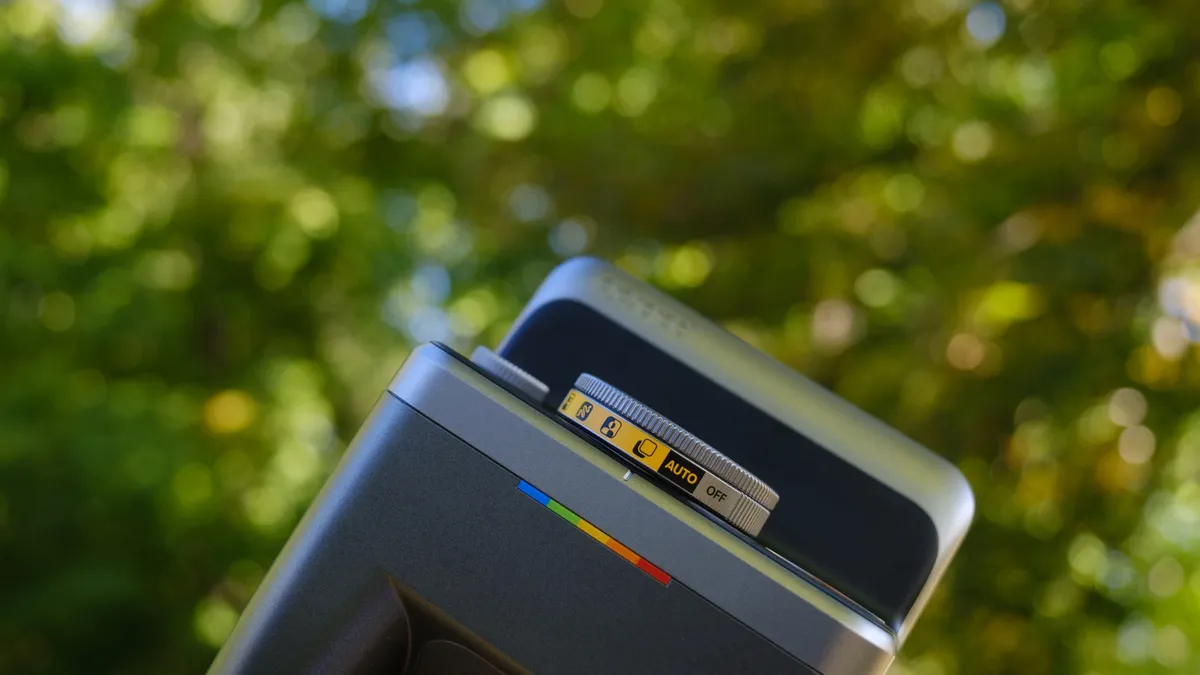
At the back of the camera, a miniature screen shows a tally of the number of shots remaining (or, in the case of the double exposure and split mode, the shot number that you’re on). Two buttons nearby control the flash and self-timer.

Film loads into a door at the bottom of the camera. Loading is fairly straightforward – load with the protective film face up and the rainbow tab facing out towards the front of the camera.
The camera has a rechargeable battery using USB-C. That battery is rated for up to 15 packs of film.

Rather than Polaroid’s typical bright colors, the Mod takes on a more classic black and silver design. I think it’s quite eye-catching!
Polaroid Mod: Performance

The Polaroid Mod is built around experimental creative photography. Turn the mode dial from Off to Auto, and you can get a classic, straightforward Polaroid like this:

But that’s about as normal as the Mod gets – the rest of the four modes around the dial are built for experimental, creative photography.
Double exposure combines two shots on one classic Polaroid frame. This mode is limited to two shots – you can’t, for example, take triple exposures – but opens up a lot of fun experimental shots.
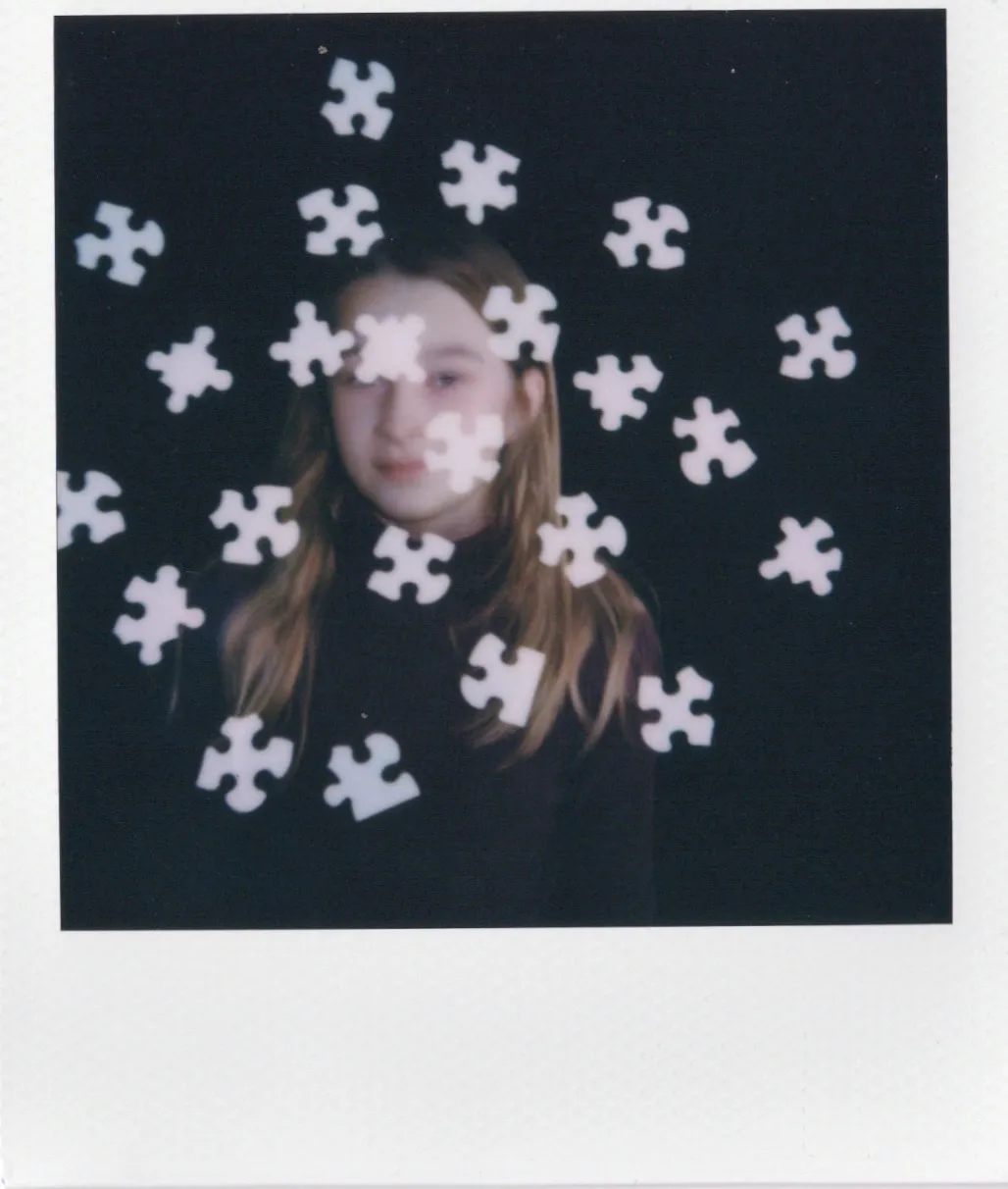
Split mode uses an accessory that comes with the Mod – a lens cover that only covers half the lens. In this split mode, you place the cover on one half of the lens, take a shot, then move the cover to the other half of the lens and take another shot to combine two photos into one frame.

Light painting mode uses a longer six-second exposure to blur moving light sources – like traffic on a city street, or moving around a sparkler or flashlight. This mode requires a tripod, or placing the camera on a table or another surface to hold it steady.

Motion freeze combines a longer, three-second exposure with a burst from the flash at the end. This mode is built to be shot while moving the camera during that exposure. The result is that any light sources create blurred streaks while the subject is sharply lit with that burst from the flash. It’s a creative effect that works best when there are a lot of light sources in the background – like city lights or string lights.
Motion freeze also works using a bright, colored video light on the subject to put both a blurred subject and a sharp subject in the same shot. That's the technique that I tried, but my video light wasn't quite strong enough, so the effect is more subtle:

The Polaroid Mod makes it refreshingly simple to get in-camera creative effects on analog with a twist of the dial. Part of the joy of instant photography is happy accidents – and putting experimental modes into a twist of the dial is bound to create more of those unexpectedly wonderful results.
Waiting for the photo to appear on the film is part of that experience, building anticipation. It was almost physically painful to wait for the instant film to develop and see how the shots turned out.
Using the creative modes doesn’t necessarily require an in-depth understanding of photography. I think you can get some creative shots with the Mod if you have no idea what terms like aperture and shutter speed mean.


But while creators don’t need to know the photography jargon, the best shots come from understanding each mode and how to get the best results. Polaroid includes a paper guide in the box that includes essential tips, such as using a tripod for the light painting mode, that creators will want to revisit often.
The Mod’s creative modes are the antidote to increasingly over-perfected modern photography. That said, like most creative endeavors, expect some failures. I used two packs of film in the Mod, and I liked about half of those shots. That’s not bad considering the experimental format, but when every shot costs about $2 / £2, those failed experiments can add up.
I ran into three challenges that tended to create a few failed experiments. First, if you turn the flash off, it automatically turns back on for the next shot – including for the second shot in the double exposures and split frame modes. I forgot to turn the flash off again for the second shot more than once.
Second, the Mod’s viewfinder has some parallax errors – photography jargon that means that the viewfinder isn’t entirely accurate because it’s placed in a slightly different position from the lens. Parallax errors also tend to be exaggerated when shooting up close. The parallax made it particularly challenging to precisely line up double exposures and split shots.

Finally, the Mod – and instant photography in general – doesn’t always get the exposure right. The Mod uses an f/11 lens – even in fairly good lighting, like shooting in the shade, the camera wants to use the flash, and if you turn it off, you might get some blur or a shot that’s too dark. I got a handful of shots that were overly bright, and I would have preferred my long exposures and motion freezes to be a bit brighter.
The Polaroid Mod is an analog camera built for taking unusual, experimental shots. While experimental photography will also include some missed shots, the Mod makes experimenting with photography simple and fun.
Polaroid Mod: Verdict

The Polaroid Mod rebels in a world of over-Photoshoped photographs and AI-generated images. The Mod doesn’t want to be perfect – it wants to be fun – and Polaroid’s latest camera deserves that word.
The Mod is the Polaroid camera to choose if you want an analog film camera for experimenting – without the cost and complexity of fully loaded, manual-mode-capable cameras like the Polaroid I-2.
It’s not quite perfect; exposures are sometimes off, and I’m a bit annoyed that you have to turn the flash off for every shot. But my biggest annoyance says a lot about the camera: Experimental photography means inevitable failures, so photographers need to be willing to grab a few packs of film.
While film is a bit pricey, I think the Mod itself sits at a great price point. It's a more affordable option that still has room to experiment without the price of the Polaroid I-2.
The Polaroid Mod is the camera for creators unafraid of experimenting.
Polaroid Mod: Alternatives
You may also like
For more analog inspiration, browse the best instant cameras or the best hybrid instant cameras.

