
A flashgun gives far better results than the comparatively weak pop-up flash found on some cameras, with a more powerful burst of light, and often the ability to bounce light from walls or ceilings. But, for even more creative control, a flash trigger enables you to position the flashgun exactly where you want it, completely separately from the camera.
Being able to liberate your speedlight from the hotshoe for off-camera effects opens up a whole world of possibilities, and the ability to control multiple lights from one unit offers even more. Once upon a time, flash triggers were physically tethered to their lights with a cord, but in this wireless age, a physical connection is no longer necessary.
Flash triggers generally work via radio frequency (RF) or infrared (IR), but for this guide, I've hunted down the best RF flash triggers you can buy right now, as they offer a greater range and don't require a line of sight. Different triggers are compatible with specific camera systems – so I've listed the compatibility options of each unit featured.
There's more information on picking the best flash trigger for your own needs towards the end of this article, along with the answers to some frequently asked questions. And if you're still building your speedlight setup, you'll want to check out our guide to the best flashguns and strobes.

Ben is the Imaging Labs manager, responsible for all the testing on Digital Camera World and across the entire photography portfolio at Future. With years of experience trialling and testing photographic kit, he's a human encyclopedia of benchmarks when it comes to recommending the best buys – here he picks out the best wireless flash triggers for your money.
The best flash triggers
Why you can trust Digital Camera World Our expert reviewers spend hours testing and comparing products and services so you can choose the best for you. Find out how we test.
Best overall

The Godox X3 Pro Wireless Flash Trigger is a major refinement and modernization of the brand's popular flash triggers, offering a sleek, compact design and significant usability enhancements compared to the older (but cheaper) Godox XPro trigger. The most prominent feature is the new 2.4-inch LCD color touchscreen, which provides a bright, responsive, and intuitive interface. Users can easily manage their setup by tapping to select groups and swiping to adjust flash power or mode. Color-coded groups further simplify the identification of individual lights in complex studio or location environments.
Design-wise, the X3 Pro features a low-profile body that sits comfortably on the camera and introduces a brilliant self-locking hotshoe mount for quick attachment and release. It replaces disposable batteries with a built-in, 2930mAh lithium-ion battery rechargeable via USB-C.
Performance is seamless and dependable, offering instant connectivity with Godox lights across a 100m range. It supports essential functions including TTL, Manual, Multi, and high-speed sync up to 1/8000 sec. The X3 Pro also introduces Pro Shooting modes – including One-Shoot, All-Shoot, and an L-858 Mode for Sekonic light meters – and a Creative Shutter Control function for programming time-lapse and long-exposure sequences directly on the unit. This command-center functionality allows photographers to stay focused on the scene rather than menu-diving.
Read our full Godox X3 Pro Wireless Flash Trigger review
Most versatile

The Elinchrom EL-Skyport Universal Plus Transmitter & Receiver Set is designed for maximum compatibility across virtually all camera and flash setups, earning its 'universal' designation. To achieve this universal compatibility, the system lacks camera-specific dedication, meaning it does not support TTL (Through-The-Lens) metering or High-Speed Sync (HSS) with regular focal-plane-shutter cameras. When paired with compatible Elinchrom "RX" flash heads, the transmitter can remotely adjust power levels, but for all other flashes and speedlights, power must be adjusted manually.
The system emphasizes simplicity over advanced automation. It uses a straightforward pushbutton interface with illuminated status displays instead of a modern color touchscreen or LCD panel. However, it remains a highly reliable and robust remote flash trigger system. Founded on a dependable 2.4GHz RF wireless system, the set provides an impressive triggering range of up to 200m (656ft), ensuring rock-solid connectivity even through obstacles and around corners.
The kit consists of a transmitter (which can pivot upright for optimum range) and a receiver, both of which are solidly built and powered by universally available AA batteries, offering excellent stamina. The receiver features a cold shoe and a 2.5mm sync socket (with a 1/4-inch adapter included) to connect various flash heads and guns. Ultimately, the Elinchrom EL-Skyport is best for photographers prioritizing consistent performance and wide-ranging compatibility over specialized TTL and HSS features.
Read our full Elinchrom EL-Skyport Universal Plus Transmitter & Receiver Set review
Best touchscreen

The Neewer QZ Touchscreen TTL Wireless Flash Trigger is a sophisticated next-generation controller that modernizes off-camera lighting. Moving away from the cryptic buttons and tiny monochrome screens of the past, the QZ features a vibrant 2-inch HD OLED color touchscreen that makes managing complex lighting setups as intuitive as using a smartphone.
The build quality is impressive, packing a powerful 100m range and a built-in rechargeable Li-ion battery (offering up to 10 hours of use) into a compact, 60g frame. It supports a full suite of professional features, including TTL, High-Speed Sync (HSS), and 'TCM' – a standout function that converts TTL exposures into manual settings for consistent results. For those who prefer tactile feedback, a physical scroll wheel accompanies the touchscreen for precise power adjustments.
While currently limited to Canon, Nikon, and Sony systems, its reliability is top-drawer. It communicates seamlessly with Neewer’s modern flash range and can trigger other brands via an optional receiver. Though priced slightly higher than budget alternatives, the QZ’s elegant interface and 100% triggering reliability make it an excellent investment for photographers looking to simplify their creative workflow.
Read our full Neewer QZ Touchscreen TTL Wireless Flash Trigger review
Best compact
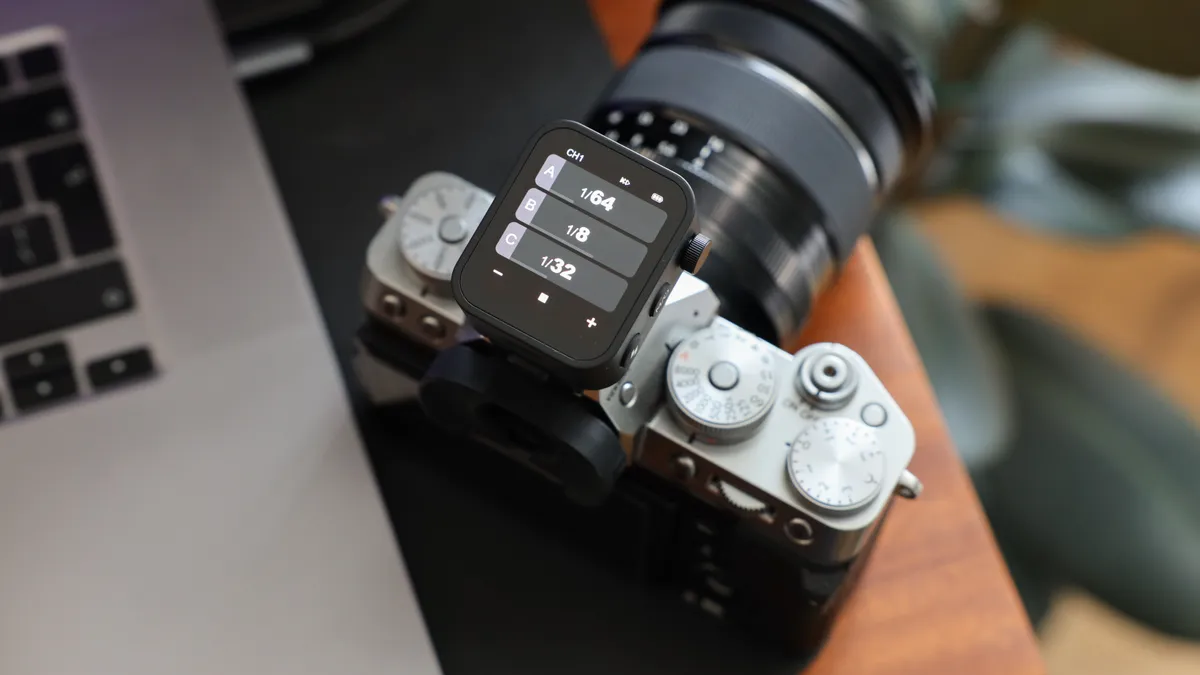
The Godox X3 (also known as the Xnano and Flashpoint R2 Nano in various markets) offers the functionality of Godox's larger models in an exceptionally compact and portable form factor. It is a top choice for photographers already invested in the Godox flash ecosystem, and is available for Canon, Nikon, Sony, Fujifilm, and OM/Panasonic camera systems.
The standout feature of the X3 is its user-friendly, high-clarity OLED touchscreen interface, which makes it a doddle to navigate menus and view settings. The trigger supports a full range of advanced features, including reliable 2.4GHz wireless transmission up to 100m, TTL (Through-The-Lens) automatic exposure, Manual and Multi-Flash modes, as well as High-Speed Sync (HSS) up to 1/8000 sec. I found performance to be reliable and consistent, keeping all flashes perfectly in sync.
The minimalist design and diminutive size significantly reduce the bulk on the camera's hotshoe compared to other flash triggers. Power is supplied by a long-lasting, built-in 850mAh lithium battery that charges via USB-C, eliminating the need for AA batteries. However, the compact size does mean that the touchscreen can be sensitive and fiddly for precise, micro-adjustments. But all things considered, the X3 is exceptional value for money, combining advanced flash control with a stunning, easy-to-use interface in a teeny-weeny package.
Read our full Godox X3 review
Best value

The Godox XPro TTL/HSS flash trigger is a long-standing, robust, and versatile wireless trigger that offers exceptional value for money. Available in dedicated versions for Canon, Nikon, Sony, Fujifilm, Micro Four Thirds, and Pentax cameras (be sure to buy the correct one), it is built on the reliable 2.4GHz Godox X wireless system, providing a powerful and consistent triggering range of up to 100m.
The trigger excels in functionality, supporting a wealth of flash modes, including TTL (Through-The-Lens) metering, HSS (High-Speed Sync) up to 1/8000 sec, and Multi-Flash (strobe) mode. A unique feature is the TCM (TTL Convert Manual) mode, which uses an initial TTL reading to set a manual power level, providing a solid starting point for precise adjustments. It can control up to 16 flash groups across 32 channels.
The design features a large, backlit, mono LCD screen and a conventional set of buttons and dials, which some users prefer over the newer touchscreen interfaces. The build quality is solid, but the interface is somewhat dated. It is powered by a pair of AA batteries, although I found the battery gauge to be inaccurate for lower-voltage rechargeable NiMH cells. While it features a red AF-assist lamp, this is only useful for DSLRs and not for mirrorless cameras. Despite the minor flaws, the Godox XPro remains a highly reliable and full-featured trigger and is a steal at the price.
Read our full Godox XPro review
How to choose a wireless flash trigger
A decent radio-frequency flash trigger should provide up to 100 meters of range and the ability to separate your flashes into groups that fire at different power settings. This allows you to replicate a studio flash head setup for a lower cost, with separate key, fill, and accent lights. It does mean you’ll often require an extra receiver for every additional flashgun you want to incorporate; however, some more recent flashguns come with built-in receivers, so check before buying any extra equipment you might not need.
Different triggers will have different features. Some will have Through The Lens (TTL) metering functionality, which automatically reads the lighting conditions and adjusts power output accordingly, while others are manual-only. Some will also be able to use High-Speed Sync (HSS), which enables the use of flash in tandem with fast shutter speeds, allowing you to freeze fast action. Depending on the kind of images you shoot, this may or may not be necessary.
Wireless flash triggers are usually designed to work with a single camera brand, with variations specifically for Canon, Nikon, Sony, or other camera systems, so double-check you've got the right version before you click 'Buy'. Universal triggers that are more broadly compatible forgo exotic features like TTL or HSS.
Here are five things to keep in mind when shopping for and using wireless flash triggers:
1. Stand back
The kits I've featured use radio frequency triggering, which, unlike cheaper infrared systems, usually work at a range of up to 100m without needing a direct line of sight.
2. Channel hopping
With radio frequency triggering comes possible interference from other RF devices. A system with multiple channel options or channel coding will lock out uninvited airwaves.
3. TTL triggering
A triggering system that wirelessly transmits TTL metering signals is a must if you rely on the fire-and-forget simplicity of a TTL flashgun, but these triggers inevitably carry a premium.
4. Stay put
Don’t fancy wasting time running between multiple flashguns to set their power? More advanced triggers enable you to remotely control flashgun settings from the transmitter.
5. Sync speed
Typically, a flash trigger will enable a shutter speed up to 1/250 sec, but top-end systems boast high-speed sync with compatible flashguns, enabling up to 1/8000 sec shutter speeds.

How we test flash triggers
When we test flash triggers, we put them through their paces in our dedicated studio. We look at how easy they are to set up and use, and put them through their paces in features like wireless TTL and high-speed sync. We use our test camera's maximum sync speed and check for banding or misfires. We also assess the build quality of the trigger, as well as the battery life and operational range.
FAQs
Do flash triggers work with any flash?
Not usually. To use any fancy features, you will need a flash trigger dedicated to your camera/flashgun model, as each manufacturer has a unique layout of hotshoe pins and a proprietary system of communicating information to flashguns. The exception is a universal flash that uses only the standard central firing pin, but cannot relay any other information.
Why is my flash not firing?
While it is possible that a flash is not firing due to a technical fault with the trigger, receiver or flash itself, there are a number of common issues worth checking for before sending it off for repair.
Check that everything is plugged in correctly – a loose connection might be the problem. Check that all triggers and receivers are turned on, with radio transmission enabled, and are set to the same channel/group. Make sure that the flash unit is set to the right mode (it might be in Master rather than Slave), and that the shutter speed setting is not exceeding your camera's maximum sync speed. And finally, it may sound obvious, but do check that all parts of the chain have charged batteries.
