



Digital Camera World Verdict
The Poco F9 Ultra gets remarkably close to delivering a true flagship experience without the usual flagship price. It combines excellent performance, a superb display, long battery life, and a surprisingly capable camera system, although its image processing and software still lack some of the polish of the very best phones. For the money, though, there are very few compromises that would stop me recommending it.
Reasons to buy
- +
Gigantic battery
- +
Bose sound system
- +
Super-bright screen
- +
Powerful performance
- +
Great cameras
Reasons to avoid
- -
Some bloatware
- -
Not the longest support terms
- -
No 4K120
Why you can trust Digital Camera World Our expert reviewers spend hours testing and comparing products and services so you can choose the best for you. Find out how we test.
Poco’s wallet-friendly flagship destroyer is back, just 8 months after the last one. But this early arrival has a downside: it means that the F9 Ultra doesn't get Qualcomm's next-gen processor, and instead uses the same Snapdragon 8 Elite Gen 5 as its predecessor.
In lieu of a processor upgrade, Poco has super-sized the battery, upgraded to a brighter, faster display, and added a 200MP main sensor.
Are these changes enough to remain competitive? I’ve been using it as my main phone for the past week to find out.
Specifications
Screen |
6.9-inch 185Hz OLED |
CPU |
Qualcomm Snapdragon 8 Elite Gen 5 |
RAM / Storage |
12+256GB / 16+512GB / 16+1TB |
Wide Main Camera |
200MP 24mm f/1.68 |
Ultra Wide Camera |
50MP 18mm f/2.4 |
Telephoto Camera |
50MP 115mm (5x) f/3.0 |
Front Camera |
32MP f/2.2 |
Video |
Up to 8K30 / 4K60 |
Battery |
8050 mAh |
Operating System |
HyperOS 3, Android 16 |
Size (HWD) |
163.49 x 77.94 x 8.74mm |
Weight |
235g |
Price
The Poco F9 Ultra starts at $799, with early bird deals bringing that down to $729. Last year's F8 Ultra started at $729, so the price has increased by $70.
There are three models to choose from. The base model gets 12GB of RAM and 256GB of storage, while the 512GB model and (all-new) 1TB variant both get 16GB of RAM. They cost $949 and $1,199, respectively, but each has its own early-bird discounts available.
The pricing puts the phone in competition with other upper-mid-rangers like the Oppo Reno 16 Pro, Honor 600 Pro, and Xiaomi 17T Pro. It's also up against the base model Samsung Galaxy S26 and iPhone 17. In any case, the spec sheet holds up well against all opponents. It has the largest battery, the best processor around, and solid cameras, too.
Design & Handling
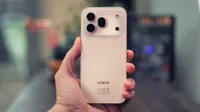
The Poco F9 Ultra looks very similar to its predecessor; only this time, there's no crazy denim-coated option. Instead, you can choose between a rather understated Black model or a slightly more eye-catching Dark Cherry, and I have the latter in for testing.
I absolutely love the colour. It manages to stand out from the crowd without being too bright or garish. The hue is perfectly matched on the aluminium side rails and camera island, and the glass-fibre rear panel has a smudge-resistant finish with a little texture to it.


It's no doubt an iPhone-inspired design, and rumors say Apple will have its own Dark Cherry colourway, but the Bose-branded subwoofer helps to ensure that it doesn't look too much like a copycat. There's a hidden new feature with this button-shaped speaker grille, too. It now has a white LED backlight encircling it, and it can pulsate along with your music, or when someone calls you. It's not the most useful addition, but it's cool, and I think that matters.
The phone is as sizable as ever, with a 6.9-inch display, and it's fairly hefty, at 235g. This is essentially a gaming phone, though, and that comes with territory. Unlike some competitors, there are no extra buttons or triggers, just the usual volume rocker, lock button, and SIM tray.
I was pleased to see that Poco has kept the ultrasonic fingerprint scanner; it's incredibly quick and reliable, outshining most similarly-priced competitors. It's also IP68-rated and has Corning Gorilla Glass 7i protecting the screen, along with a factory-applied plastic screen protector and a free hard-shell clear case included in the box.

The display has a blazing-fast 185Hz refresh rate, making it one of the fastest we've ever come across. Sadly, apps that will make use of this feature are few and far between, but at the very least, it should offer a competitive advantage in games like CrossFire: Legends and Blood Strike, while games like Call of Duty will cap out at (a still impressive) 165Hz.
It's also a super-bright panel. Poco says it can reach 10,000 nits covering 1% of the display area, or 4500 nits for 25% of the display. They're slightly confusing metrics, but all you really need to know is that it's one of the brightest screens around, and it's more than bright enough to compete with direct sunlight. Equally important, it can dim all the way down to 1 nit for late-night doomscrolling.
Otherwise, it's the type of crisp, vibrant OLED panel that you'd expect from a 2026 flagship, with fairly slim symmetrical bezels on all sides. Strong haptic motors aid the gaming and typing experience, but the speakers are the real star of the show.
Poco has, once again, teamed up with Bose to engineer a 2.1 sound system with a dedicated subwoofer. This time, Poco says the system has been refined to produce deeper bass and clearer sound overall.

I never tried the F8 Ultra, but I spent a lot of time with the Honor Magic 8 Pro, which also comes with a built-in subwoofer. I often found Honor's solution to be too bassy, and eventually ended up turning the bass down in the software, so I didn't have the highest hopes for the F9 Ultra, but it surprised me.
These speakers are shockingly well balanced. The bass is deeper and fuller than most phones, without being overpowering; the mids and highs are clean and detailed, and there's a good amount of stereo separation. It makes for a great experience when watching videos or playing games around the house.
Of course, we are still talking about phone speakers, so keep your expectations in check. They can't match an affordable Bluetooth speaker or a pair of headphones, but they come closer than most.
Camera Performance
The Poco F9 Ultra's main camera has been upgraded significantly. It now uses a 200MP 1/1.56-inch sensor from the HP5 family. It's slightly smaller than last year's 50MP 1/1.31-inch sensor, but the extra resolution should help a lot with digital crops between 24mm and 115mm, before the dedicated telephoto takes over. I think that's a good thing, because I find 5x telephotos to be a little more zoomed-in than I'd like for a lot of situations.
Said telephoto is unchanged from last year, but that's fine, because it was already pretty great. I believe it's also the same unit that the Xiaomi 17T Pro uses, and I was impressed with it there, too. I just can't help but wish it was an 85mm-equivalent instead.


The ultrawide is also unchanged, with a 50MP resolution and a respectable 1/2.88-inch sensor size. Its weakness is that it's fixed focus, so it's no good for close-up shots. The selfie snapper is 32MP. It does a decent job and has a nice wide FOV, but the lack of autofocus means you have to stand in the sweet spot to get the sharpest shots.
Aside from the lack of AF on the ultrawide and selfie camera, it's a very well-rounded camera setup. All sensors are high resolution, and the main camera can focus pretty close up; combined with a bit of digital zoom, it does a solid job for macro capture. The telephoto is also decent; it has a minimum focus distance of around 30cm, but with its 115mm equivalent focal length, you can get nice and close for some detail shots.


Poco lets you zoom up to 100x in the camera app, but I wouldn't recommend pushing it that far. The AI image processing gets very heavy-handed at such zoom levels, and the finer details become filled with oil-painting-like artifacts. At 10x, though, the image quality is superb, and you can even push it a bit further when the situation calls for it.


In low-light conditions, you'll want to stick to the main camera as often as possible. The larger sensor, combined with pixel binning and software enhancement, results in the cleanest images of the trio, mostly free from noise and blurring. The other cameras do a decent job, but smaller sensors mean they're quite prone to motion blur
If you want to give your photos some more personality, there are lots of filters to choose from in the camera app. They're mostly the same as the ones you'll find on other Xiaomi phones, but of course, you don't get the Leica-branded ones. That said, my personal favourites, the Positive and Negative film simulations, are both available here - and they look as excellent as ever.


Video capture is also impressive on this phone. Not only can you shoot at 4K 60fps on every single lens, but you can do so with Log enabled, and you can even apply preview LUTs. You can also shoot at 8K, if you fancy, but that only works on the main camera.
Sadly, there's no 4K120, but there's nothing unusual about that in this price bracket. The Poco F9 Ultra still offers more than most of its direct competition.
Phone Performance
The Poco F9 Ultra, somewhat strangely, is powered by the same Qualcomm Snapdragon 8 Elite Gen 5 processor as its predecessor. Normally, the Poco F-series devices always feature the latest Snapdragon chip, but this time, the brand has jumped the gun and released devices before Qualcomm’s next-gen chips are announced.
I suspect this was done to keep the phone in its affordable price bracket without sacrificing specs elsewhere. That's fine by me; it's still the fastest SoC that money can buy (right now), and it's more power than most users need.
This move also means that we haven't seen a RAM downgrade, as we have elsewhere. The 256GB base model still comes with 12GB, and the higher storage capacities both come with 16GB. I have the fully loaded 1TB option for testing.
Unsurprisingly, the phone is a rocket. It’ll handle all of your daily needs without breaking a sweat, and if you're into graphically intensive games, the F9 Ultra will handle them with finesse.
I loaded up my usual performance-hungry favourites, NTE and Wuthering Waves, and the phone was able to run both on high graphics settings at 60fps. It didn't get too hot in the process, and a solid game overlay let me tweak my settings further.


The experience is made all the more pleasurable by the super-bright screen, powerful speakers, and absolutely gigantic 8050 mAh battery.
The Poco F9 Ultra has the largest battery capacity of any phone I have tested to date, and despite frequent gaming sessions and plenty of camera use, I was getting two days from a charge on a regular basis. You could probably go longer with more conservative usage.
What's more, it charges super quickly. It supports up to 100W speeds with a wire or 50W wirelessly, with a compatible Xiaomi charging stand. There's no charger in the box, though, just a USB cable.

As for the software, it's the usual Hyper OS experience. I found it to be reliable and bug-free throughout my testing, and it's extremely customisable, so you can easily make it your own.
It isn't my favourite Android skin from an aesthetic standpoint, but that's easy to tweak. And there's a bit of bloatware when you first set it up, but it's all easy to remove.
There aren't really any standout features to mention; you get all the same stuff that we've seen on recent Xiaomi and Poco devices. That includes plenty of AI assistance like translation, transcription, and photo editing tools - plus the usual Google goodies like Gemini and Circle to Search.
Poco says you can expect six years of security patches and four major OS upgrades for the F9 series. It's not a class-leading promise, but decent enough at this price.

Verdict
Historically, Poco phones have been my go-to recommendation for people who want flagship-level gaming at an affordable price. Now, though, I feel like Poco has something to offer for just about everyone.
The F9 Ultra has one of the biggest batteries around; it's super powerful, it looks and feels premium, the speakers are top-notch, and the cameras are really impressive, too. No matter what you want from your phone, you'll likely find it here.
At this price, I don't think you'll find a better all-rounder - and with the way prices are trending, I don't see that changing any time soon.
Design ★★★★½ |
It may be verging on iPhone-clone territory, but the backlit Bose subwoofer, Dark Cherry colourway and premium materials throughout make for a very fetching phone. Add to that one of the fastest and brightest OLED screens I've ever tested, and there's not much to complain about. |
Camera Performance ★★★★½ |
The camera system is very well rounded. I think it offers enough to appease casual shooters and aspiring content creators alike. The main sensor is fantastic, the telephoto is great, and the ultrawide outdoes a lot of its direct competition. |
Phone Performance ★★★★☆ |
With the Snapdragon 8 Elite Gen 5 and an advanced cooling system on board, the Poco F9 Ultra will plow through any game you can throw at it, multitasking and advanced video editing pose no threat, either. You can do all of these things for a long time, too, because the battery is one of the best around. The software is decent, but it comes with some bloatware, and it lacks any standout features. Middle-of-the-road software support terms also weaken the appeal |
Value ★★★★☆ |
It may not be quite as cheap as last year's model, but that's an industry-wide issue. The F9 Ultra is still great value for money, especially considering the top-tier specifications. |
Overall |
★★★★½ |
Alternatives