
Filmmaker, photographer, and adventurer Doug Allan's career spanned more than ten major awards, including BAFTAs and Emmys, but the start of the legendary creator's career was anything but conventional.
Allan's career started in diving, making him an unlikely entrant into photography, and it was his unique, unrelated background, combined with a love for adventure and using a camera, that paved the way for such an incredible and successful career, including working alongside Sir David Attenborough. Allan died on April 08, at age 74, the loss of a photography legend.
My colleague and editor of Digital Camera Magazine, Niall Hampton, had the pleasure of interviewing Allan back in 2020, where he shared the story of his amazingly unconventional journey from marine biologist stationed in the Arctic to wildlife cameraman collaborating with none other than Sir David Attenborough.

“My time in the Antarctic, which started in 1976 with the summer in Signy [Signy Research Station], was then followed up with two winters in Signy, were my formative years,” said Allan.
Having been offered a position at the station as a diver by the British Antarctic Survey (BAS), Allan was following his instinct instead of convention—now a marine biology graduate—building on a love for diving he’d developed during his youth in Scotland.
“My job was to make sure that the scientists and the biologists and the guys working in the lakes, they got their job done safely [...]. But I was also encouraged to train anyone on the base who wanted to learn how to dive.
“It was quite remarkable, they decided they didn’t want to dive until the winter, so they were basically taught from zero underneath the ice.”

Allan was part of a tight-knit team stationed at Signy Island and went on to spend eight years working intermittently from the research facility. The camaraderie and harsh conditions bore incredible stories, which Allan wanted to picture in their entirety, leading him to pick up a camera.
“The Antarctic was where I really got interested in photography, it was such a wonderful place to live, such an unusual place and lifestyle,” said Allan.
“It was all stills I was doing back then, but I wanted to get not just the wildlife but the whole story about how the base ran itself—how we dived, getting changed, cutting the holes with a chainsaw underneath the ice, all that sort of stuff.”
Speaking to Niall, Allan reflected on how his initial period working in the Antarctic was like “training to become a photojournalist” while also developing the technical diving skills needed to survive in freezing Antarctic waters.
“For me at that time in my life, it was just perfect [...]. I learned my own limits, the difference between getting a bit chilly and hypothermic and frostbite. It gave me a feeling for snow and ice environments which I took on into my filming career,” said Allan.
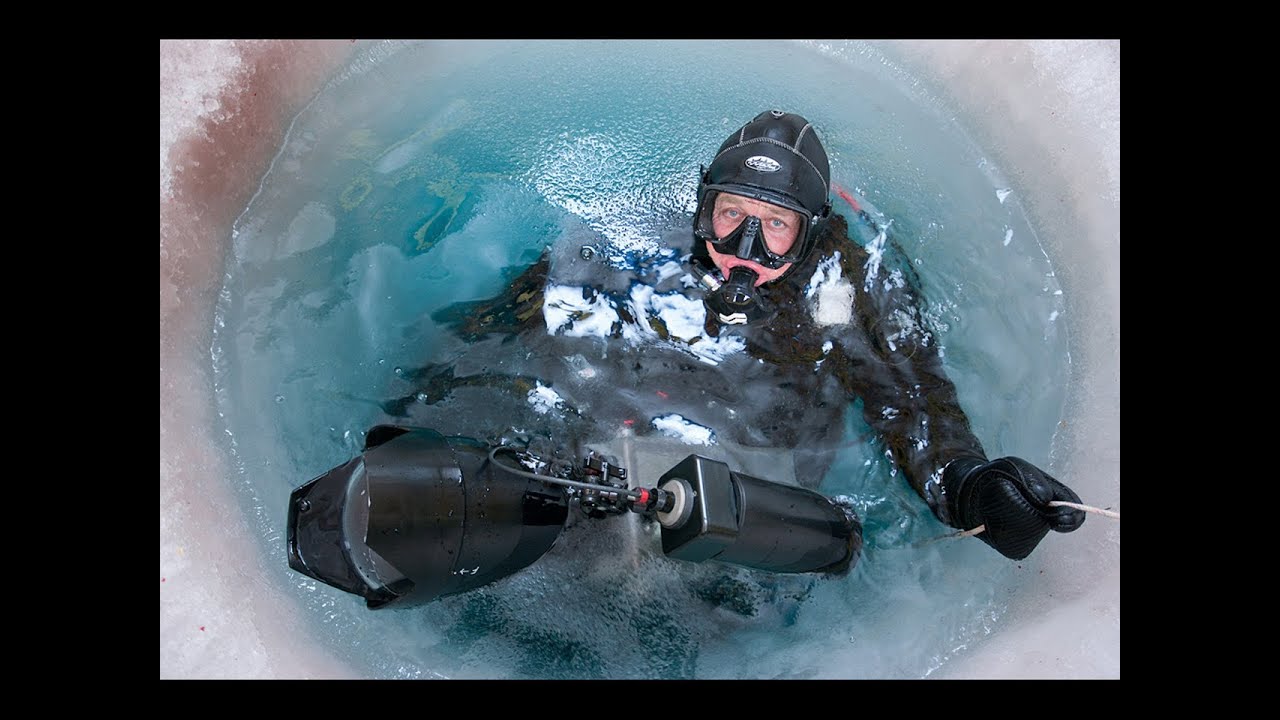
Watch: Doug Allan talks about being attacked by a walrus while diving
Allan wasn’t planning on becoming a wildlife filmmaker, but a chance encounter with David Attenborough in 1981 on Signy Island reshaped his plans completely. “Meeting David was undoubtedly one of these points where after that you’re faced with going in a certain direction or following David,” said Allan.
Attenborough was getting footage for his next series, Living Planet, and the time Allan spent helping the film crew made him realize that filmmaking combined everything he enjoyed—wildlife, small teams, and adventure—and that his Antarctic background had given him a unique edge.
“It was either David [Attenborough] or Ned [Brian Kelly], the producer, at one point they said to me, you know, Doug, if I want to go to Africa there’s about a dozen people I can ask [...], but if I want to come back to the Antarctic, I’ll have to come to you.
“Because you’re the only person that I know who knows about the animals under the ice, and the cold weather and preparing the equipment.”
Inspired by the encounter with Attenborough and his team, while back in the UK, Allan bought a 16mm film camera to take with him on his next assignment with BAS, this time to Halley Station.
A colony of emperor penguins lived just 12 miles from the station, and before leaving the UK, Allan had approached the BBC about securing footage of them for an upcoming series on birds.
While the initial pay was a “pittance,” as Allan put it, the deal was high-stakes. Allan had been told that upon release, the program would feature a “significant” amount of footage shot by him.

“[Meeting] David led to the emperor penguins and influenced my decision; the emperor penguins led to a longer shoot. And I would say by the end of early mid-1985, I was kind of established and could see the way ahead to make it full-time,” said Allan.
The following years brought many more filmmaking successes and unforgettable experiences for Allan, including further collaboration with Sir David Attenborough on Planet Earth.
In 2006, while working on the series, Allan and his assistant, Jason Roberts, became the first-ever film crew to go to Kong Karls Land, a specially protected small archipelago east of Svalbard, where the duo shot the famous footage of polar bears emerging from their dens.

Looking back on Allan’s career and the insights he shared with Niall during their interview, you could say that he was one of the luckiest filmmakers in the world. However, his success came not only from being in the right place at the right time, but also from combining passion with niche expertise. “Play to these unique skills that you have because not many people have those,” Allan said.
Sadly, we will never see new footage from Doug Allan; he died on April 08 on a trekking trip in Nepal. But we are left with the incredible story of a celebrated filmmaker, but also a brilliant person, who took what was probably the most unconventional and fascinating route into the industry.
You might also like
Discover our expert pick of the best cameras for wildlife photography, which includes mirrorless rigs with blazing-fast fps and crystal-clear resolution.

