
A key aspect of a gripping movie is the wide-angle field of view that seems to suck you in, so much so that a standard storyline can seem enthralling.
Back in the 1950s, a pioneering Dutch company called De Oude Delft (Old Delft) wanted to bring this cinema format to amateur movies and devised an anamorphic lens adapter for 8mm and 16mm home cameras.
The Delrama Anamorphic Lens Adapter was thus born, and its creators claimed it a ‘miracle’ as it reduced panning for wide shots, meaning less money spent on film. While innovative, the device never quite worked miracles, and was ultimately confined to history.
Now, French YouTuber Mathieu Stern has found an old Delrama for just €2 (about $2.30 / £1.72 / AU$3.25 / $3.15 CAD) and has put it through its paces, placing the innovative invention back in the public eye.
The Delrama used curved, reflective prisms to compress wider images into smaller film in order to be projected later at full size. The technology achieved a 1.5x squeeze factor, meaning a 16mm lens, for example, could capture a field of view equivalent to shooting at 11mm.
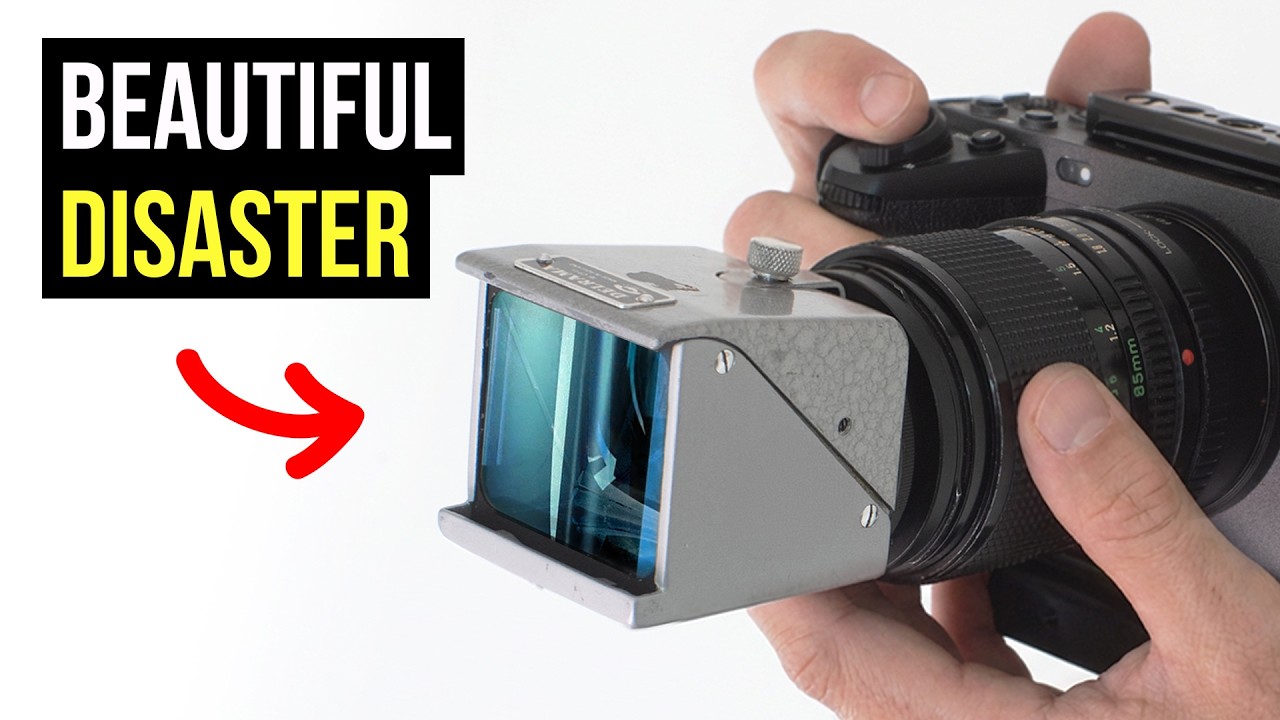
Watch: a YouTuber found a relic Delrama Anamorphic Lens Adapter for €2 ($2) and put it to the test
Before the Delrama, anamorphic lenses used spherical glass, and early models often introduced unwanted artifacts and light smearing into images. The Delrama, however, achieved zero distortion and crisp sharpness across the frame giving it a competitive edge.
The Delrama adapter was based on an earlier, much larger anamorphic adapter designed by De Oude Delft for Hollywood. Technicolor had hired the Dutch manufacturers to produce this original adapter for the 35mm Technirama process cameras used on the production of Walt Disney’s Sleeping Beauty.
Disney wanted the intricate details of one million individual hand-painted scenes to be clearly rendered in theaters, and De Oude Delft’s technology was the answer.
But the original Technirama adapter and subsequent Delrama adapter had their shortcomings, which ultimately led to their downfalls.
While the Technirama adapter was cumbersome and quickly succeeded by competitors who'd refined spherical glass, the Delrama adapter was prone to mold.
Nowadays, anamorphic compression is achieved in-lens using spherical glass, albeit to much more advanced standards than back when the Delrama and Technirama were released.
The Delrama and its big brother, the Technirama adapter, will ultimately remain relics of history. But it’s great to see these once innovative designs make a reappearance.
You might also like…
Discover our pick of the best film cameras and an interesitng story about a 2026 nature documentary filmed entirely on Super 8 film.

