



Digital Camera World Verdict
I like that the Manfrotto Uncover Backpack feels a bit like a ‘buy one get one free’ deal. That’s because it easily converts between a split camera / daypack and a full-sized, general-purpose backpack by simply removing the camera insert, which serves as a camera bag of sorts in its own right. Multiple access points are a bonus, and the roll-top design instantly adjusts the size to accommodate different loads. However, actual camera space is quite limited, there are fairly few additional pockets, and the organizer section could be a little better organized.
Reasons to buy
- +
Removable camera insert
- +
Roll-top expandability
- +
Back and side camera access
- +
Quality construction
Reasons to avoid
- -
Limited camera space
- -
Not many extra pockets
- -
Organizer section could be better
- -
No waist strap
Why you can trust Digital Camera World Our expert reviewers spend hours testing and comparing products and services so you can choose the best for you. Find out how we test.
Think Manfrotto and you’re probably thinking tripods, ranging from budget-friendly sticks right up to top-flight professional options. However, the Italian outfit has been operating since the 1960s, so it’s no surprise that it’s diversified along the way. There are light stands and accessories, which is also no surprise as the photojournalist Lino Manfrotto originally started the business by selling light stands. More recently, Manfrotto has designed and manufactured a wide range of camera bags, backpacks, and roller cases. The latest and arguably greatest of these are from the new ‘Uncover’ collection.
Typical of Manfrotto, there’s some snazzy Italian design flair and quality construction behind the Uncover range of backpacks and messenger / sling bags. The backpack that I’m majoring on here is the Manfrotto Uncover Backpack 30L, while also checking out the smaller 24L version. Both are very similar in terms of design, features, and construction; it’s just that one’s bigger than the other. That filters down to the camera inserts themselves.
The camera compartment of the 30L is designed to accommodate a mirrorless camera body or compact DSLR, along with three to five lenses, or a small drone kit. The 24L can take a compact camera body and up to three lenses, or a small drone. Both also serve as a daypack for your daily essentials, with an expanding roll-top design, and you can convert them to full-sized, general-purpose backpacks by quickly and easily removing the camera inserts. All in all, they aim to be among the best backpacks for photographers.

Manfrotto Uncover Backpack: Specifications
| Row 0 - Cell 0 | Uncover Backpack 24L |
Uncover Backpack 30L |
Capacity |
20.5L to 28.5L expandable |
25L to 33L expandable |
External dimensions (WxDxH) |
36x20x40.5-62cm / 14.2x7.9x15.9-24.4in |
40x21x44-64.5cm / 15.8x8.3x17.3-25.4in |
Internal dimensions (WxDxH) |
23x13x40-57cm / 9.1x5.1x15.8-22.4in |
28x16x41-60cm / 11x5.3x16.1-23.6in |
Backpack type |
Removable camera insert / daypack |
Removable camera insert / daypack |
Camera access |
Rear / side |
Rear / side |
Laptop compartment |
14-inch laptop + tablet |
16-inch laptop + tablet |
Tripod fastener |
Yes |
Yes |
Chest / Waist strap |
Chest |
Chest |
Baggage trolley strap |
Yes |
Yes |
Rain-proof cover |
No |
No |
Weight |
1.6kg / 3.53lb |
1.8kg / 3.97lb |
Manfrotto Uncover Backpack: Price
The Uncover Backpack 24L launched with a price of $300 / £229 / AU$429, while its bigger sibling, the Uncover Backpack 30L, came in at $330 / £239 / AU$439, so there’s not much difference between the two in terms of cost.
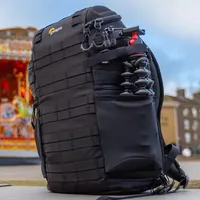
For the sake of comparison, one of the biggest names in the camera backpack market is Lowepro, and the Lowepro ProTactic BP 350 AW III (one of my favorite camera backpacks) costs around $300 / £211 / AU$530, which is pretty similar in most world regions but rather pricier in Australia.
Manfrotto Uncover Backpack: Design & Handling
When you want to pack a camera kit and all the stuff you need for a day out into one backpack, you can soon find yourself running out of space. On the other hand, you don’t want to be lugging around a backpack that’s bigger than you need it to be. The Manfrotto Uncover grows or shrinks to order, accommodating larger or smaller collections of kit and caboodle for any particular journey. That’s thanks to a roll-top design, enabling you to unclasp the top section and roll it out to a greater height.

The height range on offer equates to 40.5-62cm / 15.9-24.4in for the 24L, and 44-64.5cm / 17.3-25.4in for the 30L. In terms of capacity, the range is 20.5L to 28.5L for the smaller backpack and 25L to 33L for the larger one. In practice, the amount of extension feels considerable, allowing you to pack quite a bit of extra stuff when you need to, and to save space with a smaller backpack when you don’t.

It’s only natural to think of any backpack as something you wear on your back, but I do like a grab handle to be featured in the design. This makes it easy to pick up the bag with one hand and move it around when the need arises. Sure enough, the Manfrotto features a rope-style strap at the top of its back, underneath which there’s also a handy small loop.

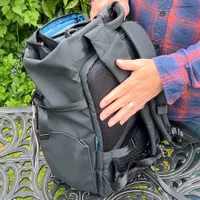
For longer journeys that involve airports and other travel terminals, a luggage trolley can help take the strain. The backpack can conveniently attach to the handles of these trolleys, thanks to a trolley pass-through which doubles as a padded back panel for when you’re actually wearing the backpack.

Like the back panel, the shoulder straps are generously padded to enhance comfort. They’re also durable, the backpack in general being based on Manfrotto’s custom ‘TriTex’ three-layer fabric, which is designed to be highly durable and water-resistant, along with weather-sealed YKK zippers and a PU-coated base, thus avoiding the need for an additional slip-over weatherproof cover. Getting back to the shoulder straps, I like that they have a big range of adjustment and that both feature a handy attachment loop.

When the going gets tough, and you’re trekking across rough terrain or generally making life difficult for yourself, you can find that backpacks tend to slide around, and the straps can slip off your shoulders. To help avoid this particular problem, the Manfrotto has a chest strap, which makes the backpack feel more secure, as well as keeping the shoulder straps in place. Like the shoulder straps, it has a wide range of adjustment and this time features an elasticated section to enhance comfort. However, unlike many camera backpacks, there’s no waist strap for keeping it in place, for example, when you’re climbing over obstacles. Ideally, I’d have liked a removable waist strap to be included, giving the option of using it or not, as needs dictate.

I’ve often seen webbing and attachment loops featured extensively on backpacks and think they’re a great idea. It’s really useful to be able to add extra pouches and various paraphernalia, fastening them securely to the outside of the bag. Manfrotto’s take on it for the Uncover range is to construct the front panel from ‘FlexGrid’, made from dual-laminated Cordura with laser-cut holes. This gives the option of attaching carabiners, tools, accessories, and pretty much anything else you can tie on or attach to it.

There’s a slim pocket featured on one side of the bag. The reason that it’s so slim is that it’s actually integrated into a larger zippered flap that enables access through the side of the backpack, right through to the camera compartment. As has become popular in many camera backpacks of late, the side flap gives the advantage that you can grab your camera with attached lens in double-quick time, without having to open the whole backpack and dig it out.

The side pocket on the other side of the backpack has relatively generous dimensions, expanding to accommodate the likes of a drinks bottle or tripod. Again, it’s opened and closed with a weather-sealed YKK zipper, just like all the other zippers featured around the bag.

The main compartment of the backpack that holds the camera insert opens from the rear. I like this arrangement, as it means that I don’t need to lay the rear of the backpack (that I’m subsequently going to wear against my back) on mucky ground to get at my camera kit. What I’m less keen on is that this sort of design often demands that you rotate the shoulder straps around to the front of the backpack before you can open the zipper. There’s no need for that here, as the shoulder straps don’t interfere with the path of the zipper track.

Opening the rear zipper also reveals the upper compartment with its mesh lid, as shown in the image above. Undoing an additional zipper gives access to this compartment, typically used for daily essentials. As I’d expect, you can also get into the upper compartment through a zipper on the top of the outer shell. Manfrotto’s ‘SmartLift’ system enables you to adjust the placement of the floor of the upper compartment, in conjunction with altering the roll-top height, as well as converting it into a full-height backpack with the camera insert removed.

The camera insert is quickly and easily removed, its lid slotting in and out of a receptacle built into the backpack. I’ve removed the insert for the image shown below, and you’ll notice that the lid folds over and has a zipper to close it, coming complete with a carrying handle. As such, it serves as a camera bag of sorts in its own right.

Whether fitted in the backpack or in standalone mode, the camera insert is supplied with a number of adjustable dividers, using the time-honored method of Velcro strip fasteners to keep them in place. They’re smartly designed and well-made.

The organizer section is built into the inside of the main flap of the backpack, utilizing its full height. As such, it offers a fairly generous amount of space but only has three sub-sections. These comprise a full-width pocket at the bottom, and a pocket that’s divided into two halves up top, opened with a single zipper. It works okay, but I think it could have been better with dedicated pockets for the likes of a wallet, smartphone, key fob, pen, and so on.

Manfrotto Uncover Backpack: Performance
As I said at the outset, I’m majoring on the larger 30L edition of the Manfrotto Uncover Backpack, and that’s the one that’s featured in all of my individual product images. Performance is very good in terms of robustness, durability, and weather-resistance. The backpack is also comfortable to wear, with nicely padded contact areas for the back and shoulders. However, a waist strap would have given extra stability, but is omitted in the design. On the upside, another performance plus point is that it’s quick and easy to get to your camera kit when you need it in a hurry.

My only real disappointment, considering that I was using the larger version of the backpack, is that I filled pretty much the whole camera insert with relatively little kit. As you’ll see above, I’ve managed to pack my Nikon Z6 III camera with a mounted Z 24-70mm f/4 S lens in its retracted state, along with three other similarly sized lenses. There’s a bit of space left over for spare batteries and another small accessory, but that’s pretty much it. If I needed to carry bigger lenses or more of them, I’d have to use lens wraps or pop them into pouches, and eat into the general daypack compartment.

There are times when I definitely want to just grab my camera with its mounted lens in a hurry, before a photo opportunity passes me by. I like that the Manfrotto has a zippered side access flap, which enables me to get hold of my camera with minimum fuss and bother, and maximum speed.

Increasingly, photographers and people in general need to carry laptops and tablets with them, whether they’re at work, rest, or play. The smaller 24L version of the backpack has an integral sleeve that can hold a laptop of up to 14-inch size, whereas the 30L can accommodate up to a 16-inch laptop. Both versions also have an additional tablet sleeve.

Unlike laptops and tablets, a tripod is a more camera-specific accessory. Again, the backpack accommodates, this time with the larger of the two side pockets. You can simply pop the tripod in feet-first, and there’s a hidden strap that you can pull out of a receptacle near the top of the backpack to secure the tripod in place.

Manfrotto Uncover Backpack: Verdict
I don’t think there’s any such thing as the perfect camera backpack. There’s always room for improvement, but more importantly, a lot of how ‘good’ a bag is comes down to personal requirements and taste. I like the expandable roll-top design of the Manfrotto, and that it can so easily convert between a split camera backpack / daypack and a full general-purpose backpack. However, I feel the versatility comes at the expense of the camera insert being relatively small, even in the larger 30L version of the backpack.
In other areas, I like the speedy side-access flap for grabbing my camera in a hurry, and the full-height rear zipper that gives easy access to everything else. The quality of the bag is also excellent, both in terms of its construction materials and how they’re put together. All in all, it’s an excellent backpack that serves its purpose very well, but I’d like a few extra dedicated accessory pockets, a better organizer section, and a waist strap, the last of these preferably being removable.
Features ★★★★½ |
Smart features include roll-top expandability with SmartLift system, a removable camera insert and FlexGrid front panel for attaching accessories. |
Design ★★★★½ |
The design is clever and stylish with high-grade materials and very good build quality, but there’s no waist strap and the backpack is only available in one black/grey colorway. |
Performance ★★★★☆ |
The backpack is robust, durable and very weather-resistant but even the larger version has relatively little camera storage space. |
Value ★★★★☆ |
Pricing is reasonable for both size options of the 24L and 30L backpacks but they’re not particularly great value for money. |

Alternatives