With neutral density filters, or ND filters, you have one of the most tried-and-tested tools for controlling light. Making long exposures possible in any and all light conditions, ND filters may seem simple, but they're vital for creating the kinds of photographic effects that simply aren't possible to replicate in post-processing. Any serious landscape photographer should have a set of ND filters in their bag – but which to choose?
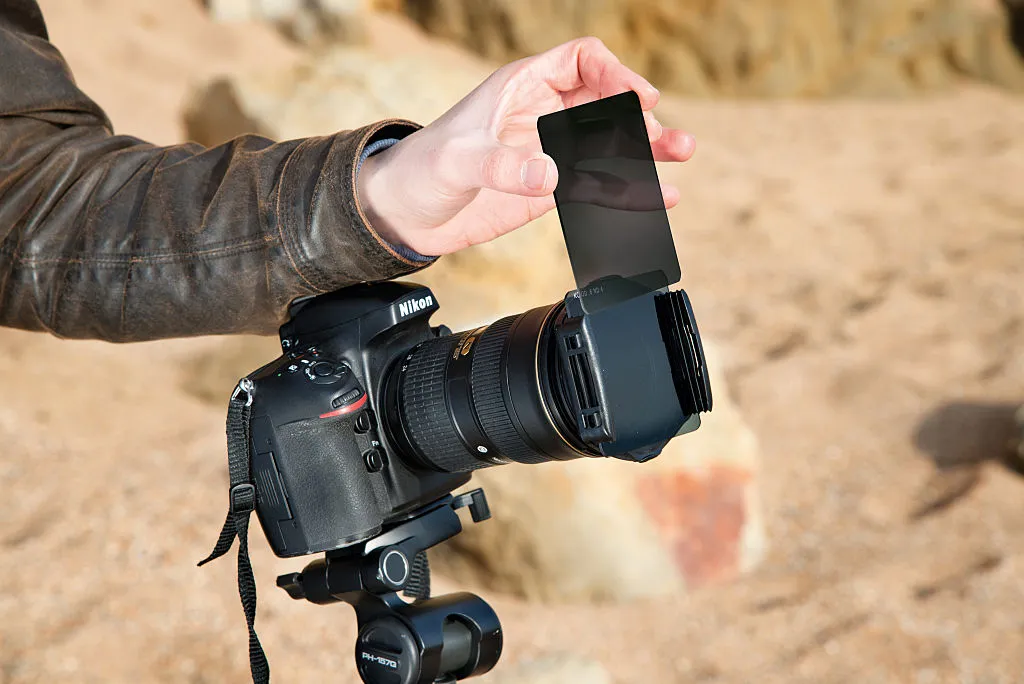
A primer for the uninitiated: an ND filter is essentially a piece of darkened glass placed over the front of a lens. Made from high-quality materials to retain sharpness, an ND filter reduces the amount of light that reaches the camera sensor, allowing longer shutter speeds to be used. This enables long-exposure effects, such as smooth water, traffic trails, or ghostly crowds, at various times of day.
ND filters come in two varieties – square and circular. Square filters slot into a holder that is attached to the lens in advance, making them easy to slot in and out, once you're set up and ready to go. Circular filters screw directly onto a lens, so they require less paraphernalia. However, it can be fiddly and time-consuming to screw into a lens on location, particularly when it's cold and dark, and many can't be used with ultra-wide lenses that have bulbous front elements. You will also need to pay attention to the filter thread size; circular filters come in a variety of sizes to fit different-diameter lenses, and the bigger the filter, the more expensive it tends to be. That said, it's sensible to buy the biggest-sized ND filter for the lenses you're likely to use with it, then use 'step up' rings to attach it to smaller-diameter lenses.
ND filters also come in different strengths – stronger filters cut down more light. They can be referred to in a variety of ways; you might see terms like "ND 1.8" or "ND64" being used. The best thing to do is check the stop count, which all ND filters will specify. Both ND terms above cut the exposure duration by six stops. It's much simpler to think of it that way!
The term 'neutral' signifies that neutral density filters should have no effect on the color of the image projected onto your camera's sensor, and should merely reduce the intensity of the light reaching it. However, some filters, particularly cheaper ones, can have a noticeable effect on the color of an image, giving a warmer or cooler cast. This can be corrected easily enough in software, but it is worth being aware of before you choose your filter.

Ben is the Imaging Labs manager, responsible for all the testing on Digital Camera World. Whether he's in the lab testing the sharpness of new lenses, the resolution of the latest image sensors, or the range of monster zooms, Ben is our go-to guy for technical insight. He's also the team's man-at-arms when it comes to filters, and is a human encyclopedia of benchmarks when it comes to recommending the best buys.
Best neutral density filters
Why you can trust Digital Camera World Our expert reviewers spend hours testing and comparing products and services so you can choose the best for you. Find out how we test.
Best square ND filter overall


I've been hugely impressed by Cokin’s Nuances Extreme ND filters, which is why I've made them my number-one pick for the best ND filters you can buy. Made with tempered mineral glass, these high-quality filters provide flawless color accuracy and pitch-perfect sharpness in all corners of the frame. This is thanks to the nano metallic alloy coating, as well as the quality of the glass.
My testing proved that the filters were as good as their marketing promised. The filters also precisely matched their f-stop light reduction range, so you know exactly what you're getting when you fix one on. The 'Extreme' designation is there because the lenses are hardy and drop-resistant, a quality complemented by the Cokin EVO filter holder, which has an effective foam gasket to guard against light leaks.
These aren't the cheapest options for ND filters, but they really are superb. The Nuances Extreme ND filters come in 6-stop and 10-stop densities, and are available in three sizes: P-size (84x100mm), Z-Pro (100x100mm), and X-Pro (130x130mm).
Read our full Cokin Nuances Extreme Neutral Density filter review
Best budget circular ND filter

Hoya’s ProND range of circular filters comes in 3-stop, 6-stop, 10-stop, and 16-stop variants, and the lowest three strengths are available bundled in a kit. Most common filter thread diameters are catered for by the 49-82mm size range, though the frame is slightly deeper than with some rival filters, which could introduce minor vignetting when shooting with a very wide lens.
As you’d expect, Hoya is keen to promote the ProND’s color neutrality and exposure accuracy, with features like a Metallic ACCU-ND coating on both sides of the glass. And it really does work: I tested the ND64 (6-stop) and ND1000 (10-stop) ProND versions and found them to have no negative impact on image sharpness at any point in the frame.
Color accuracy was a shade off the standard set by the best square filters, but a 0.5% deviation from the ND64 and a 1.3% difference from the ND1000 won’t be visible in real-world shooting. A 77mm ProND 1000 compares well with similar rival filters in price, making it good value considering its decent image quality.
Read our full Hoya ProND filter kit review
Best magnetic circular ND filter

The Freewell x Dunna Did It Videography Kit is a beautifully built magnetic filter system that excels in optical clarity. Centered around four fixed neutral density filters (ND4, ND8, ND16, ND32) and a Glow Mist 1/4 diffusion filter, it provides exceptional optical performance without meaningful sharpness loss or vignetting.
The standout feature is its ultra-slim profile: each solid ND filter measures just 2.95mm thick and weighs 18.4g. Combined with a secure twist-lock mechanism on top of the magnetic connection, I felt completely confident that the filters would not accidentally knock loose off my lens. The included protective case and the built-in exposure and white balance reference on the rear cap are thoughtful additions for filmmakers.
However, I found that its greatest design strength is also its biggest drawback. Because the filter frames are so thin, separating stacked filters can be frustratingly fiddly. Additionally, the kit includes only one base ring and is incompatible with other Freewell filter lines. Overall, if you prefer the color consistency of fixed ND filters over variable NDs, this is a sleek, high-quality, and highly capable setup for video creators.
Read our full Freewell x Dunna Did It Videography Kit review
Best premium square ND filter


In terms of sheer quality, it's hard to beat Lee Filters. The firm's ProGlass IRND range delivers a new benchmark in ND filter performance. While, like all Lee stuff, they don't come cheap, they're among the best you can get. With six density options, ranging from two stops all the way up to a mega 15 stops, they are a superb choice for the photographer who needs the best.
The IRND name indicates that the filters are coated to block infrared and ultraviolet light, delivering better image contrast and clarity. Lee filters of years past were well known for having a cool color cast, but this is no longer the case, with the IRND lineup delivering pitch-perfect color accuracy in my testing. Sharpness was also top-notch, in both the corners and the center of the frame.
It does take a little time to set up: you'll need a 100mm filter holder (Lee, predictably, recommends the LEE100 holder) as well as the appropriate-sized adapter ring to fit it onto your lens. Also, calculating exposures with the more extreme levels of filtering can be a bit of a head-scratcher, so Lee has considerately made it easier with its companion app, which helps you to work out the optimal exposure time for a balanced image.
Read our full Lee Filters ProGlass IRND review
Best large square ND filter

Kase’s Wolverine range of filters is named to suggest toughness: each filter is coated to make it scratch-resistant, as well as water-repellent and anti-reflective. They come in several sizes – some square, some rectangular – that go right up to 150 x 150mm, which can accommodate the broader field of view in a wide-angle lens. There’s a choice of five densities between three stops and a massive 16 stops – something for nearly everyone, in other words.
The filters fit into any standard holder of the correct size, but Kase chooses to place the light seal on the filter holder rather than the filter – so if you use another company’s holder that doesn’t have a seal, you could let some light in.
During my testing, I spotted a very slight color cast that is easily corrected, but no lessening of detail. I also liked the tough feel to the filters and the fact that they are easy to clean.
Read our full Kase Wolverine 100mm ND1000 review
Best premium circular ND filter

While the Lee Big Stopper has been beloved of landscape photographers for many years now, some decried the fact that it was only available in the square format, requiring a separate holder to attach to a lens. Well, no longer – Lee Filters has heard your cries and unveiled a version of its 10-stop ND, the Big Stopper, in a screw-on circular version.
The Big Stopper is unrivaled in its ability to tame powerful light, rendering long exposures possible in even bright conditions, and the high-quality Lee glass also means that vignetting is kept to a minimum.
Bear in mind that the Elements Big Stopper is currently only available in four filter thread sizes – 67mm, 72mm, 77mm, and 82mm – so check your lens is compatible before buying. And if 10 stops feels like overkill, the 6-stop Little Stopper is also available as a Lee Elements circular filter.
Read our full Lee Filters Elements Big Stopper review
Best circular ND filter for choice of sizes

If you own a lens with an especially small or large diameter, your choice of screw-in filters can be pretty limited – which is where companies like Urth come in. Its circular filter range comes in no fewer than 18 different sizes, from 37mm all the way up to 112mm. Each size is available in a choice of five densities running up to 10 stops. (Urth makes square filters and a holder, too.)
The Filter Plus+ series uses high-quality Schott glass with coatings to aid light transmission and make cleaning easier. Each filter is supplied in a classy tin, with its size and strength on the lid, so you don’t have to guess. If you like to use step-up rings to fit a filter on a smaller lens, there should be room in the tin for both the filter and step-up ring.
During my testing of an Urth 10-stop filter, I was pleased with the accuracy and the level of detail my shots retained. I did notice some color difference when I used Auto White Balance on two different makes of camera, although switching out of AWB killed the issue.
Read our full Urth ND1000 Filter Plus+ review
How to choose the best ND filter
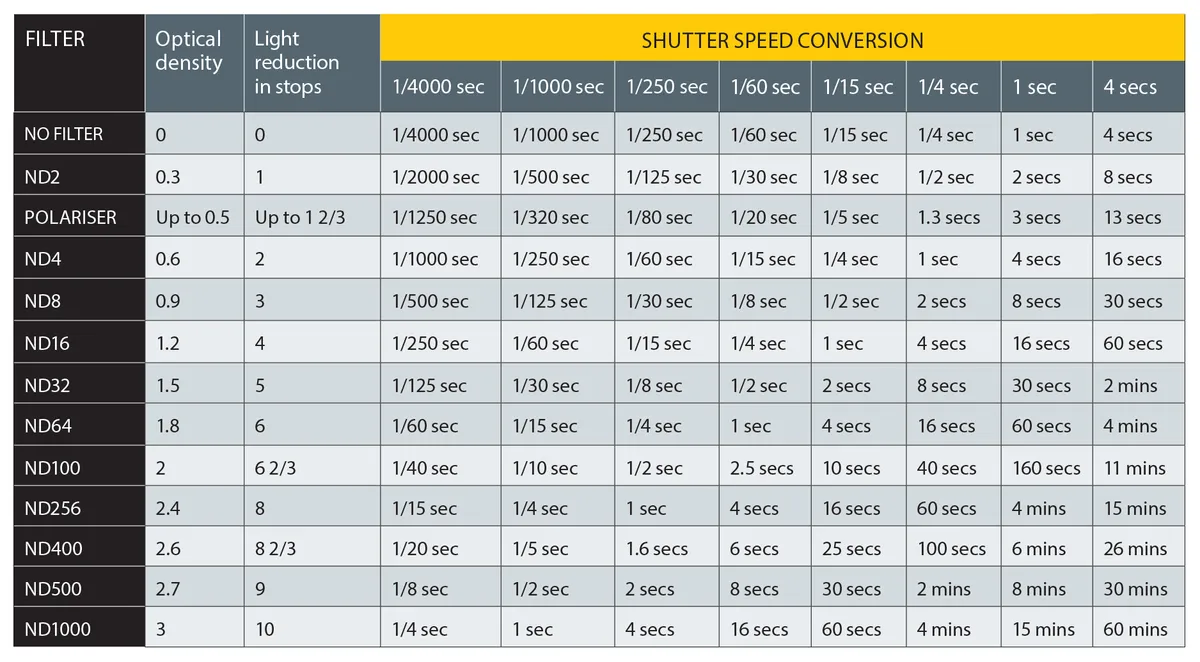
Neutral density filters are made in different strengths, and there a few different scales that are used to measure this. Some manufacturers use an NDxx number; others can quote a number for the optical density; and some use a figure to describe the light reduction in ‘stops’.
This table compares the systems and shows how much slower a shutter speed each filter type will let you achieve with your camera.
Are round filters best?
A circular ND filter is convenient to use and prevents light leaks, as it screws directly into the lens, rather than requiring a filter holder to be attached first. The downside is that it takes longer to screw in a filter than simply slotting it into a holder. You will also need a separate filter for each different diameter lens you intend to use with it, although you can get around this by using step-up rings to adapt a larger filter to fit a smaller lens.
What about square filters?
While they require a holder and an adaptor ring, the great thing about square ND filters is that once the holder is attached to a lens, it is really quick and easy to swap filters in and out to try different filter strengths or combinations. You will need to ensure that the ND filter is attached properly to prevent light leaks; most have a foam gasket to prevent stray light creeping in at the sides. As square filter holders typically come with a set of adaptor rings, they can easily be used with multiple lenses.
Which density should I go for?
Lighter (2-6 stop) filters will generally provide a sufficient shutter speed reduction to smooth moving water into a pleasing blur or give clouds a streaky appearance. A denser 10-stop filter (often referred to as a 'Big Stopper') will slow down your shutter speed enough for moving people in your scene to effectively be 'blurred away', rendering busy streets as deserted cityscapes. For an extreme effect, a 15-stop filter (or 'Super Stopper') will extend a 1/100 sec exposure to five-and-a-half minutes long.
Will an ND filter reduce image quality?
Neutral density filters should do what they say on the tin – remain neutral. While color casts can be corrected in image-editing software, the best ND filters shouldn't introduce any noticeable color effects. A decent ND filter shouldn't reduce sharpness at all, as any fuzziness from poor glass quality won't be fixable with image editing.
Can I get more creative with an ND filter?
An ND filter is one of the most creative tools in a photographer's arsenal! Any movement in a scene can be given varying degrees of blur, which is determined by the speed of the movement and the strength of the filter, and experimentation is key. A square ND system holder opens up even more creative possibilities, enabling the stacking of additional filters, such as polarizers or graduated ND filters, for images with even greater creative appeal.
What if I want more versatility?
Consider a variable ND filter. These handy filters are made from two sheets of polarized glass with an adjustable outer ring that can be rotated to control the filter density and thus the exposure length. They are often used when shooting video to maintain a consistent shutter speed. See our separate guide to the best variable ND filters.
How we test ND filters
A neutral density (ND) filter should simply block light transmission by its rated density – it should not impact image quality. To test this, we run the same lab testing procedure as we would when reviewing a lens, both with and without the ND filter fitted. We then compare sharpness scores to see whether the filter affects image sharpness anywhere in the frame.
We also use a color accuracy chart and processing software to check whether a filter causes a color cast; if it does, we can measure the exact deviation from optimal color. We compare a filter's optical performance to its retail pricing, the range of filter sizes/diameters available, and its overall handling quality to give a final value rating.
Find out more about how we test and review on Digital Camera World
