
During the last few years of testing the best bird feeder cameras, I’ve seen them evolve from novelty smart gadgets that look more like outdoor webcams into high-quality nature-watching companions. The majority of these weatherproof, motion-activated feeding stations can stream high-definition clips and use AI-powered databases to help identify thousands of migratory bird species straight to your smartphone.
With new models landing frequently, shopping for a smart feeder can be complicated. The market has become entangled with recurring app subscriptions, making a sub-$100 camera quickly become an expensive recurring item if your favorite features are locked behind a paywall.
And earlier this year, wildlife conservation bodies like the RSPB and BTO issued strong directives to avoid overfeeding to combat the spread of deadly bird parasites. Because busy feeding hubs concentrate wildlife, choosing a feeder isn't just about pixel count anymore – it’s about safety, ventilation, and how easy the components are to clean.
Over the past four years, our expert team has field-tested over 20 leading models across seasons, monitoring battery drain, solar charging, and app identification accuracy. If you’re looking for the best all-rounder in design, app experience, and image quality, our top recommendation is the Bird Buddy Smart Bird Feeder – while my personal favorite for beginners is the Birdfy Rookie.
Below, I’ve broken down the best bird feeder cameras on the market, sharing their app costs side-by-side to help you choose the safest and highest-quality setup for local wildlife and your budget.

With a degree in wildlife photography – that included animal behaviour and ecology – and over a decade of experience in the photo industry, Lauren brings a blend of scientific knowledge and technical expertise to our bird feeder reviews. She's field-tested many of the cameras in this guide in her own garden to help you evaluate wildlife tech not just for its image quality but also for its safety and performance. The rest come from our expert team of staff and freelance reviewers.
The Quick List

The Bird Buddy Smart Feeder can identify birds and remind you of when they visit with phone notifications, so you can see your garden visitors even when away from home.
Read more below

Birdfy's Rookie smart bird feeder camera is great value and ideal for beginners, offering AI recognition tech in a low-maintenance and easy-clean package.
Read more below

This 4K camera is a well-rounded option, though the app and ID experience aren't quite as smooth as Birdfy or Bird Buddy.
Read more below

This fir wood feeder is great to look at and blends into a garden better than most plastic options. 1080p video is clear, and the Birdfy app is as good as usual.
Read more below

One camera not enough for you? This product has two: a wide-angle camera for overall coverage and a motorized panning camera that can track and capture detailed close-ups of birds.
Read more below

Built from durable materials and despite being one of the more affordable cameras on our list, it offers 1080P video up to 25 fps, and there are 940nm LEDs for recording footage in low light. There are no AI smart features though.
Read more below

Another twin-camera Birdfy smart bird feeder – but this one is exclusively designed for capturing shots of hummingbirds, if you are lucky enough to have them in your backyard.
Read more below
The best bird feeder cameras
Why you can trust Digital Camera World Our expert reviewers spend hours testing and comparing products and services so you can choose the best for you. Find out how we test.
Best bird feeder camera overall
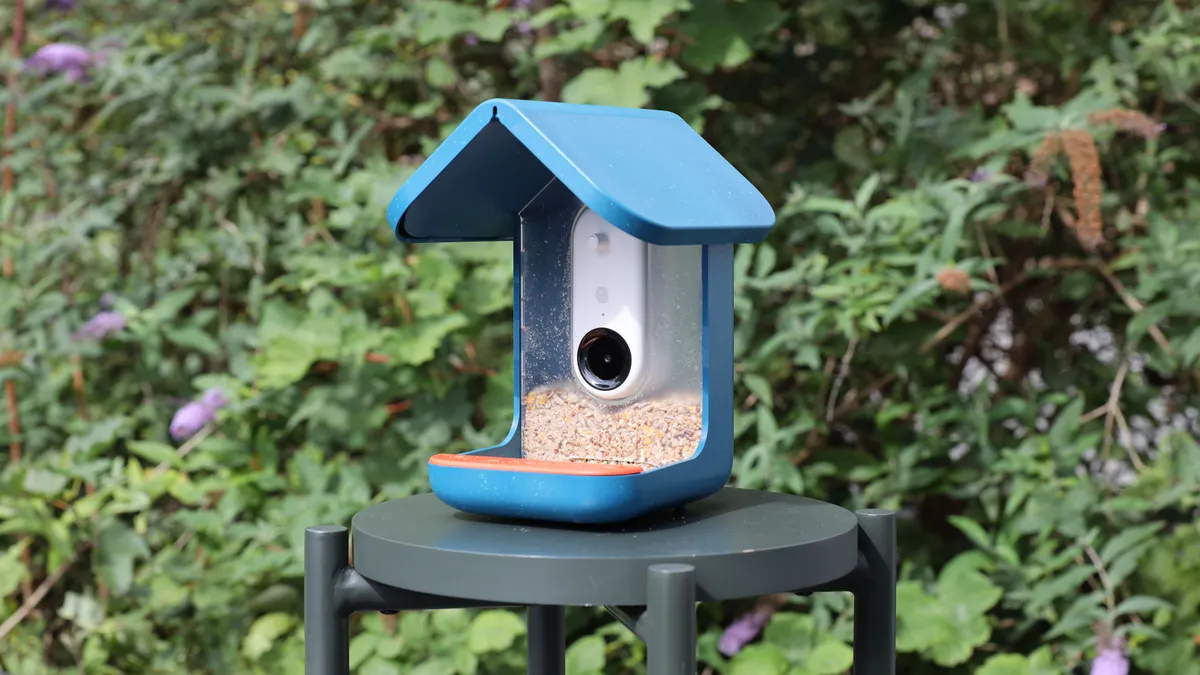
Although our Reviews Editor, Gareth, tested the Bird Buddy Smart Feeder several years ago, it's still one of the most engaging and well-crafted ways to immerse yourself in nature right in your own backyard. The feeder is well designed and visually appealing, but the app that comes with it enhances the experience with its delightful interface and intuitive navigation. The feeder itself is built with a design with birds' safety in mind, and the product itself is IP65-rated to ensure weatherproofing.
While particularly suited for families with children who will enjoy the colorful and fun interface and facts, even adults will find it thoroughly enjoyable. The app does a great job of identifying birds and reminds you of when they visit, keeping records of all your feathered visitors.
I've just tested the Bird Buddy 2; in many ways, an exceptional upgrade from the original model. But I won't be recommending it until the full features, such as 2K and slow-motion recording, are available (and the product is more widely available).
Read our full Bird Buddy review


Best budget bird feeder camera

The Birdfy Feeder Rookie is your compact, budget-friendly entry into smart birdwatching. You’re essentially getting the same video quality (Full HD at 30fps) as in their top-tier models, though a solar panel is extra, and without it you need to bring the camera inside every couple of weeks to charge.
The Rookie camera isn't the best resolution in this guide, but it delighted me with enough detail to pick out individual barbs on the feathers of my favourite Robin. The 9:16 portrait format video means clips perfect for quick social sharing, but limiting if you want a more traditional full-screen landscape view.
Design-wise, there isn’t a protective roof overhang to protect the lens from the elements, and the fixed camera view doesn't cover the full feeding tray. But I enjoyed how easy the feeder was to wipe out and clean – without any tight, awkward nooks where wet seeds can rot, you can take it apart for a real soak and scrub.
Setting up the camera via the intuitive Birdfy app is a piece of cake, and easily manageable for grandparents, kids or just beginners. The AI identification is near-instant, and Birdfy can match garden visitors against a database of 6,000 species to ping your phone the second a robin or tit lands.
The Rookie is a really smooth package, and even if you opt for a limetime AI subscription at the point of purchase, still offers fantastic value.
Read my Birdfy Rookie review


Feeder with the best resolution camera

The second-generation Kiwibit Beako is a well-constructed wildlife camera that turns your garden into a nature cinema. In hands-on testing by our expert reviewer, Rob Redman, he was especially impressed by the wide variety of mounting options included in the box, such as pole, wall, and rock-solid fence-strap mounts.
These make it incredibly easy to set up securely, regardless of your garden layout. The built-in 4.4W solar roof also performed flawlessly during our weeks of field testing, keeping the 5200mAh battery completely full without requiring a single recharge.
Like most smart cams, the best parts of the experience are locked behind a subscription. Without one, you can stream live video for free, but have to pay a monthly fee to extend clips past a brief 20 seconds, secure two months of cloud storage (the Beako does have a physical microSD card slot), or access the AI species identification tools.
The headline 4K resolution is the highest of any camera in this guide, though it does behave more like a crisp dashcam. Tester Rob found that when birds were flying in and out incredibly fast, the camera was forced to use fast shutter speeds, resulting in slightly choppy footage.
On high-contrast days, the dynamic range (the camera’s ability to balance light skies and deep shadows at the same time) struggled, resulting in pure white areas of sky and less detail hidden in the deep shadows. But honestly, I’ve found that feeder cameras usually suffer in these ways, and the footage is better than many, with a well-calibrated motion sensor to boot.
Read our full Kiwibit Beako review
Best wooden bird feeder camera

The Birdfy Feeder Wood is my personal favorite, design-wise. The fir wood blends into a natural garden layout rather than looking like a conspicuous security camera. It also feels robust, and the birds in my patch felt brave enough to visit within 30 minutes of installation. The integrated 2W solar roof kept the 5200mAh battery topped up throughout a grey winter when testing, eliminating low-battery anxiety. I found that the camera’s 1080p sensor (the same as the Birdfy Rookie) can capture surprisingly intimate, detailed, and colorful results, highlighting fine plumage textures even on flat, overcast days.
Choosing a wood aesthetic over a plastic model does bring a trade-off in maintenance. Porous wood is harder to deep-clean and sanitise to prevent avian diseases. During wet weather, I also found that damp seeds do get stuck in the metal base blocker, causing shoots to sprout and rendering it prone to gunk. The wood also requires you to commit (ideally) to annual oil sealing to prevent black mold in rainy climates and keep it at its best.
The accompanying Birdfy app – as I’ve already mentioned in this guide – is intuitive and features a very accurate AI ID system. While you get motion alerts and a 30-day rolling cloud history for free, unlocking the full bird recognition features requires a monthly subscription or buying the upfront AI Lifetime bundle. If you are willing to put in the cleaning effort, it is a gorgeous, high-capacity backyard feeder upgrade.
Read my full Birdfy Wood review


Best bird feeder camera with two views

The duo has two camera views, as its name suggests. The unit has a wide-angle camera for overall coverage and a motorized panning camera to track and capture detailed close-ups of birds as they feed. This is complemented by a secondary side-mounted camera that offers a completely different viewing angle, making it possible to observe feeding behaviors from multiple perspectives.
Our tester found the build quality to be very robust, with IP65 weatherproofing for durability in all conditions. The solar panel is also welcome, connecting to both camera units via USB-C, and potentially has about two weeks of battery life depending on usage patterns.
The app provides a polished user experience, with features like AI bird identification, customizable notifications, and the ability to save and share your captured moments. While the AI recognition occasionally makes mistakes, it generally performs well and helps create an engaging log of your backyard visitors.
Note, though, that the side camera can only be mounted on one side due to its fixed-angle design, which may limit placement options. Also, the Full HD video resolution, while adequate for most purposes, might leave some wanting higher resolution options.
Read our full Birdfy Feeder 2 Duo review
A durable, easy-to-use feeder

The Technaxx Birdcam TX-165 rejects modern smartphone integration and instead favors simple, functional utility. I’d recommend it if you’re on a budget or don't want to faff with companion apps and Wi-Fi, though this old-school camera does bring a few compromises.
Without Wi-Fi, you can’t check the feeder remotely and have to physically retrieve the internal microSD card and view files. Settings are managed on a small 2-inch interior screen via small fiddly buttons, though our tester found the manual excellently written. It also lacks a solar option, meaning you are fully dependent on replacing 4x AA batteries.
On the performance front, the f/2 wide-angle lens has a limited depth of field that keeps subjects sharp within a tight 6–15cm range while blurring the background garden. The 1080p, 25fps can't compete with 2K or 4K rivals; the footage is crisp enough for you to get a clear bird ID. Plus four infrared LEDs help to capture clean black-and-white clips at night when nocturnal wildlife is active.
Its three-piece ABS plastic design proved robust, and its discrete, camouflaged look blended naturally into the garden. Essentially, this is a rugged trail camera tucked inside a housing with dual food hoppers. You get several fixing options in the box, including wall mounts and tree straps, which allowed our Editor in Chief, Chris, to secure it to an apple tree branch using wire. It’s a rugged, straightforward option, suited to those less bothered about the gamification of birdwatching.
Read our full Technaxx Birdcam TX-165 review


Best hummingbird feeder

If you want to capture images of hummingbirds, you need a bird feeder camera that is designed for the task. Birdfy's Hum Feeder Duo has put a lot of thought into this, with a twin camera set-up that takes images from the front and the side as the bird feeds. A large 20-fluid-ounce reservoir is provided for you to give your visitors plenty of sugary solution to drink.
We don't get hummingbirds in the UK, so we're awaiting one of our US reviewers to give this a test run with the right species. However, we're impressed with the construction and setup of the feeder.
Best still, it uses the wireless AI bird identification system that I've tried successfully with four other Birdfy units and other families of birds. As there are some 366 recognized species of hummingbird, this smart system could save you hours of research as you try to work out the exact type of bird you have captured footage of.
How to choose the best bird feeder camera
If you're looking for shots of birds that are going to win you competition prizes, then currently, no camera on this list is going to give any of the best cameras for wildlife a serious run for its money. The cameras in this guide are for hobbyists and bird enthusiasts who want to keep tabs on the feathered friends in their backyards.
It is simple to pick the right bird feeder camera for you based on how much you value each of the following criteria:
Mounting options: Consider where you might want to put your bird feeder, as some come with tree mounts or wall fittings. Some bird feeders come with all the necessary mounts in the box, while some are optional extras that can push the price up quite a bit.
Connectivity options: Most smart bird feeders communicate via a 2.4GHz Wi-Fi frequency; if your home router uses a combined, undivided 5GHz mesh network, you may need to split your network bands in your router settings to complete the initial camera connection.
Power source: Some bird feeder cameras run off traditional batteries, but most are rechargeable via USB-C or, increasingly, solar power. Check the battery size and quoted run times for each camera.
AI bird recognition: Most smart bird feeder cameras come with AI tech to recognize thousands of different species, and they can be set to alert you when they land on the feeder. If you want to increase your bird knowledge, this feature might help you – but the AI technology isn't always accurate, of course (and often comes with a cost).
Video output: Most bird feeder cameras come with a standard resolution of 1080p, which is more than adequate for monitoring birds but not really high enough for extracting high-quality stills. Some birdcams offer 4K resolution, but at a premium cost. If you only plan to share your videos on social media, 1080p or 2K is more than enough resolution, but if you hope to do more with your photos and videos, then check out our picks for the best camera for wildlife.
Brand / Ecosystem | Models Included | Included for Free | Subscription Tiers & Costs | Features Behind Paywall |
|---|---|---|---|---|
Bird Buddy | #1 Smart Feeder | Basic AI bird species identification, automated postcards of visiting birds, and standard live video streaming. | $69.99/year (Individual Premium) | High-resolution 2K video streaming, unlimited cloud video history saving, advanced "Bird Care" avian health tracking, and proximity warning alerts (e.g., cat detection). |
Birdfy (Netvue) | #2 Rookie | Standard live view streaming, 30-day rolling cloud history for basic motion triggers, 60-frame slow-motion playback, and a lifetime 5GB media locker. | $4.99/month or $49.00/year (AI Species Tracking) | AI species identification database tracking (matches 6,000+ species). Extending automated recorded motion clips from 20 seconds up to 30 seconds. Note: Entry-level models like the Rookie require this on top, top-tier packages often include the Lifetime AI bundle in the box. |
Kiwibit | #3 Beako Smart Feeder | Free standard live video streaming, local recording to a physical MicroSD card, and a restrictive 24-hour rolling cloud backup. | $4.99/month or $47.49/year (Single Cam) | Advanced AI species identification tools, extending cloud video recordings past the strict 20-second threshold, and expanding the cloud storage history window out to 60 days. |
Technaxx | #6 Birdcam TX-165 | 100% Free Functionality. All video captures (1080p at 25fps) and 8MP photo assets are saved natively to a local physical MicroSD card. | $0.00 (No Subscriptions Available) | None. This feeder features completely offline storage. |
Where is a good place for a bird feeder camera?
If you position your bird feeder camera in a place where birds feel safe, they're more likely to visit often. The RSPB notes that you should position a bird feeder in a "quiet, safe area that is sheltered from the wind." Doing so will also allow you to hear their bird call clearly if your feeder has a microphone.
Make sure the birds have somewhere to hop to if possible, near hedgerows or tree cover, and away from loud disturbances, pets, and children, which might scare birds away.
With my photography hat on, you want to consider the light quality too. Facing your feeder camera into direct rising sun can cause sun flares, but under a hedge blocks the light and may give you a muddier picture. Aim for a spot where the light is most balanced for most of the day, and if the feeder is Wi-Fi enabled, where the signal reaches easily!
How do I clean my bird feeder camera?
It's incredibly important to clean bird feeders and, indeed, bird feeder cameras regularly, as this prevents the transmission of deadly diseases like Trichomonosis. The RSPB recommends cleaning feeders outside, wearing gloves, using a bucket of hot soapy water, a long cleaning brush, and – very important – a bird-safe disinfectant solution. Best to buy this from a bird or wildlife charity or outlet to ensure total safety.
You should aim to rinse all the separate parts of your feeder, of course, avoiding getting water in or near the camera element. Dry your clean feeder outside completely before you refill it. You should really clean a feeder weekly, and some feeders, like the Bird Buddy, have app features to set up a cleaning reminder.

How we test bird feeder cameras
I've personally been testing bird feeder cameras for four years at Digital Camera World, starting with the Netvue Birdfy back in 2022. Both my team and I test products in our own yards for weeks, but usually, months. It can take a while before our local birds feel comfortable enough to visit the feeder and get our first footage, and we never rush this process to begin the review.
As a camera website, we know exactly what to expect from different cameras in terms of photo and video quality, and we have a lot of experience assessing cameras in all shapes and sizes. This means we are perfectly positioned to not only judge how well each bird feeder camera performs in isolation but also to compare it to the competition as we have in this guide.
We also assess bird feeders for factors like build quality – waterproofing, rot-resistance – and price, but also care for the birds, with careful consideration to the materials used, the birds' safety when using the feeder, and importantly, how easy the feeders are to clean to avoid spreading diseases.
All this means that we can confidently recommend any product we have reviewed, and you can confidently trust us when choosing the right feeder for you.
Find out more about how we test and review at Digital Camera World.

