
Digital Camera World Verdict
The Birdbuddy 2 is a well-built bird feeder camera that’s waiting for software updates to unlock 2K and slow-motion imagery. It’s a good-looking, well-made product, and I love the integrated solar panels, which almost remove the need for charging. It will suit real bird lovers who want a fun app and really accurate bird ID, but not those on a budget. Great if you have the patience to wait for the full features, but it doesn't yet fulfil its potential.
Reasons to buy
- +
Premium, eco-friendly plastic build
- +
Rotating camera for portrait and landscape views
- +
Exceptional solar efficiency in standard power mode
Reasons to avoid
- -
Hardware is currently software-locked (No 2K or Slow-Mo yet)
- -
Livestreaming can be extremely slow to load
- -
Postcards take a while to start being recorded
Why you can trust Digital Camera World Our expert reviewers spend hours testing and comparing products and services so you can choose the best for you. Find out how we test.
I’ve spent a lot of time over the last few years watching and testing the smart bird feeder cameras, watching the market move from chunky plastic casings to the more compact and streamlined products that dominate today’s best bird feeder camera guides.
Many brands have tried to replicate the formula, and Birdbuddy is one name that helped to nudge the gamified birding trend along by being sold in major shops. Their latest-gen BirdBuddy 2 builds on the original, still housing a sleek solar-integrated roof and hanging design.
But I think the real headline feature here is a twistable camera module you can pop on and off to change from portrait to landscape instantly. For years, Birdbuddy fans have been locked into a 9:16 portrait view – frustrating if you wanted to see more of the surrounding action in a traditional 16:9 landscape crop. By making the camera rotatable, Birdbuddy is perhaps also pleasing the more traditional wildlife photographers (like me) among us.
Looking briefly online at reviews for this Birdbuddy 2 release, users have complained that the hardware has arrived with a few beta-phase software bugs, making its initial launch feel a little unpolished. Of course, I’ll be doing my own research for you to see if that’s true.
Like the many other smart feeders I’ve tested, this is a product designed to turn your smartphone into an interactive field guide, using AI to identify visitors and collect them in a digital scrapbook. It exists for those who want a fun, tech-forward way to connect with nature, even if you’re stuck in an office all day. I’ve been eager to see if this new model could maintain its spot at the top of our lists, or if it has become a victim of its own ambition. Does the new camera actually change the game, or is the original BirdBuddy (a firm Digital Camera favourite) the smarter buy?

Birdbuddy 2: Specifications
Video Resolution |
2K Video Quality (with HDR), Slow Motion up to 95-120fps |
Feed Capacity |
1.4 liters (approx. 6 cups / 47.3 oz) |
Dimensions (H x W x D) |
9 x 6.3 x 6.9 in (23 x 16 x 17.5 cm) |
Weight |
1.3 lbs (approx. 600 g) empty |
Battery |
3900mAh rechargeable lithium-ion |
Power |
Integrated solar roof |
Connectivity |
Dual-band Wi-Fi (2.4GHz & 5GHz), Bluetooth 5.1 |
Materials |
BPA-free weather-resistant plastic |
Waterproof Rating |
IP67 Certified |
Birdbuddy 2: Price
The Birdbuddy 2 sits at the top end of the smart feeder market. With limited availability still after being announced at CES in January 2026, it's expected to hit the market in mid-2026 for an RRP of $199 / £199 / AU$310. This is a premium price compared to non-branded options on Amazon, especially since the first-gen model was already considered quite a splurge.
It's more expensive than the Birdfy Feeder 2 (around $150 / £130), which offers a larger 1.5L seed capacity for those who hate refilling regularly. And the Birdfy Bamboo is also cheaper at roughly $189 / £175, with a more natural, garden-friendly aesthetic than Birdbuddyy’s plastic housing.
Features-wise, I'm still not sold on the price. The landscape camera option is definitely a long-overdue pro and really nifty, with a wider 135-degree field of view and a microphone so that the AI software can use the audio to help identify species by their birdsong. But if you're not bothered about these extras or the postcard style of bird collecting, the price tag is still steep for what’s essentially a smart plastic bird box.


Birdbuddy 2: Design & Handling
While rivals like the Birdfy Wood lean into natural materials, the Birdbuddy 2 (or 2.0 Pro) is built from a BPA-free, recycled ASA plastic that feels very hardy. It’s thoroughly wipeable, and should be more resistant to UV yellowing and impact than your average garden gadget, though I still wouldn’t trust dropping it on my patio. The IP67 rating also means it should handle dust, snow, and heavy rain.
Setup was a breeze, taking me less than ten minutes as the feeder comes mostly assembled, save for mounting the camera and snapping the perch into place. Birdbuddy has a particularly helpful paper manual, and the app walkthrough is equally simple; like most cameras, you need to scan a QR code and follow some on-screen steps to connect to your WiFi and Bluetooth.
Aesthetics are totally objective, of course. Although the colourful and fun toy-like design is well-known in the birding world, I think it can feel a bit loud and conspicuous for something trying to maintain a naturalistic garden look.

The new circular camera module is the main change with this second-generation model, compared to the long, tall pill-shaped camera of the original. It’s satisfyingly hefty and pops in and out of the feeder with a magnetic thunk to allow you to switch between portrait and landscape modes. There’s a Gorilla Glass lens cover, too. In my time testing, it has survived driving rain and a vigorous squirrel scratch, and I rarely found it fogging up compared to other models I’ve tested recently.
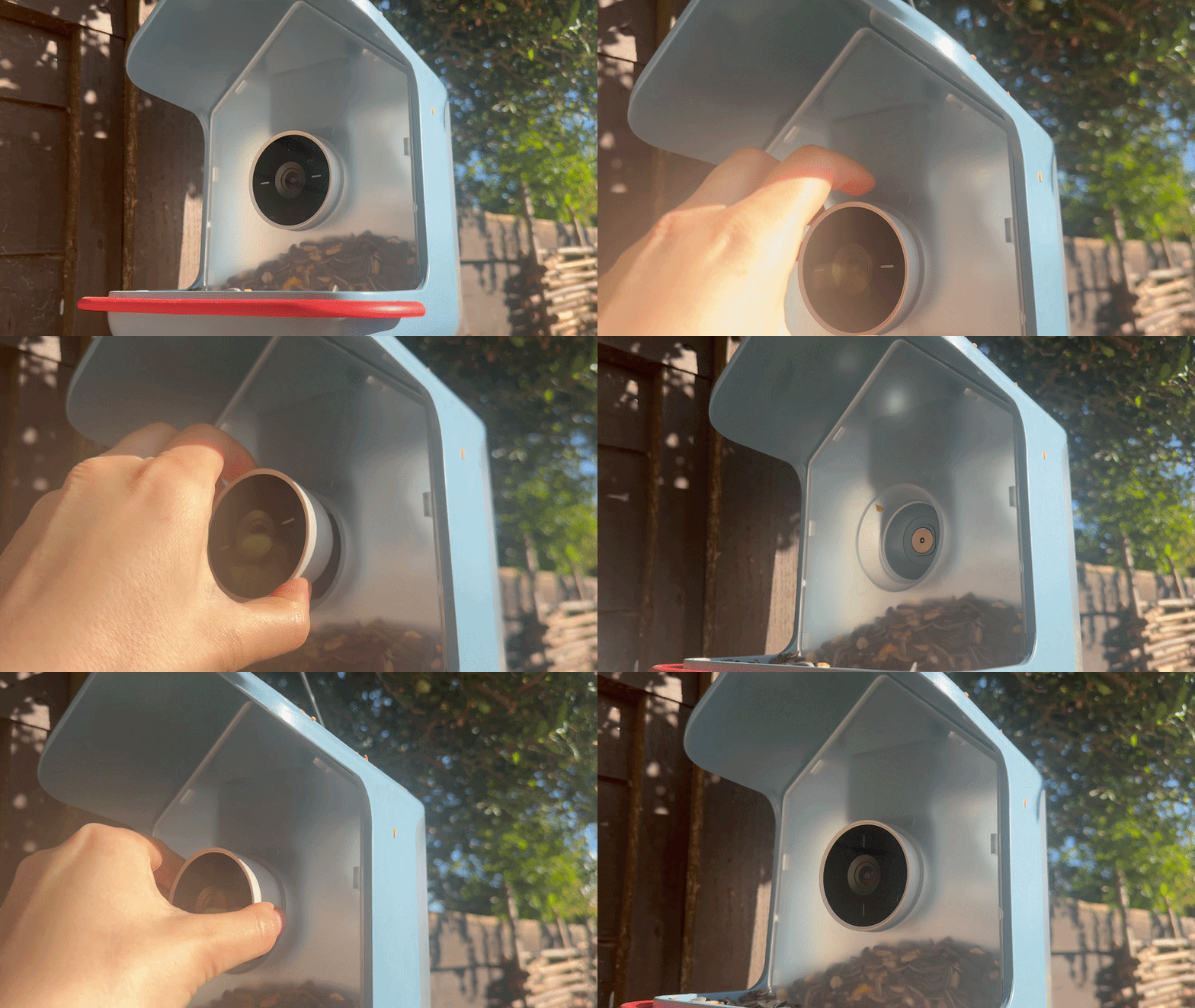
The integrated solar roof is another great design feature. The panels are flush and smooth, meaning no messy cables that irritate me in other setups. The mounting situation for the Birdbuddy 2 is where my enthusiasm started to wobble, quite literally. The feeder comes with a universal pole mount, but the default solution is with a stainless steel metal hanger.
Even in a gentle breeze, I found the feeder acting a bit like a sail, swinging and spinning in a way that I think may have put off more skittish visitors like goldfinches. Then there’s the balance. Much like the original model, the Birdbuddy 2 is weighted toward the rear, and I found it always tipped backwards slightly, pointing toward the sky. For a product at this price point, I don’t think you should have to DIY a hanger just to get a level shot.

One big disappointment for me is that the seed tray feels too shallow and sits too close to the camera lens. In landscape mode at least (portrait is much better), I noticed that if a bird sat eating in the tray, it was cut off at the bottom of the frame, leaving me with a great view of the horizon but only the top of a blue tit's head. It's frustrating that the camera is capable of a wider, cinematic view and multiple orientations, but the feeder floor can make it hard to get a full shot.
Refilling the feeder is super simple, thankfully. To top up the seeds, you pull out a large tray at the back of the unit, fill it up, and clip it back into place. It’s a clean, deliberate motion that avoids the seed-everywhere disaster I’ve experienced with top-fill feeders. I haven’t had to do a deep clean of the feeder yet, but you can't exactly blast it with water as there’s a charging point inside.
And the strangest design choice of the Birdbuddy 2 is the charging process. With the original model, you would pop the camera module out, bring it inside to charge, and leave the feeder hanging. Because the camera and solar roof are now so tightly integrated, you have two equally annoying options when the battery dies. Either bringing the unit (seed-covered and mucky) inside to plug it in, or popping the roof off while it's still attached to the camera module, all while fighting with the hanging bracket.
Birdbuddy 2: Performance
Above: Sample clips from the Birdbuddy 2 camera
To use a well-worn cliche, the performance of the Birdbuddy 2 is currently a tale of two feeders – the one promised on the box and the one currently swinging from my garden fence. On paper, this is a camera capable of 2K and slow-motion capture, but in my testing so far, the software has let me down as it’s still seemingly in beta mode.
At the time of writing this review, the headline 2K resolution is unavailable and greyed out on the camera settings in the app, as is the promised slow-motion modes (960p at 90fps). I’m currently only able to choose 1080p/30fps for video and 5MP for photos, which is a pretty frustrating spot to be in, as I’m also struggling to be able to run the firmware update suggested by the app. Every time I do, I’m met with an error, despite charging the camera, resetting the app, and my WiFi router.
As the image quality stands, though, the Birdbuddy 2 offers sharp images and clips in the right conditions. As with most small-sensor cameras, performance varies wildly with light. Bird Buddy gives you lots of advice on positioning a feeder in the app, which I think will really help beginners or those not au fait with photography exposure already.
In gentle sunshine, the Birdbuddy 2 produces detailed results, while shaded shots lose that pop of colour and look significantly flatter. I tried facing the feeder in two separate ways during testing. Facing the feeder away from an overhanging hedge and directly into the sun gave me more vibrant, punchy colours in Blue tit feathers.
The video occasionally brings up noticeable compression artefacts, which look like small digital blocks during fast flight or in moving backgrounds like rustling leaves. As for audio, the microphone is clear enough to record the occasional chirp with a clarity that matches most other high-end feeders, though it won't be replacing a dedicated field recorder anytime soon.


I found Birdbuddy’s Postcard system confusing at first, but it's become my favorite way to review my garden comings and goings from the day. At first, I was worried the camera wasn't working, because I’d watch a bird land out of my kitchen but receive nothing. It seems the mechanism needed a few days to learn the environment – something Bird Buddy does mention in the app – and from then on, the AI became much more reliable.
I actually now prefer this highlights reel approach over the constant notification bombardment of other feeders, as it feels more curated; instead of 200 clips of the same House Sparrow, you get a handful of well-composed shots and videos that are genuinely worth saving to your collection. So far, the AI identification has been correct every time, though admittedly, only having to name the 4-5 species that have landed so far.
However, the experience is let down by the livestreaming. It consistently takes upwards of 20 seconds to load, by which point the bird has usually finished its seeds and departed. Even more frustrating are the frequent "something went wrong" error screens that suggest checking my Wi-Fi strength. I have a Birdfy unit mounted in the same spot that connects instantly, so I don’t know if this suggests the Birdbuddy’s dual-band Wi-Fi isn't quite as robust.


If there’s one area I’m really impressed with, it’s the solar panels on the roof. I’ve been running the feeder on standard power mode (balanced for postcards and battery), and despite some typical grey UK weather, the solar panel has kept the unit pinned at 100% battery for two weeks straight. For those with shadier gardens, you can toggle the power modes to be more aggressive, but for most, the solar roof truly delivers on the set-it-and-forget-it promise.
I’ve mentioned the Bird Buddy app several times already, but it has one of the most fun and detailed interfaces I’ve used. There are also easy extras like inviting a friend to share your camera view via a WhatsApp link, plus reminders to clean your feeder regularly. Guidance on supplementary bird feeding - in the UK at least - has changed in recent months. The RSPB now recommends feeding only between November and April to avoid spreading diseases from feeders. Bird Buddy has either preempted or reacted to this advice, and in the app, you can set a reminder to clean your feeder every 30 days. In practice, I’d want to clean it when it needed it (more in wet, gritty weather perhaps), but it’s a thoughtful addition.

Bird Buddy 2: Verdict
I’ve spent several weeks using the Bird Buddy 2, and honestly, I'm finding it hard to score. The design is mostly an improvement on the original, and though it's more fiddly to charge, I haven't actually needed to once because of the solar panels. The recycled ASA plastic isn't at all brittle, the magnetic camera thunk is incredibly satisfying, and the Gorilla Glass should help to protect the lens over time.
Performance-wise, my experience is that the product is still in early access mode. It's frustrating to have a 2K-capable camera locked to 1080p resolution, plus a firmware update that doesn’t actually let you run through. I’ll reach out to Bird Buddy support for more help on this, but if I were an absolute beginner with bird cameras or a first-time user, I’d definitely be frustrated and disappointed with the experience so far.
My recommendation is based on what kind of birder you are. If you’re quite techy, like the gamification of the app, and you’re happy to pay a premium now for features that might arrive in a firmware update later this year, you’ll enjoy the experience of Bird Buddy and the advanced resources, advice, and reading in the app.
The bird ID is accurate, the social sharing is easy, and the solar roof is brilliant. If you want a tool that works right now, you might be better off with the Birdfy Feeder 2 or the Birdfy Bamboo. They have similar (or currently better) video quality and free AI features. Overall, the Bird Buddy 2 is a fun, 2K-ready camera that's being held back.
Features ★★★☆☆ |
Bird ID initially slow to trigger, but settles into an accurate highlights system |
Design ★★★★☆ |
Solid and easy to refill and wipe, harder to charge |
Performance ★★★★☆ |
Images sharp in sun, artefacts present in busy scenes |
Value ★★★☆☆ |
Not worth it until the 2K video and slow-mo recording unlock |
Should you buy the Birdfy Buddy 2?
✅ Buy this if...
- You're happy waiting for 2K video to arrive
- You want neat, integrated solar charging
🚫 Don't buy this if...
- The cost is higher than many competitors
- You want a natural-looking wood housing
Alternatives
Do also check out our full guides to the best bird feeder cameras, and to the best birdbox cameras

