
Choosing the best image-stabilized binoculars is about much more than simply opting for the highest magnification you can afford. The best models need to balance a sharp, steady view with comfortable handling, useful features, and a price that makes sense for the way you actually plan to use them.
The higher the magnification, the more noticeable even the smallest movement of your hands becomes. That can make fine detail harder to see, distant subjects more difficult to track, and longer viewing sessions surprisingly tiring. Image stabilization is designed to counteract this movement in real time, helping to keep the image much steadier and allowing you to see more clearly.
Using built-in sensors and stabilization technology, these binoculars can be particularly useful for birdwatching, wildlife observation, marine use and viewing distant landscapes. A steadier image makes it easier to pick out small details and follow moving subjects, while also helping to reduce eye strain during longer periods of use.
There is also a major practical advantage to stabilization. It allows you to use higher magnifications without having to rely on a tripod, which means less equipment to carry and a setup that is ready to use almost instantly. That can make a real difference when you are following wildlife, watching from a moving boat, or travelling with limited space in your bag.
The usual binocular specifications still matter, of course. Magnification determines how close your subject appears, while the size of the objective lenses has a big influence on brightness and low-light performance. You should also consider weight, size, battery life, ergonomics, and how comfortable the binoculars are to hold for extended periods.
As magnification increases, stabilization becomes even more valuable because every small movement is amplified. With that in mind, this guide brings together the best image-stabilized binoculars available right now, with options covering different budgets, experience levels and types of use.

For nearly two decades, Sebastian’s work has been published internationally. Alongside his career as a professional sports photographer, he is also a keen country sportsman and can often be found on the shooting field, sailing on the open sea, or enjoying a variety of other rural pursuits. More often than not, he will have a pair of binoculars, a monocular, or a spotting scope close at hand.
Best image stabilized binoculars in 2026
Why you can trust Digital Camera World Our expert reviewers spend hours testing and comparing products and services so you can choose the best for you. Find out how we test.
Best overall


✅ You want the best: With its Vari-Angle Prism IS system these binos utilizes gyro sensors and micro-processor to give a rock-steady image
✅ You want rugged: being both waterproof and fog proof these binos are built to tackle any situation
❌ You're on a budget: these cost a fortune, so are out of reach for most of us
❌ You want something light: Due to their size and tech inside these are not the lightest around
As a binocular enthusiast, I’ve always been intrigued by Canon’s offerings—especially their top-tier ‘L’ grade optics, marked by the iconic red ring that signals exceptional quality. Combined with the sizable 42mm objective lenses, these binoculars promise outstanding visual clarity and performance.
Given the substantial price tag, it’s reassuring to know these binoculars are built to last. The O-ring sealing ensures reliable waterproofing, while Canon’s innovative image stabilization (IS) feature, powered by their Vari-Angle Prism system, uses advanced gyro sensors and microprocessors to keep your view rock-steady.
Other standout features include a comfortable 16mm eye relief, anti-fog technology, and a rugged, rubberized exterior that enhances durability. The wide 65° angle of view and a large 4.2mm exit pupil deliver bright, vivid views, even in challenging low-light conditions like dusk or dawn.
Sure, dropping over a grand on binoculars is no small decision. But the Canon 10x42 L IS WP binoculars deliver exceptional performance that more than justifies the investment—whether you’re stargazing, birdwatching, or exploring nature on either side of the Atlantic.
Read our full Canon 10x42 L IS WP binocular review for more details

Canon 10x42L IS WP
| Attribute | Value () |
|---|---|
| Optics | 5 |
| Features | 4.5 |
| Value | 4 |

Best for high magnification

✅ You want high magnification: with a lens set of 20x40 these are perfect if you want to observe far-reaching views
✅ You work on water: being waterproof with an IPX7 means if the worst should happen, you have 30 minutes to save them!
❌ You don't like carrying: with a weight of 853g these binos are very heavy to be carrying around all day
❌ You want close focusing: Unfortunately, the closest you can actually see anything is 5 meters
For those who want to get closer to distant subjects without the traditional bulk associated with high-magnification binoculars, the contemporary and cleverly compact Fujifilm Fujinon Techno-Stabi TS-L 2040 strikes a very appealing balance. It shares the exact same dimensions as its 16x TS-L 1640 sibling, yet weighs a few grams less, and the modest price increase for the extra reach feels entirely reasonable.
At 20x magnification, the built-in image stabilisation system becomes less of a luxury and more of a necessity, and here it feels well worth the slight premium. Add in the generous 40mm objective lenses, which gather plenty of light in dim conditions, and the TS-L 2040 proves itself a strong all-weather companion for wildlife watchers and dedicated birders alike.
As with other Techno-Stabi binoculars I’ve handled from Fujifilm, the build quality immediately conveys a premium feel, which is reassuring given its premium positioning. Thankfully, performance rises to meet expectations, delivering a clear, stable image that should easily satisfy keen enthusiasts who demand both reach and reliability.
Yet beyond the optics, it’s the inspired industrial design that really lingers. The TS-L 2040, much like its TS-L 1640 sibling, feels like a contemporary classic in the making – thoughtfully designed, genuinely practical, and refreshingly timeless. Unlike fleeting trends, this is a piece of kit that looks set to stay relevant for years to come.
Read our Fujifilm Fujinon Techno-Stabi TS-L 2040 review for more details

Fujifilm Fujinon Techno-Stabi TS-L 2040
| Attribute | Value () |
|---|---|
| Optics | 5 |
| Features | 4.5 |
| Value | 3.5 |
Best budget

✅ You're on a budget: Under £600 / $700 these are the best budget stabilized binos available
✅ You want control: these have the ability to turn the image stabilization on or off, whenever you want, by a click of a button
❌ You want low‑light performance: sacrificing low‑light capability due to the small 2.1 mm exit pupil makes these binos appear noticeably dimmer during twilight, shaded areas, or for older users whose pupils don’t dilate as widely
❌ You want tripod compatibility: there’s no screw thread for mounting on a tripod or tabletop, limiting flexibility for extended observation without handheld shake
A steady, shake-free view is exactly what we all hope for when lifting a pair of binoculars to our eyes. Whether you’re tracking a bird in flight, soaking up the atmosphere at a music gig, or following the decisive moments of a sporting event, the goal is the same: to see the subject clearly, without distraction.
Nikon’s Stabilized 12x25 S and 10x25 S binoculars deliver this with surprising assurance. Activate the stabilization and the difference is instant – panning across a scene feels fluid, with subjects gliding into view as though they were moving on ice. It’s a feature that transforms the experience from one of managing shake to simply enjoying what you’re looking at.
Construction is another area where Nikon impresses. While these binoculars sit firmly in the premium bracket, their design suggests an investment built to last. The body feels solid and well-engineered, offering the reassurance that they can withstand years of regular use.
At the same time, they don’t weigh you down. Their relatively compact size and low weight mean they’re genuinely pocketable – a rare trait in the world of stabilized optics. This makes them the kind of companion you’ll actually take with you, whether on a countryside ramble, a day trip with the family, or a sightseeing expedition abroad. In fact, they’re far more likely to come along than the bulkier, heavier alternatives from chief rival Canon.
Nikon’s move into this space also signals something important: real competition in the stabilized binocular market. For years, Canon has largely had this niche to itself, but with Nikon stepping in, the field opens up. More choice for consumers inevitably drives innovation, sharper design, and hopefully more competitive pricing. That can only be good news for those of us who want cutting-edge stabilization in a compact, go-anywhere package.
Read our Nikon Stabilized 12x25 S reivew for more details

Nikon Stabilized 12x25 S
| Attribute | Value () |
|---|---|
| Optics | 5 |
| Features | 5 |
| Value | 4.5 |
Best for everyday use
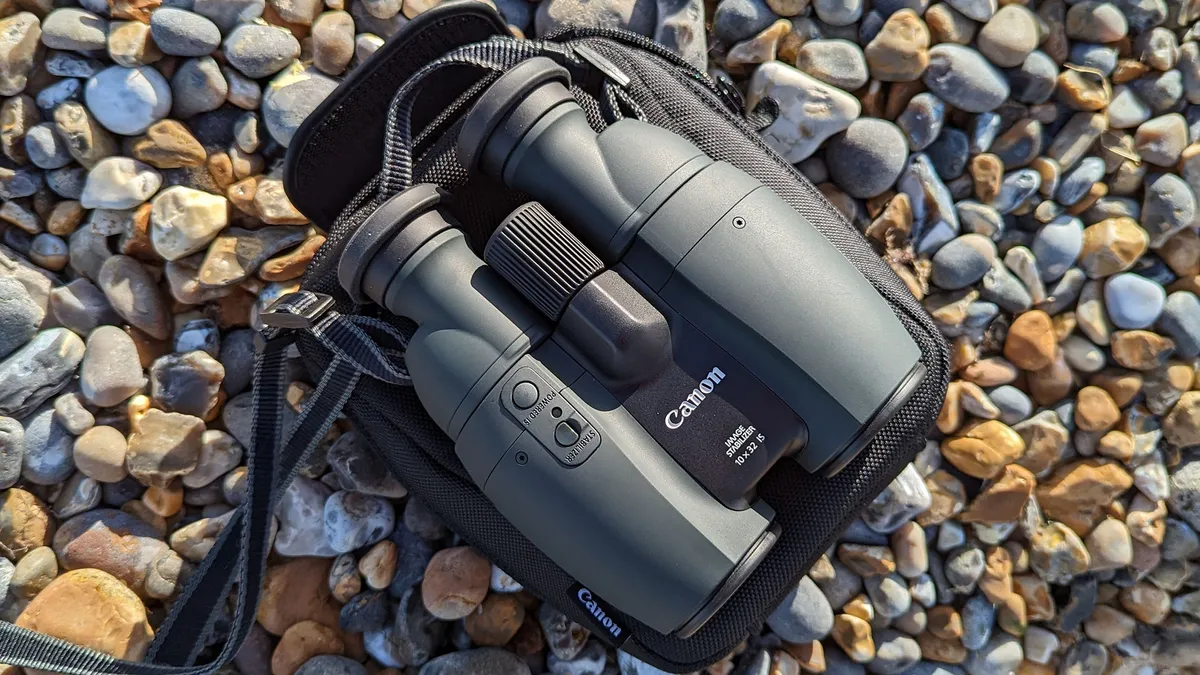
✅ You want a main brand: Canon is the king of IS binos at the moment and that means something
✅ You want rugged: these binos offer a durable and robust construction
❌ You want anti-fog: No Nitrogen-purging present leads to fogging of the lenses
❌ You want great optics: these binos do suffer from color fringing around contrasted edges
These stabilized binoculars offer a significant advantage to observers by providing steady, lifelike views that are beautifully magnified. During our review, we found ourselves reluctant to put them down, fully immersed in the experience.
However, there are a couple of issues worth mentioning, primarily due to the price. Specifically, chromatic aberration and lens fogging were noticeable.
While we believe these problems shouldn’t be present at this price point, they don't detract from the overall enjoyment of using these binoculars. If you’ve never tried image-stabilized binoculars before, be prepared - once you experience them, it’s hard to go back.
If you can afford the investment and the occasional fogging doesn’t bother you, this pair is a fantastic choice.
Read our full Canon 10x32 IS binoculars review for more details

Canon 10x32 IS
| Attribute | Value () |
|---|---|
| Optics | 3.5 |
| Features | 4 |
| Value | 3.5 |
Best for bird watchers

✅ You want to use on the move: with powerful image stabilization these are perfect to use while on the move on safari
✅ You want rugged: being both waterproof and fog proof these binos are built to tackle any situation
❌ You want weather proofing: with the cost, we'd expect these to offer better weather-sealing.
❌ You want long battery life: its 9-hour battery life from two AA batteries is ok, but I'd like to see better
Canon’s 12x36 image-stabilized Porro prism binoculars strike the perfect balance between powerful 12x magnification and a 36mm objective lens, offering clear, edge-to-edge views that are ideal for both birdwatchers and sports enthusiasts.
The anti-shake system, which combines gyro sensors and a microprocessor, ensures a steady image—even when viewed from a moving vehicle. Plus, the batteries can last up to nine hours of continuous use, providing long-lasting performance.
These binoculars feature the same Super Spectra lens coating found in Canon's EF camera lenses, enhancing resolution while minimizing distortion, ghosting, and scattered light for sharper, more accurate views.
For comfort and ease of use, the binoculars are coated with a rubberized exterior, providing a secure grip. The image stabilizer button and focus knob are conveniently positioned for quick access and smooth adjustments, ensuring a responsive experience.
Overall, these binoculars are exceptionally well-specified, offering great value for those seeking high-quality optics with advanced image stabilization.
Read our Canon 12x36 IS III review for more details

Canon 12x36 IS III
| Attribute | Value () |
|---|---|
| Optics | 4 |
| Features | 4 |
| Value | 4 |
Best image-stabilizing binoculars for travel

✅ You're on a budget: at under £500/$500 these are great from a main brand
✅ You want 'compact': suited to a more compact environment their size and weight is suited to everyday use
❌ You want AA batters: the Image stabilization feature requires the use of an optional CR123A battery!
❌ You want to use all the time: Due to its magnification set I would suggest optimal viewing in the day time
Canon's image-stabilized Porro prism binoculars prove that not all stabilized models are bulky or heavy. This compact pair combines 8x magnification, a 20mm objective lens, and a lens-shift shake reduction system into a lightweight 420g design, making it perfect for travel and everyday use.
While the image stabilization - borrowed from Canon’s RF and EF camera lenses - is a standout feature, it’s not the only thing that ensures sharp, clear views. The Super Spectra Coating on the glass enhances contrast and reduces glare, further improving image quality.
A tactile focusing wheel sits conveniently between the adjustable eyecups, allowing for easy adjustments without taking your eyes off the subject. A dioptric adjustment is also included, making these binoculars ideal for spectacle wearers.
The CR123A battery, which powers the image stabilization, offers up to 12 hours of use, though it must be purchased separately. And while these binoculars may come at a higher price than non-IS models with similar specs, they are Canon’s entry-level option in their lineup—a solid choice for anyone looking to start with premium image-stabilized optics.
Read our full Canon 8x20 IS review for more details

Canon 8x20 IS
| Attribute | Value () |
|---|---|
| Optics | 4 |
| Features | 4 |
| Value | 4 |
How we test IS binoculars
In our buying guides, we prioritise image-stabilized binoculars that are well made, reliable, and capable of handling the demands of regular birdwatching and wildlife observation. Most importantly, they must provide a consistently steady, judder-free view that makes effective use of their built-in stabilization systems.
Magnification also plays an important role in our selection, so we include a variety of options suited to different subjects and viewing styles. Price is another key consideration, which is why this guide covers models across a range of budgets, helping you find the right balance between performance, features, and value.
What do the numbers, such as 10x42, stand for on binoculars?
Binoculars are normally described using two numbers, such as 10x42 or 8x20. The first number tells you the magnification, while the second refers to the diameter of the objective lenses in millimetres.
A pair of 10x42 binoculars, for example, magnifies the view by 10 times and uses 42mm objective lenses. Greater magnification can be useful for bringing distant subjects closer, but it also comes with a few drawbacks. The field of view can become narrower, the binoculars may be larger and heavier, and even tiny movements of your hands are exaggerated. This is one of the main reasons image stabilization becomes so useful at higher magnifications.
Objective lens size, meanwhile, plays an important role in how much light the binoculars can gather. Larger objective lenses will generally produce a brighter image, which can be particularly beneficial when viewing wildlife at dawn or dusk, or when using binoculars in darker environments such as woodland.
Those two numbers also help determine the exit pupil, which can have a noticeable effect on viewing comfort and low-light performance. You calculate this by dividing the objective lens diameter by the magnification. An 8x20 pair therefore has a 2.5mm exit pupil, while 10x42 binoculars offer a larger 4.2mm exit pupil. If you regularly use binoculars in lower light, an exit pupil of around 4mm or greater will usually provide a brighter, more comfortable viewing experience.

