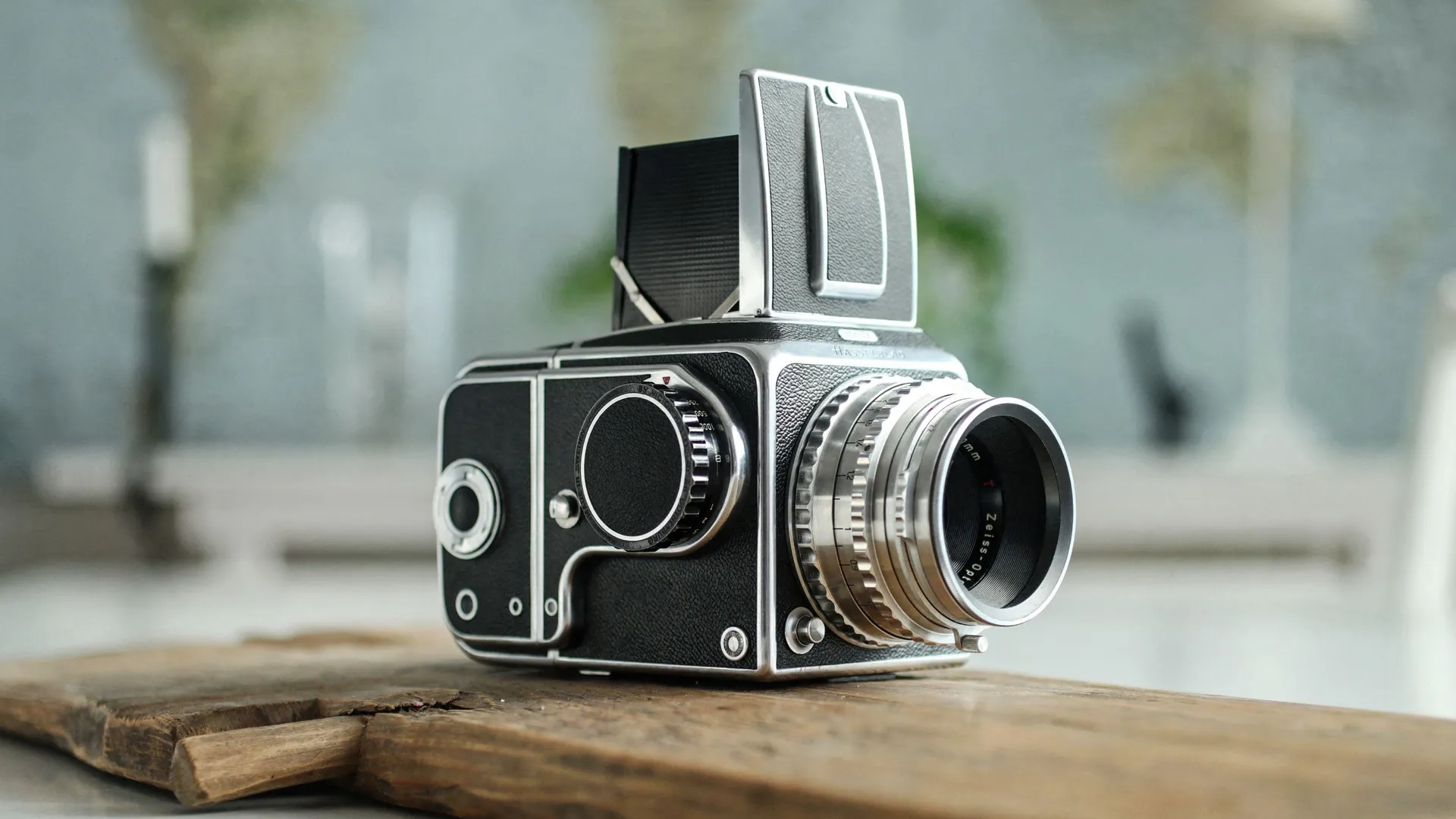
In 1966, a customs officer in New York looked at a passport and commented that the bearer had the same name as a famous camera. The visitor just smiled and said, “I am the camera.”
Born in 1906, Victor Hasselblad was raised in a family that ran a large trading (import / export) business, including a small division that distributed Kodak products throughout Sweden.
He eventually joined the family business, but was more interested in photography than commerce. He became an accomplished bird photographer and camera expert, studying photographic manufacturing in both Europe and the United States.
Early in World War II, the Swedish military presented him with a captured German reconnaissance camera and asked him to build something similar for them. His famous reply was: "No, not one like that, but a better one".
He formed a new company, Ross AB, to build this new camera. Nobody is sure why that name was chosen – though the best bet is that as a defense contractor in neutral Sweden, "Ross AB" was a nondescript name that did not reveal its purpose.
Building on his experience with the HK-7 aerial reconnaissance cameras, after the war the avid birdwatcher set about designing his dream camera: a waist-level SLR that made 6x6 photographs on 120 film, the Rossex.

By 1948 it was ready and the company was renamed Victor Hasselblad AB. It was a beautiful camera, designed by Sixten Sason, who also designed the original Saab car.
It was modular with interchangeable lenses, film backs and viewfinders. It had a focal plane shutter of stainless steel foil, speeds up to 1/1600 sec. It had an array of fine Kodak Ektar lenses and was now called the Hasselblad 1600F. It was the world’s first SLR for 120 film, yet smaller and lighter than most medium format cameras of the day.
It was so far ahead of its time that it stood alone for a decade, though its general design was later copied by Bronica, Mamiya, Rolleiflex and, eventually, Arsenal in Kyiv (then part of the Soviet Union) as well.
When the 1600F’s shutter proved not to be as reliable as hoped, Hasselblad reduced the top shutter speed to 1/1000 sec and, critically, redesigned the internal “gear stack” that controlled it, creating the more reliable Hasselblad 1000F of 1952.
While testing the 1000F for an article in the December 1954 issue of Modern Photography, the editor, Herbert "Burt" Keppler and the magazine's staff ran some 500 rolls of film through the camera and, during that time, accidentally (some reports say deliberately) dropped the camera onto a hard floor – twice!
The camera continued to function well enough for the tests to be completed – and the incident became one of the stories that established Hasselblad's reputation for ruggedness. Ironically, over time the 1000F's shutter also turned out not to be as reliable as expected.

Sadly, even the 1000F’s redesigned focal plane shutter was still not as reliable as Hasselblad wanted. So, in 1957, Hasselblad introduced the 500C, replacing the focal-plane shutter with a Compur leaf shutter built into each lens. This made them more expensive, but totally reliable – a practice that continues with the best Hasselblad lenses today.
The 500C became one of the most successful professional cameras ever made, because it offered exceptional reliability, flash synchronization at all shutter speeds and outstanding image quality, thanks to the large 6x6cm negatives and superb Carl Zeiss lenses.
In the 1960s, US astronaut Wally Schirra was a fan. Owning a 500C himself, he suggested that NASA use the cameras in space – which started a long cooperation with Hasselblad and NASA.
Custom-modified Hasselblads first flew with Schirra on his Mercury 8 mission, on October 03 1962. The success of Schirra's photographs established the Hasselblad as NASA's still camera of choice for the remaining Mercury flights, and all flights of the Gemini and Apollo programs.
When Apollo missions were to go to the moon, NASA considered the lighter Leica cameras. The Saturn rocket had lots of power to reach the moon, but the LEM (Lunar Excursion Module) did not, and every ounce counted.
Then some bright soul figured out that if they simply left the camera body and lens on the moon, the film back alone could be returned to the earth.

That said, during Apollo 15 (1971), astronaut James Benson Irwin used a modified Hasselblad 500EL on the lunar surface. Although it was intended to be left on the moon with the others, to save weight for lunar samples, he brought the camera home.
For years it remained in private hands, eventually becoming the subject of debate over its provenance because NASA records indicate that other lunar Hasselblads also came home.
Mission transcripts show, for example, that Alan Shepard was instructed to bring his camera back and evidence suggests that Eugene Cernan also brought his home. When the Irwin-associated camera was auctioned by WestLicht in Vienna in 2014, it sold for $940,000 (around £571,000 / AU$1.2 million).
So, if you really want a Hasselblad and you've not got the budget, there are up to 12 (some say 16) very lightly used ones on the moon. All you have to do is go and pick one up!
Read more of David Young's ongoing series on classic cameras, as well as his book A Brief History of Photography.
You might also like…
Take a look at the best Hasselblad cameras of today – which are still among the best medium format cameras on the market.

