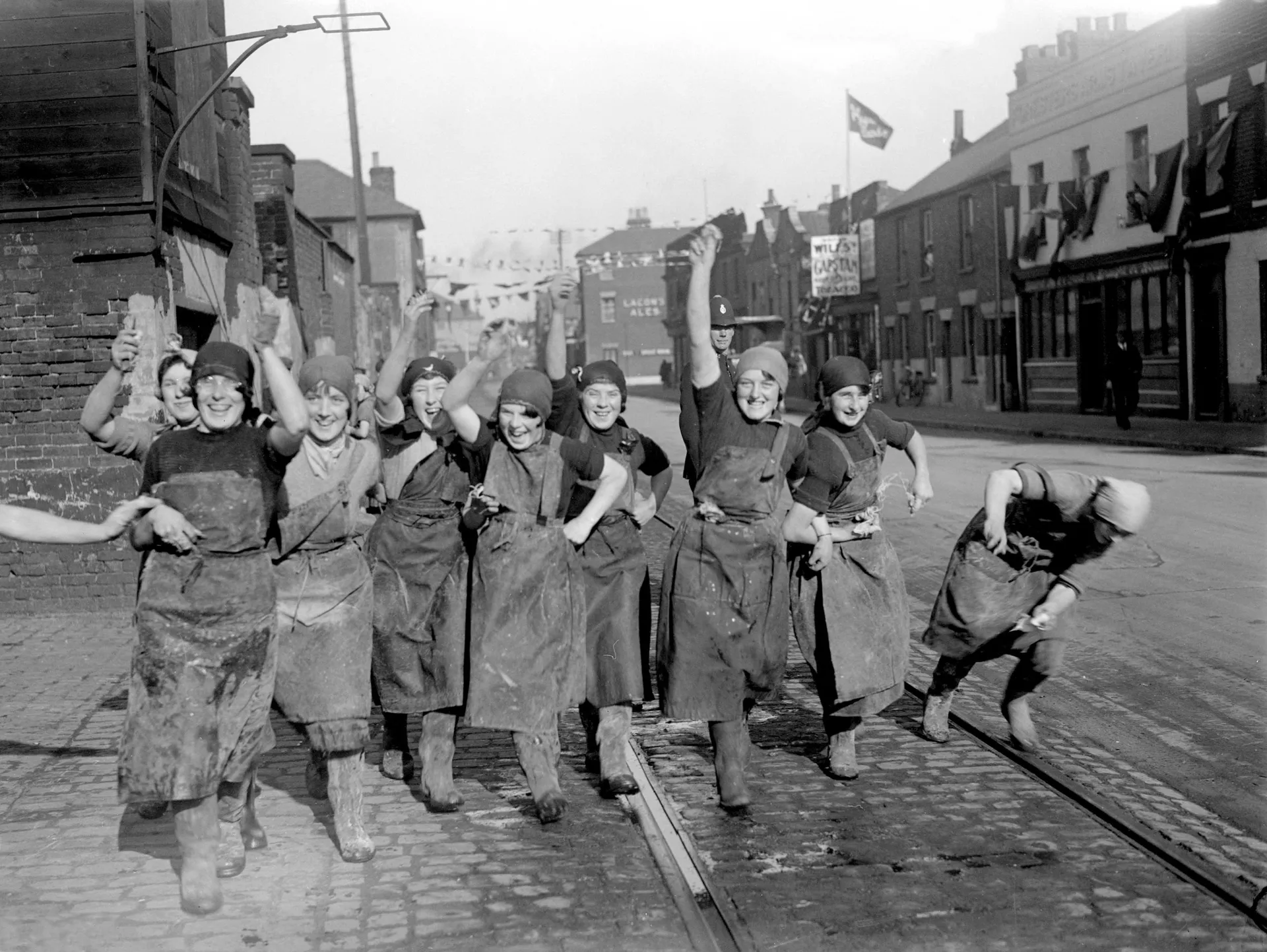
Think Britain in the 1930s and, if you've been watching a lot of History Channel documentaries, you'll probably picture things like hunger marches, unemployment lines and the gathering shadow of war in Europe.
All of which, of course, was very important. But as a new photo book highlights, there was a lot more to the decade than that.
Historian Steven Brindle and writer Maureen Hill have brought together hundreds of photographs, most of which have never been published, in a huge hardback titled Britain in the 1930s.
Many have been sourced from the archive of Associated Newspapers, publisher of the Daily Mail, with others coming from Getty Images' Hulton and Keystone collections. They're arranged by county, from Cornwall to Orkney, across 616 glorious pages.
Brindle frames the book around English Journey of 1934 by the celebrated 20th-century novelist, playwright and broadcaster, JB Priestley.
The latter identified three Englands: the old country of cathedrals and villages, the industrial England built by the Victorians and a new, American-influenced world of arterial roads, cinemas and dance halls.
What's striking is how untouched the countryside was by the modern world of the 1930s. "It is remarkable how little impact the 20th century seems to have had; there is hardly a single building from after 1900 to be seen, and very few from after 1800," Brindle writes in the introduction.
In terms of photography, meanwhile, it's a real treasure trove. Many were taken by newspaper photographers whose names have been lost, yet time and again the compositions are superb. Here are some of my favorites.
Liverpool's 'dust-bins'

In 1930, Liverpool Police equipped its point-duty officers with these protection boxes, which shielded them from wind and mud. The idea came from a motorist's letter to the local paper, and the force promptly christened them "the dust-bins".
The constable's white sleeves made his signals visible to drivers, and the photograph frames him perfectly against the street behind.
Boxing Day at the Ritz

A cashier smiles from behind the pay desk at Manchester's Ritz Dancing Hall on Boxing Day 1938. The signs behind her advertise half price for children and a sixpence (6d) refreshment voucher with evening admission.
Dance halls were exactly the kind of place JB Priestley had in mind when he described his "new England".
A crossing for the schoolchildren

Schoolchildren who have to cross a dangerous road in Oxford are escorted by a man holding a Safety-First sign, an early forerunner of the lollipop man. According to the book, this was a new innovation for 1932.
The motion blur in the image is a clear reminder of the slow shutter speeds photographers had to work with at the time.
Sweet success at Bournville

Two women carry towers of finished boxes out of the Cadbury's chocolate factory at Bournville in Warwickshire, where the Quaker brothers George and William Cadbury had built a model village for their workers.
By the 1930s, this was the largest processor of cocoa in the British Empire, employing around 10,000 people.
Sheep come to Winsford

Flocks of Exmoor sheep arrive in the Somerset village of Winsford for the Exmoor Horn Sheep Breeders Society Show and Sale in 1937.
A man on horseback drives them past a row of parked cars, highlighting how this was still a world in which horses and motorcars shared the road.
The Queen Mary at Clydebank

Crowds gather on the riverbank to admire the new liner, Queen Mary, at Clydebank, where it had been built. The vessel set off on its maiden voyage from Southampton to New York in May 1936.
The giant crane on the left and the smoking tug give a vivid sense of the industrial muscle still at work on Clydeside.
Geese on the move

Geese are driven down the street in the village of Carlton, near Helmsley in Yorkshire, by a man with a stick and a boy in wellies.
This was the 20th century but, with the church tower behind them and not a car in sight, this could easily be the 19th.
The Harrow tuck shop

Boys in straw boaters crowd the Harrow School tuck shop at the beginning of term in 1933, with stacks of Toblerone chocolate on the counter.
While Etonians still wore top hats, Harrovians stuck to their boaters. One boy stares straight down the lens, mid-mouthful.
High above the hops

Men on stilts examine hop vines in Kent in 1937, checking whether they're ready for harvest. Each year, thousands of Londoners flocked to the Kent hop gardens for a working holiday. The second man is framed perfectly between the legs of the first, and the rows of vines draw the eye to the vanishing point.
Britain in the 1930s by Steven Brindle and Maureen Hill is published in hardback by Atlantic Publishing on November 05 2026, priced £50 (approximately $66 / AU$95).

