


Digital Camera World Verdict
The Fotga six-in-one adjustable IR 530-750nm is a 'cheap and cheerful' filter priced at around $25/£25. Its standout feature is a variable cut between 530nm and 750nm, offering convenient creative flexibility without the need to constantly swap filters. This makes it a highly enjoyable, budget-friendly option if you are shooting with a full-spectrum converted camera. However, the filter does have its limitations. It lacks oil- and water-resistant coatings, and its deep profile isn't ideal for filter stacking or ultra-wide lenses. If you prioritize maximum image quality, want to shoot exclusively in specific color or black-and-white infrared, or use a standard camera, a dedicated IR filter is a much better investment. But for affordable, full-spectrum experimentation, the Fotga opens up plenty of creative possibilities without breaking the bank.
Reasons to buy
- +
Variable strength between 530nm and 750nm
- +
Very affordable
- +
Wide range of sizes
Reasons to avoid
- -
Rattles around in hard case
- -
Fiddly to dial in strength
- -
Not weather sealed
- -
No oil or water resistant coatings
Why you can trust Digital Camera World Our expert reviewers spend hours testing and comparing products and services so you can choose the best for you. Find out how we test.
Fotga is a relatively unknown manufacturer that aims its products at the entry-level end of the market. Cash is tight for everyone right now, so when I learnt that Fotga's infrared filter boasts a rather unique ability to vary the cutoff point of infrared light between 530nm and 750nm, all for just 25 bucks, my interest was certainly piqued!
So why is this filter special, and what makes it different? Well, as an infrared filter, it blocks out certain wavelengths of visible light, and this creates an ‘infrared’ look, typically seen in contrast-heavy black-and-white images, where blue skies turn a deep black and green leaves reflect a lot of infrared light, so appear ghostly white.
The Fotga Variable Infrared filter is unique among the many IR filters I’ve tested (see our buying guide to the best infrared filters) because it has a variable strength, which can be set anywhere with a lower wavelength limit between 530nm (low enough to experiment with color infrared photography on a full-spectrum converted camera) to 750nm (more suitable for that high-contrast black-and-white infrared look).
Modern mirrorless and DSLR cameras generally come with an 'infrared cut' filter attached to the front of the digital sensor that largely eliminates infrared light, so only visible light reaches the sensor; this creates a sharp, full-color image.
You can, however, shoot infrared images with a ‘standard’ camera by attaching an infrared filter to the front of the lens that does the opposite of the IR cut filter, and completely blocks visible light, so only IR light passes through. But because this is 'fighting' the effect of the IR cut filter, the sensor will have very low sensitivity to IR light, meaning it takes an extremely long time to expose the image. This works perfectly well for long-exposure black-and-white photography.
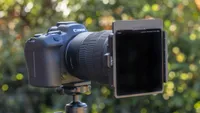
To retain more normal shutter speeds, the IR cut filter needs to be removed to convert a camera to 'full spectrum', so-called because it will be sensitive to the wider spectrum of both visible light and 'invisible' IR light. It's an extremely technical and precise job that is best left to the professionals, so for this test, I got hold of a Canon EOS R converted to full-spectrum by the experts at Advanced Camera Services. With the IR cut filter removed, I could test the Fotga's filter’s ability to shoot both in color and black and white at regular shutter speeds. Here's how it got on…
Fotga Adjustable Infrared Filter: Specifications
Filter type |
Variable IR |
Filter threads |
43, 46, 49, 52, 55, 58, 62, 67, 72, 77 & 82mm |
Stackable |
Yes |
Material |
Optical glass |
Weight |
52g (77mm) |
Fotga Adjustable Infrared Filter: Price
The Fotga 530-750nm variable infrared filter is very affordable, ranging from $19 / £21 for the smallest 43mm option to $25 / £28 for the largest 82mm size, which is a bit of a steal, and you definitely get a lot of filter for your money.
It's certainly a lot cheaper than many IR filters I have tested, especially given its versatility in cutting a variety of wavelengths.
Fotga Adjustable Infrared Filter: Design & Handling
The Fotga filter frame is made from metal and has quite a different construction to the other IR filters I have tested, because it’s made up of two twisting metal frames that, when turned, control its strength. Rather than one piece of glass, there are two, and it works in a similar way to a circular polarizing filter or variable ND filter, with the strength of the effect increasing as the frontmost piece of glass turns against the rear one, restricting or opening up the IR cut-off point.

The filter is available in 11 sizes between 43mm and 82mm; I tested the 77mm version. The rim of the filter displays markings showing the strength that the filter is currently set to. There are no hard stops, so you can keep turning the filter past its intended range.
I actually saw the strongest effect just before the 750nm mark, so the markings didn’t seem 100% accurate and needed a little refining to get the strength I was after. I would have preferred the filter had hard end stops at the minimum and maximum settings – this would also provide a good bit of haptic feedback when turning the filter while your eye is looking through the viewfinder.

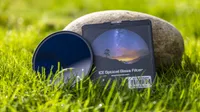
It’s heavier than its competition, with the Fotga coming in at more than twice the weight of a filter like the ICE IR760. This makes sense, though, as it is a much deeper filter with two layers of glass. The 77mm version I got hold of still tipped the scales at a relatively lightweight 52g, so it’s hardly going to break your back, but it is worth noting.

I can’t remember a time when I’ve seen a product shipped in such barebones packaging. Inside the branded cardboard box, which has no website or filter specifications, there’s a clear plastic hard case protecting the filter, but with no foam to stop it rattling about. I suppose this is fine if you plan to leave the filter attached to your camera, but if you’re going to be taking it off and switching filters regularly, I would definitely recommend getting a more substantial case for it.
Fotga Adjustable Infrared Filter: Performance
As a budget filter costing less than $25 / £30, I wasn’t expecting much in the way of coatings, so I wasn’t at all surprised when my tests revealed there was no oil, water, or dust resistance on either side of the filter.

It’s great to have the ability to shoot both color and black-and-white infrared photos by turning the front filter ring – though note that you’ll need a converted full-spectrum camera to shoot color infrared – shooting with a normal non-converted camera will merely produce a red-tinted image.
One issue I’ve had with cheap circular polarizing filters is that moisture can get trapped between the two panes of glass, which can be difficult to remedy. While I didn’t encounter this issue in my testing, it is something to be aware of, but I guess it’s so attractively priced that you wouldn’t be too out of pocket if this happened and you needed to buy another one. I’m certainly not expecting full weather sealing at this price point!


The filter protrudes by a huge 11mm when it’s mounted, which is over twice the depth of most other IR filters I have tested, so I imagine at ultra-wide focal lengths, or when stacking filters together, vignetting could be an issue. I used the 77mm filter on my 70-200mm lens, so this wasn't an issue, but it certainly would be a concern with an ultra-wide-angle lens.
On to the image quality, then. Fine details do appear softer with the filter in place, and this appeared worse at the 530nm end, while the image looked a little sharper at 750nm, though this could be down to the increased contrast at such wavelengths.
I did wonder if the Fotga filter would show more signs of flare because of its two layers of glass at the front of the lens, and while I did see some signs of flare and hotspotting in some images, it didn’t seem to be a significantly worse offender than the other IR filters I have tested.
Fotga Adjustable Infrared Filter: Verdict
The phrase ‘cheap and cheerful’ perfectly describes the Fotga six-in-one adjustable IR 530-750nm. Costing around just $25 / £25, depending on the thread size, you really can’t expect too much, but it does offer a variable cut between 530nm and 750nm, and is a lot of fun to play around with, but you will only be able to see decent results with color infrared if you have a camera that has been converted to full-spectrum photography.
If you’re shooting on a standard camera that has not been converted to full-spectrum photography, its wider wavelength cut won't benefit you hugely, so you'd be better off with an infrared filter with a strength of 720nm or higher for black-and-white infrared images.
The filter has very few bells and whistles; there are no oil or water-resistant coatings, and it has a deep profile, which might make it a poor choice for stacking filters and using ultra-wide focal lengths. Its party trick is its ability to change its wavelength blocking strength, which makes it more convenient than swapping filters.
If you only want to shoot in color infrared or in black and white, or you’re after the best image quality, then a dedicated single-wavelength filter will be a better option. However, if you have a converted full-spectrum camera, this filter doesn’t break the bank and opens up fun, creative possibilities, so it's 100% worth taking a punt on.
Features ★★★★☆ |
The filter features a twistable front ring that can set the strength between 530nm and 750nm, which makes it a versatile filter for IR, though it needs to be used with a converted full-spectrum camera to realize its full potential. |
Design ★★★☆☆ |
The twisting strength ring is a benefit and its available in a good range of filter threads. It's let down by its deeper construction, which could lead to vignetting when stacking other filters or shooting at very wide angles. |
Performance ★★★☆☆ |
Image quality was okay, despite the filter having an extra piece of glass to create its variable strength effect. Flare can sometimes be an issue depending on the angle of the sun, though its biggest drawback is the lack of any oil, water, dust or scratch-resistant coatings. |
Value ★★★★☆ |
For around $25 / £25, you'll be hard pushed to find a more affordable IR filter. Its value is also boosted by its ability to choose a strength between 530nm and 750nm, though if you want the best image quality and coatings, you should consider a more premium option. |
Alternatives