





Many bird photographers set out to capture a frozen, pin-sharp scene, every feather in place. But sometimes, it's better to go in the opposite direction, and swap clinical detail for drama and excitement instead.
This shot of a Brandt’s cormorant by Kevin Lohman nails that approach perfectly. Local resident Lohman captured it at Natural Bridges State Beach in Santa Cruz, California. “From a public walkway above a Brandt’s Cormorant colony, I watched as birds repeatedly flew in with nesting material,” he explains to Audubon magazine.
He was shooting on a Nikon Z9 with the Nikon Z 400mm f/2.8 TC VR S, at 1/100sec, f/2.8 and ISO 1100. The image received an honourable mention in the Plants for Birds category in the 2026 Audubon Photography Awards.
Slow shutter, long lens
For a bird in flight, 1/100sec is a strikingly slow shutter speed. Most photographers would go for 1/2000sec or faster to freeze the action. But Lohman isn't most photographers.
“I slowed my shutter speed while panning, which blurred this bird’s wings and kept its head and the bundle of grass sharp,” he says. By swinging the camera to follow the bird, he kept its body still relative to the sensor, while the beating wings and background smeared into blur.
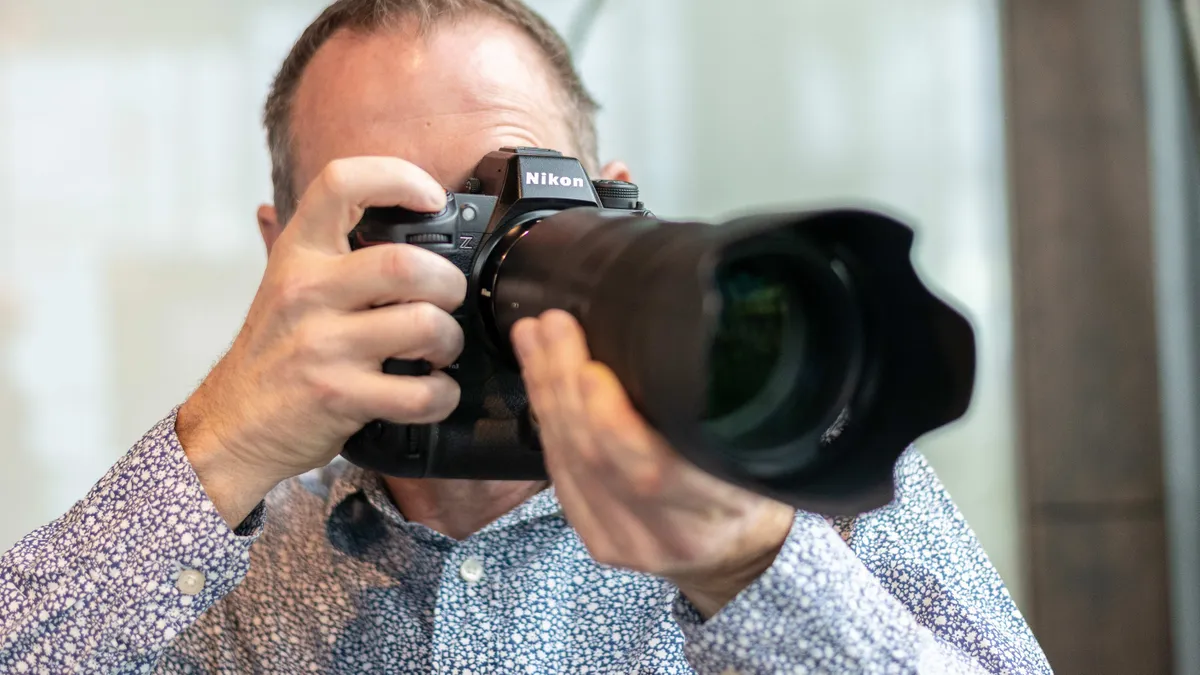
In practice, it must have been tricky, to say the least, with a lens that weighs nearly 3kg. Indeed, Lohman admits that “holding a long lens made the process more challenging and most frames were not useable, but I caught this moment.”
Creatively, the effect is striking. Judge Marlene Pantin noted that “the blurred wings in the clouds give an almost ethereal cast to the photo, creating a feeling of deep tranquility.” The palette is restrained, too: dark plumage, cool blue-grey surroundings and a single burst of green and gold from the surfgrass, which acts as the focal point.
“What drew me to this scene was the connection between ocean and cliff,” says Lohman. “These cormorants rely on marine vegetation like surfgrass to build and maintain their nests, linking the health of the nearshore ocean to their success on land. I hope the image highlights the effort behind this behavior and the importance of protecting coastal ecosystems.”
The Audubon Photography Awards, organised by the National Audubon Society, is now in its 17th year. The contest celebrates photos that capture the beauty of birds and the challenges they face. You can see all the winners and honourable mentions on the Audubon website.
You might like...
Browse the best cameras for wildlife photography and the best lenses for bird photography and wildlife.
Looking for competitions to enter? Here are 10 global photo contests now open for entries from September 2026 to February 2027.

