




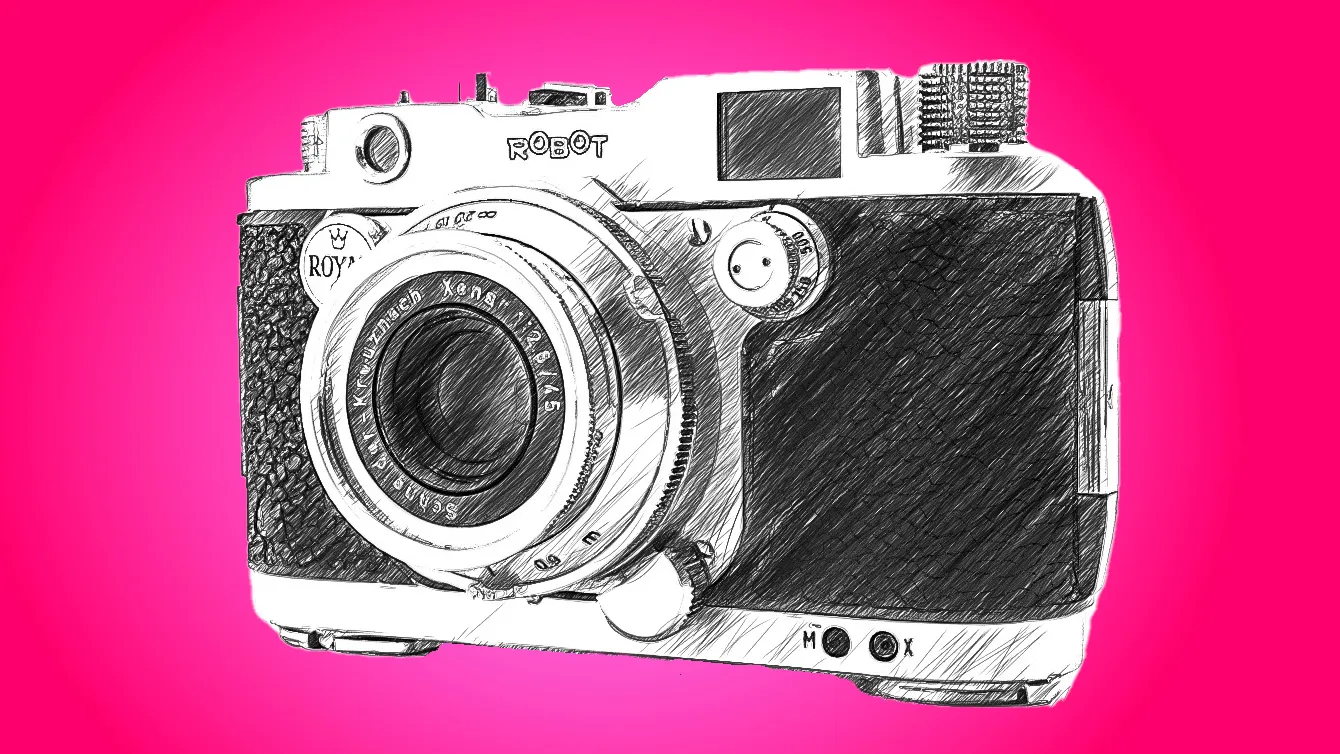
In 1920 The Czech playwright Karel Čapek had introduced the word "robot" to the world in his play R.U.R., where it meant an “automatic worker”.
The term seemed to fit, for while most manufacturers concentrated on making cameras that produced a single carefully composed photograph, the Robot was designed to make many photographs quickly, reliably, and almost automatically. In many respects it anticipated the motor-driven cameras that would not become commonplace for another 30 years.
The Robot story begins with Heinz Kilfitt, who later became famous for his Kilfitt lenses and other camera designs. He was the son of a German watchmaker and inherited an intimate understanding of precision mechanisms. During the early 1930s, he admired the Leica cameras, but wondered why the photographer needed to wind the film. Could not the camera do that?
So Kilfitt designed a clockwork spring motor, much like that used in a movie camera. A single winding of the spring advanced the film and cocked the shutter, allowing rapid-fire photography for the first time. Yet, both Kodak and Agfa rejected his proposals.
Fortunately, a young entrepreneur, Hans (Heinrich) Berning, saw its potential and founded Otto Berning & Co. in Düsseldorf to manufacture Kilfitt’s design. The original Robot immediately stood apart from every other miniature camera.
Among its innovations were the spring-motor film advance, which allowed shots to be taken at the breakneck speed of 4 photos per second. This was unheard of in the 1930s and foreshadowed the motor drives and winders of the 1960s and 70s. He also pioneered the rotary shutter, variations of which were used in many later cameras, such as the Olympus Pen F and the American-made Mercury. And because it was a focal-plane shutter, it accepted interchangeable lenses.
But the most brilliant idea was the adoption of a 24 x 24 mm negative, which allowed 50 exposures on a 36-exposure roll. When shooting at around four frames per second, this made a huge difference to film costs, and mimicked the format of the Rolleiflex.
Just prior to World War Two, in 1938, the Robot II refined the original design with better film transport, flash synchronization, a somewhat larger body for easier handling, and more interchangeable lenses.
During World War Two, the Robot became far more than a civilian camera as it was adapted to serve as Luftwaffe gun cameras and for reconnaissance and use in bombers for bomb-damage assessment. The spring drive was ideal for military use because it required no batteries and functioned reliably under harsh conditions. The compact size and rapid sequence capability made them invaluable.

After the war, Berning resumed civilian production and in 1951 brought out the Robot IIa, which was now compatible with Kodak’s new, standardized 35mm film cartridges, making the camera much easier to use.
It was followed by the Robot Star, which introduced an improved finder and automatic filml rewind. It became the classic, post-war Robot. Perhaps the ultimate Robots were the Royal 34 and Royal 36, which featured coupled rangefinders, interchangeable finders (for the different lenses) and speeds approaching six frames per second!
The Royal 24 and Royal 36 were intended as premium professional cameras competing with Leica and Contax. Mechanically, they were masterpieces, but commercially they struggled because they were expensive and arrived just as Japanese cameras were beginning to dominate photography.
Ironically, Robot achieved its greatest commercial success outside consumer photography. Thousands of Robot cameras were sold for bank surveillance, industrial inspection, scientific recording, and traffic enforcement. The spring motors were eventually replaced by electric drives and very large film magazines.
Many European (and some North American) speed trap cameras of the 1960s through the 1990s were, in essence, heavily modified Robot cameras.
Civilian Robot cameras continued in small numbers into the 1990s, with the last collector-oriented models appearing in 1996. By then, however, the company's primary business had shifted to industrial, surveillance, and traffic-enforcement imaging systems. The Robot name later became part of the Jenoptik group and survives today in industrial imaging rather than consumer cameras.
Robot cameras have an outsized reputation because they remained in production for over 60 years. But they were always a specialist product. Nobody knows for sure, but a realistic estimate is that approximately 110,000 to 130,000 consumer Robot cameras were built between 1934 and 1996.
The Robot remains one of the more interesting cameras of the twentieth century, despite never approaching the commercial success of Leica, Nikon, or Pentax. But it introduced many features that we now take for granted, long before their time.
Read more of David Young's ongoing series on classic cameras, as well as his book A Brief History of Photography.
You might also like…
Check out the best spy cameras and the best hidden camera detectors

