
Most street photography takes place at street level. But what happens if you stop pointing your lens forward, and look up instead? A new exhibition reveals what happened when Masao Gozu did just that.
The Japanese photographer spent three decades around New York's neighborhoods, pointing his lens up at apartment buildings and capturing whoever happened to be leaning out. Now his work is getting its first US museum exhibition.
Masao Gozu: Windows and Bars opens at MoMA PS1 in Long Island City, Queens, on November 05 and runs until March 15 2027.
Organized by associate curator Jody Graf, it brings together more than 40 works of photography, sculpture and archival material, dating from 1972 to the present day. So how, exactly, did this mammoth body of work come about?
An immigant in New York
Born in Hakuba, Japan, in 1946, Gozu moved to New York in the 1970s after winning a scholarship to the Brooklyn Museum Art School.

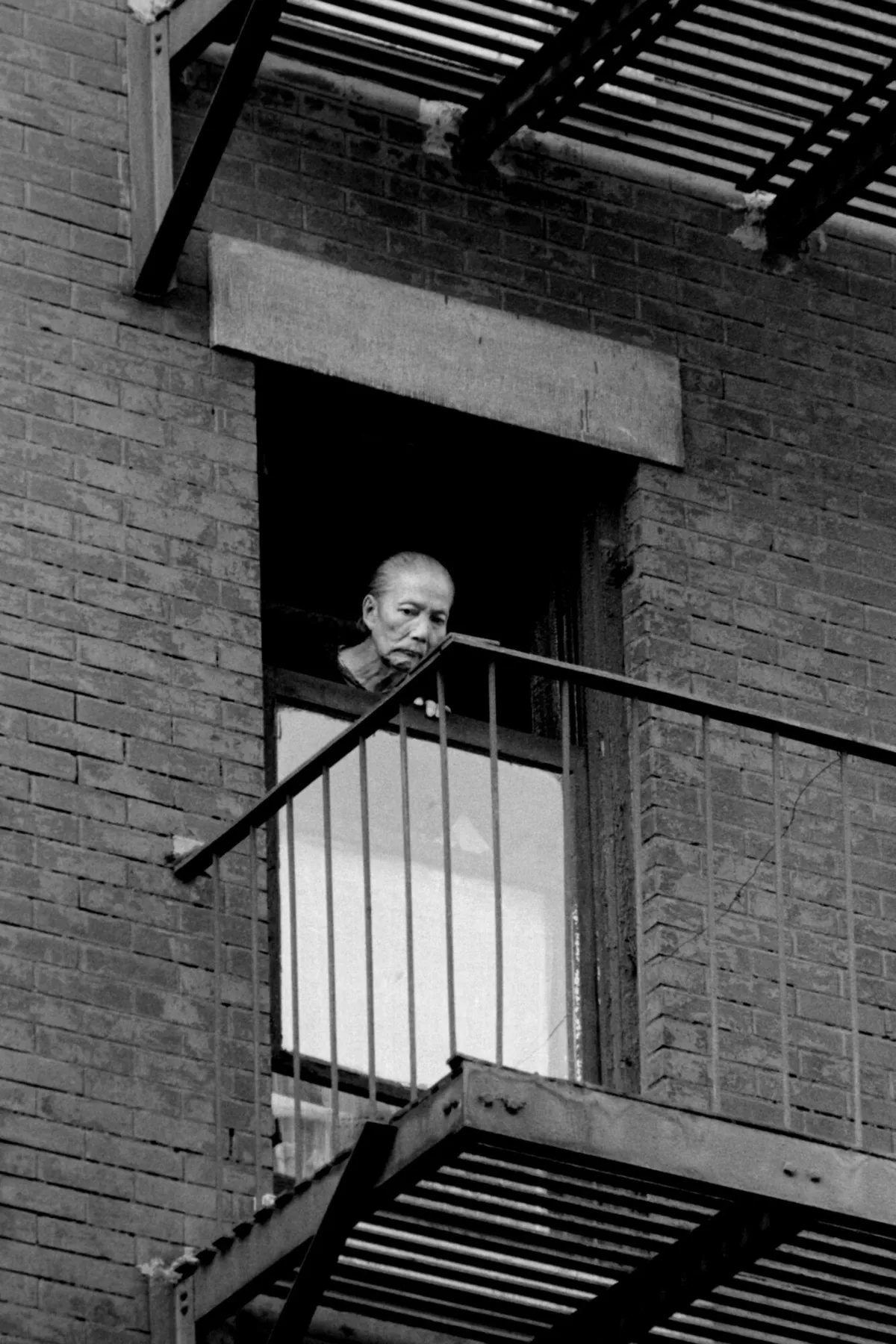

He had no formal training in photography. But as a newcomer in a city that was alien to him, he was drawn to immigrant neighbourhoods, from Chinatown and Little Italy to Bay Ridge and Crown Heights.
Typically, his subjects are gazing at something outside the frame. We never find out what it is but, in a way, that's what makes them compelling. Each apartment window becomes a stage, offering what the museum calls "the interior theater of everyday life".
One thing that grabbed my attention was the geometry. Shooting upwards from the street should produce converging verticals, with windows tapering towards the top. Yet typically, the window sits perfectly square to the picture plane.
It turns out that Gozu corrected the perspective in the darkroom by manipulating the enlarger: the analog equivalent of a perspective-correction slider. The result is a flat, formal composition in which brickwork and window frames become a rigid grid.
In one picture, a father, three children and a dog crowd into an open sash window, all staring at the same unseen event. In another, a figure in a woolly hat peeps out from behind a window decorated with an American flag.
It all acts as a clear metaphor for what Gozu himself was experiencing: a sense of estrangement in a foreign land.
View of the bar
These window photos, though, are only one half the story. The second half of the exhibition's title refers to Harry's Bar, at 98 Bowery.
Between 1976 and 1981, Gozu shot its storefront obsessively, taking a picture each time a customer looked out of the left side of the window. The framing barely changes: the same window panes, the same neon Schlitz and Schmidt's signs, the same fluorescent tube. Only the drinkers come and go.


Twelve of these images are in the show. Together, they work almost like a time-lapse. In one, a white-bearded man stands forlornly behind the glass, framed by glowing signs. In another, one of these signs has gone dark and a hunched figure leans on the bar, expression obscured.
Gozu kept making the window photographs until 2004. In 2025, he began reshooting the places he'd photographed decades earlier, and the exhibition pairs them together.
The sense of time passing is profound. In these photos, the city is a backdrop that barely moves while its people come and go. And to anyone who knows New York, that feels less like an observation and more like a definition.
Masao Gozu: Windows and Bars is at MoMA PS1, 22-25 Jackson Avenue, Long Island City, Queens, from 5 November 2026 to 15 March 2027. Admission is free.
You might also like…
Check out the best cameras for street photography and the best lenses for street photography.

