
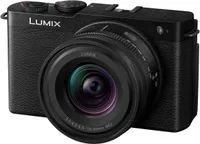
There was a lot of noise about the Panasonic Lumix S9 when it launched – and not all of it was positive.
From the complaints that it was a bigger version of the compact Lumix camera we really wanted (sound familiar?), to laments over its lack of EVF and hot shoe, to criticism of it trying to be a Fujifilm X100 VI, to blowback over the lens it launched with… the noise was hard to ignore.
And my colleagues and I were definitely part of that noise.
"Sorry, Panasonic, I don't want the S9 – I want the camera you made 11 years ago" I wrote, lamenting that it wasn't the Lumix GM1.
"The Lumix S9 hit all the right marks – until you attached a lens, said Gareth, our Reviews Editor, regarding the poorly-received 26mm launch lens. "Honestly, I didn't enjoy using the camera because of it."
Most damning of all was DCW contributor Rod Lawton, who wrote, "I saw Panasonic's Lumix S9 for the first time at a show and I just kept walking. That’s bad!"
Well, fast-forward two years from its launch, and Gareth and I both have a Lumix S9 – along with a lot of young creators who absolutely love it.
(The Lumix S9 is currently enjoying massive discounts in the Amazon Prime Day sale, particularly with the 18-40mm kit which has hit its lowest ever price in the US as well as its lowest price since January in the UK.)

So what turned us around? Well, for starters, there was plenty to love about the S9 from day one that had already won us over.
The body is absolutely tiny for a full-frame camera. Being about the same size as an X100 VI, it offered the most compact full-frame offering on the market.
Its 24.2MP sensor delivers brilliant stills at up to 30fps (though it's limited to 8fps with continuous autofocus) as well as 6K 30p open gate video.
Best of all, you can employ Realtime LUTs for both photo and video – which is essentially Fujifilm's Film Simulations on steroids, fully customizable and enabling you to perform your exact editing style and post-production looks in-camera at the point of capture.
The Crop Zoom and Hybrid Zoom functions were always big winners, too, enabling you to extend the focal range of your prime and zoom lenses by seamlessly adding a scaling digital zoom. With Hybrid Zoom on the Lumix 20-60mm lens, for example, keep turning the zoom ring and it becomes a 20-187mm!

As far as what changed, well, I have to take my hat off to Panasonic because significant improvements were made right from the off.
Firmware version 1.1 unlocked the much-maligned recording limits, which previously restricted filming to 10 mins in 6K, 15 mins in 4K and 20 minutes in FullHD. Of course, the camera is still limited by temperature build-up, as it lacks an active cooling system, but disposing of the artificial limits was incredibly welcome.
We also got the ability to display multiple frame markers when shooting open gate, which is a godsend for framing shots for multiple outputs.
The autofocus also got a serious improvement, including the addition of two new subject detection algorithms, and we received multiple quality of life improvements to everything from the startup speed to deeper integration with smartphone apps like Lumix Lab.

Perhaps most importantly, we now have lenses that actually suit the S9's size. I've often said that compact full-frame cameras are an act of folly, because there aren't enough compact lenses to go with them – and the S9 was deathly guilty of this for. However, the L-Mount Alliance stepped up.
Panasonic gave us both the Lumix S 18-40mm zoom and the Lumix S 40mm f/2 prime, amazingly both the same size. Then TTArtisan dropped a 40mm f/2 of its own, but my favorite is the Viltrox AF 28mm pancake – which is the lens that the Lumix 26mm wishes it was.
Honestly, if any of these lenses were available at launch, I think the reception to the S9 would have been completely different.
Of course, some of our core complaints remain. Until Panasonic (or a third party) releases an external EVF add-on, the lack of viewfinder still hurts. And the omission of both a hot shoe and a mechanical shutter means that flash photographers are still SOL.
But as a true hybrid camera aimed at creators on the go, the Lumix S9 has finally become the camera that Gareth and I both hoped it would be when we first saw it. It's not often that cynical journalists admit they were wrong or put their money where their mouth is, but as S9 owners we're both very happy to have seen the light!
🇺🇸 Lowest ever price
🇬🇧 New low price
You might also like…
Take a look at the best lenses for the Panasonic Lumix S9 as well as the best L-Mount lenses from the entire range.

