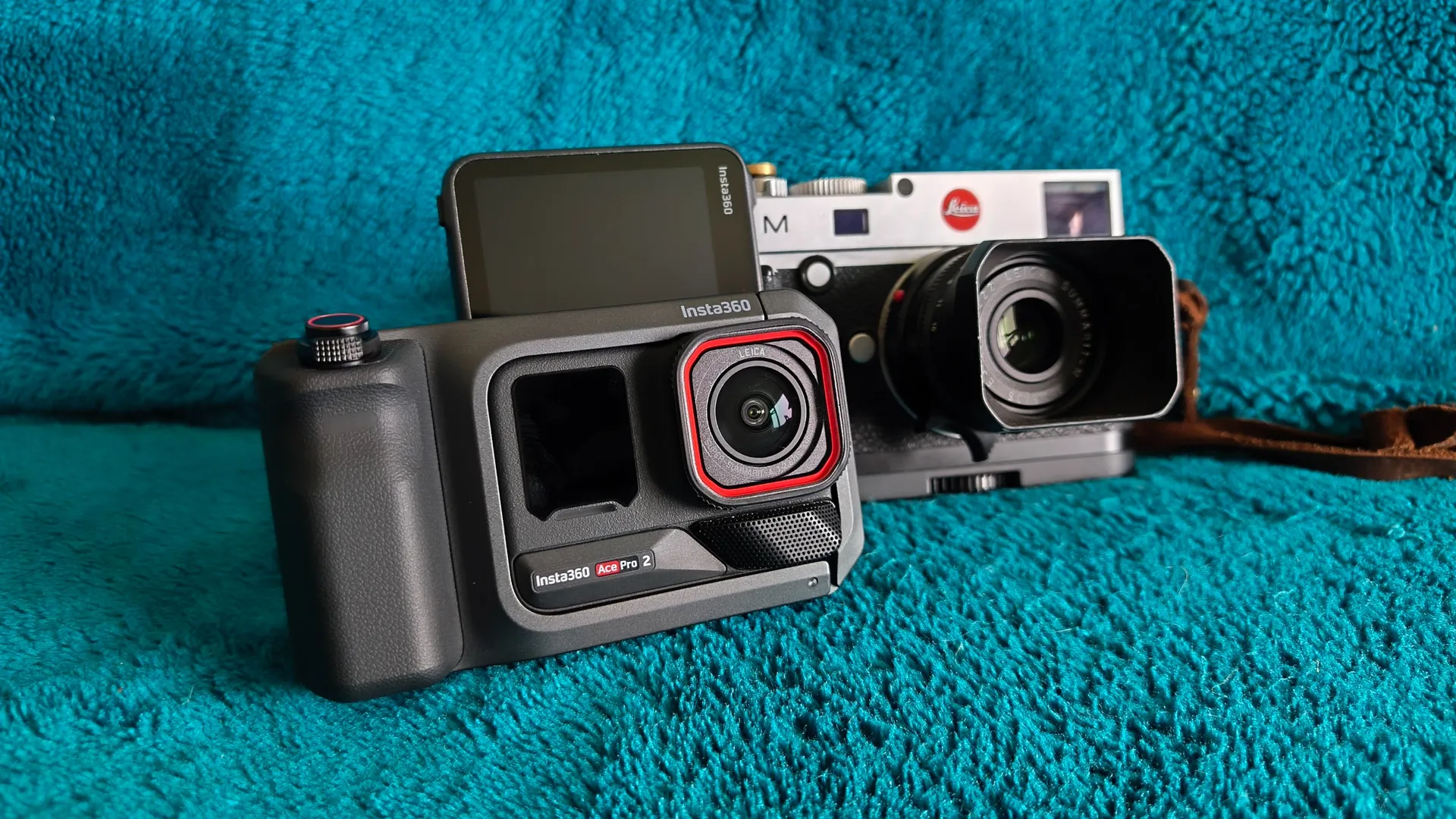
There is something slightly amusing about seeing the Leica name attached to an action camera.
Leica, after all, is a company we associate with beautifully engineered rangefinder cameras, expensive glass and a photographic philosophy built around slowing down and concentrating on the image.
Action cameras traditionally occupy almost the exact opposite end of photography: tiny boxes strapped to helmets, handlebars, cars and occasionally places where no sensible camera should ever go.
Yet the Insta360 Ace Pro 2 has been developed with Leica involvement, pairing its 1/1.3-inch sensor with Leica optics and promising image quality that goes considerably beyond what we once expected from this category.
That got me thinking: are these great images for an action camera or are they simply great images, period?
There was only one sensible way to find out, so I took the Ace Pro 2 into the field alongside my own Leica M240 to see whether a camera engineered with Leica could really stand beside one actually made by Leica.

Taken on Insta360 Ace Pro 2 with Leica Natural preset
Image credit: Future

Taken on the Leica M240 with its vivid present
Image credit: Future

Taken on Insta360 Ace Pro 2 with Leica Natural preset
Image credit: Future

Taken on a Leica M240 with vivid present
Image credit: Future

Taken on Insta360 Ace Pro 2 with Leica Natural preset
Image credit: Future

Taken on a Leica M240 with vivid present
Image credit: Future
Before anyone reaches for the pitchforks, this is absolutely not a scientific comparison. We already know which camera should win.
My Leica M240 uses a 24MP full-frame sensor, while the Ace Pro 2 is built around a much smaller 1/1.3-inch sensor capable of producing 50MP still images alongside 8K video. The lenses, sensor areas, image processing, shooting experience and frankly the entire purpose of these cameras are completely different.
I was never expecting the Ace Pro 2 to suddenly make my M240 redundant. What interested me far more was seeing just how close an action camera could now get to producing an image I would genuinely be happy to call a photograph, rather than simply a frame grabbed from an action camera.
Viewed through that lens, the comparison becomes much more interesting – because it demonstrates just how ridiculously far these little cameras have come since the early generations.

The biggest thing that changes the Ace Pro 2 experience for me is the fantastic Xplorer Grip Pro.
This substantial metal-bodied grip wraps around the Ace Pro 2 and connects directly via USB-C, adding extra battery capacity alongside a proper shutter button, zoom control, and a rear dial that can be used for exposure adjustment. Suddenly, this little action cam starts feeling remarkably like a compact camera.
That might sound like a cosmetic difference, but in use it completely changes the way I approached it. I began holding it like a camera, composing with it like a camera and actually going out looking for photographs rather than thinking exclusively about video.
Combine that with the ability to apply Leica-inspired looks such as Leica Vivid directly to JPEGs, while still having the option to record a DNG RAW file for editing later (I used Affinity) and the boundaries between action camera and traditional compact camera start becoming surprisingly blurry.
Hats off to both Insta360 and Leica, because this is where the collaboration starts feeling like more than a badge on the front.

Taken on the Insta360 Ace Pro 2 with the Leica Natural preset
Image credit: Future

Taken on the Leica M240 with its vivid preset
Image credit: Future

Taken on the Insta360 Ace Pro 2 with the Leica Natural preset
Image credit: Future

Taken on the Leica M240 with its vivid preset
Image credit: Future

Taken on the Insta360 Ace Pro 2 with the Leica Natural preset
Image credit: Future

Taken on the Leica M240 with its vivid preset
Image credit: Future
Then there is the sheer flexibility of the files. Using the full 4:3 sensor gives you a 50MP image measuring 8192 x 6144 pixels, which is frankly a slightly bonkers number to be discussing when we are talking about an action camera.
Switch to 16:9, and you are naturally cropping into that sensor area, but you are still left with a roughly 37MP file, which is hardly something to complain about.
More importantly, having that resolution available gives you freedom when editing, cropping, straightening and reframing afterward. It also means the Ace Pro 2 does not feel like a device where photographs are simply an afterthought beneath the video specifications.
The photography side of the camera feels genuinely developed, particularly once you start treating those RAW files like you would images from any other camera rather than assuming everything has to come directly out of the box and onto Instagram.
So, what happened when I put the photographs next to those from my Leica M240? Well, spoiler alert: the Leica won. Of course it did.
The larger full-frame sensor produces a completely different quality to the image – and there is a depth, tonality, texture, and natural rendering that the tiny Ace Pro 2 simply cannot replicate.
But that really was not the surprising part of this experiment. What surprised me was just how good the Insta360 images looked beside it.
They did not suddenly fall apart the moment they were placed alongside photographs from a “proper” camera. There was plenty of detail, the colors looked excellent, and the Leica Vivid and Leica Eternal looks are almost cheat codes if you want polished images ready to share within seconds.
Yet traditionalists are catered for, too, because taking that DNG file into a photo editor gives you a genuinely useful amount of latitude to work with. Considering this image came from a camera that can also be thrown onto a mountain bike and record 8K video, that is remarkable.

Taken on the Insta360 Ace Pro 2 with the Leica Natural preset
Image credit: Future

Taken on the Leica M240 with its vivid preset
Image credit: Future

Taken on the Insta360 Ace Pro 2 with the Leica Natural preset
Image credit: Future

Taken on the Leica M240 with its vivid preset
Image credit: Future

Taken on the Insta360 Ace Pro 2 with the Leica Natural preset
Image credit: Future

Taken on the Leica M240 with its vivid preset
Image credit: Future
And that, ultimately, is what I took away from this slightly ridiculous exercise.
No, the Insta360 Ace Pro 2 is not going to replace my Leica M240, and I suspect nobody at Insta360 or Leica seriously expects it to. But that was never really the point. What it proves is that the term “action camera” is becoming increasingly restrictive for devices like this.
Fit the Xplorer Grip Pro and the Ace Pro 2 becomes an incredibly capable little compact camera that happens to be rugged, tiny, capable of shooting 8K video and able to go places I would never dream of taking an M camera.
Its still images are not merely good because they came from an action camera; in the right conditions, they are genuinely good photographs.

So, can Leica engineering help make an action camera feel like a “proper” camera? After using the Ace Pro 2 this way, I think the answer is yes.
And right now, when it comes to taking still photographs with an action camera, I think Insta360 might just be leading the pack.
You might also like…
Want to dive further down the rabbit hole? See how the best action cameras from all brands compare to the best Leica cameras around!

